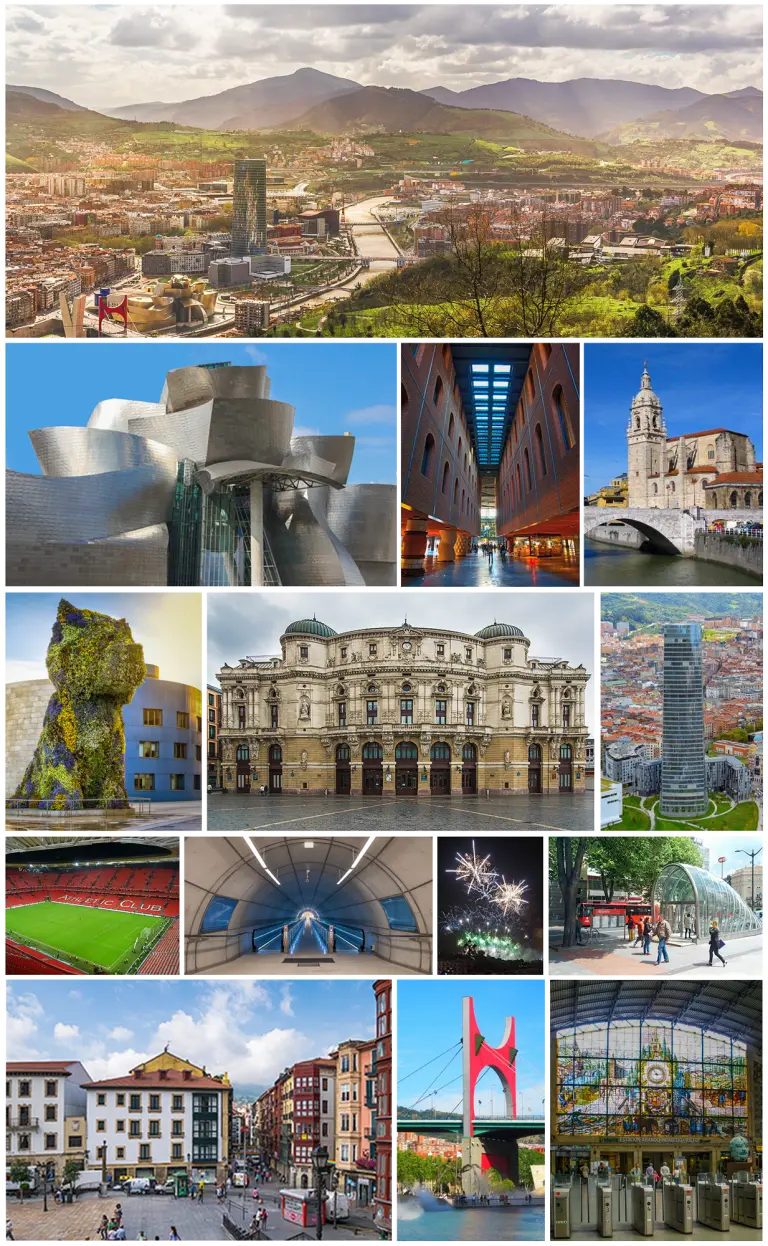
Barcelona → Bilbao
607 kmHow to get from Barcelona to Bilbao: quick summary
The fastest way to travel from Barcelona to Bilbao is by plane, with direct Vueling flights covering the route in 75 minutes and prices from €21. Driving is ideal if you want to enjoy the scenery of the Ebro valley and make food stops in La Rioja or Navarra, with 607 km of road and 6h 15min behind the wheel. The direct Renfe train (ALVIA) takes 423 minutes and departs once a day from Barcelona-Sants, while the ALSA bus offers a budget-friendly alternative with a duration of 480 minutes and prices between €45 and €100.
Driving from Barcelona to Bilbao
The road route covers 607 km in approximately 6h 15min, combining several motorways and dual carriageways of the northeastern peninsula. The main route uses the AP-2 (Autopista Zaragoza-Mediterrània) for about 214 km toll-free, followed by the AP-68 (Autovía del Ebro) over a 293 km stretch that is tolled. You will also drive along the AP-7 (Autopista de la Mediterrània) for 49 km, the A-2 (Autovía del Nordeste) for 22 km and the B-23 for 16 km. The journey crosses the Ebro valley, offering a changing landscape from the Catalan fields to the Rioja vineyards and the first green hills of the Basque Country.
By train from Barcelona to Bilbao
Renfe operates a direct ALVIA train connecting Barcelona-Sants with Bilbao-Intermod (Abando Indalecio Prieto) in 423 minutes, with a frequency of 1 train per day. The schedule is fixed: the first and last train departs at 08:50. There are no other daily departures according to the verified data, so it is advisable to book in advance. The ALVIA is a high-speed train adapted to conventional tracks, comfortable for a journey of approximately 7 hours. The price is not specified in the data provided, but as it is a Renfe long-distance service, it is recommended to check dynamic fares on the official website.
By bus from Barcelona to Bilbao
ALSA (also listed as Alsa) offers direct buses between Barcelona and Bilbao with a duration of 480 minutes (8 hours). The price ranges between €45 and €100 depending on how far in advance you book, the type of seat and the season. It is the slowest option of all, but it can be the cheapest if you book with enough lead time. Buses usually depart from Barcelona Nord or Sants station, and arrive at the Bilbao bus station (Termibus), well connected to the centre.
By plane from Barcelona to Bilbao
Vueling operates daily direct flights between Barcelona-El Prat (BCN) and Bilbao (BIO) with a duration of 75 minutes (between 1h15 and 1h25 depending on the flight). There are approximately 6 flights per day, which gives you flexibility with times. The typical price ranges between €21 and €127, with one-way fares from $23 (about €21) and return fares from $48 (about €44), according to data converted from USD. The typical range in dollars is $40-105. It is the fastest option and, if bought in advance, can be as cheap as the bus.
Recommended stops along the way
The road route allows for slight detours to discover charming towns, although some of the verified stops are in the Basque Country and others in France, which suggests alternative routes or extensions of the trip.
Durango (Durango)
A Biscayan town already in the Basque Country, a short distance from Bilbao. It’s a good place for a brief stop if you’re coming from the south: its historic quarter preserves medieval and Renaissance buildings, and it is surrounded by green mountains. Ideal for stretching your legs before the final stretch.
Azkoitia (Azkoitia)
A Gipuzkoan town in the Urola river valley, known for its religious heritage and natural surroundings. If you’re travelling at a leisurely pace, you can visit the nearby Loyola sanctuary and enjoy the tranquillity of the region.
Azpeitia (Azpeitia)
A Gipuzkoan municipality famous for housing the Loyola Sanctuary, birthplace of Saint Ignatius. The monumental complex is impressive and worth a visit if you’re interested in history or religious architecture. It is about 40 minutes from Bilbao by road.
Foix (Foix)
This stop is in France, in the Occitanie region, which indicates an alternative route through the central Pyrenees. Foix stands out for its medieval castle on a rocky outcrop and its old town with cobbled streets. It’s an interesting stop if you decide to cross the border via Andorra or the Somport tunnel.
Tarbes (Tarbes)
A French city in Occitanie, gateway to the Pyrenees. Tarbes offers a relaxed atmosphere, gardens and local markets. If you opt for a trans-Pyrenean route, it’s a good spot to rest and sample the cuisine of south-western France.
Saint-Gaudens (Saint-Gaudens)
Another French stop on the route towards the central Pyrenees. Saint-Gaudens is a small town with a remarkable Romanesque collegiate church and views of the mountains. It’s a recommended stop if you’re travelling from Toulouse towards the Basque Country.
Lourdes (Lourdes)
World-famous for its Marian sanctuary, Lourdes is one of the most unique stops on this list. Although it is not on the direct route through the Ebro valley, it is a significant detour if you’re travelling through southern France. The sanctuary, the grotto and the basilica attract millions of pilgrims every year.
Pau (Pau)
An elegant city in the French Béarn, with a Renaissance castle where Henry IV was born and a promenade with spectacular views of the Pyrenees. Pau is a culturally rich and gastronomically varied stop, ideal for a night’s rest on a trans-Pyrenean route.
Where to stay in Bilbao
The best areas to stay in Bilbao are the Casco Viejo (Siete Calles), the Ensanche and Abando, near the estuary and the Guggenheim Museum. The Casco Viejo is ideal for those seeking the atmosphere of pintxos bars and historic streets, with accommodation ranging from budget hostels (40-70€ per night) to boutique hotels (90-150€). The Ensanche and Abando are home to chain hotels and tourist apartments, with prices between 70€ and 180€ per night depending on the season. For longer stays or family trips, tourist apartments in Bilbao La Vieja or Deusto offer kitchens and more space, with rates from 60€ per night. If you’re looking for peace and quiet, Getxo and Portugalete, at the mouth of the estuary, have hotels with sea views 20 minutes by metro from the centre.
Where to eat en route
The journey between Barcelona and Bilbao is a gastronomic feast that crosses Catalonia, La Rioja, Navarre and the Basque Country. In Catalonia, try the pa amb tomàquet, bread rubbed with tomato, olive oil and salt, often served with cured meats such as jamón or fuet; and the butifarra amb mongetes, grilled pork butifarra with sautéed white beans. In La Rioja, the bacalao a la riojana is a stew of desalted cod with tomato, peppers and onion, and the patatas a la riojana are a hearty dish of potatoes with chorizo and paprika. In Navarre, the chargrilled chuletillas de cordero (lamb chops) and the trucha a la navarra stuffed with ham are unmissable. Once in the Basque Country, the bacalao al pil-pil, emulsified with olive oil and garlic, is a delight; pair it with a txakoli, a slightly sparkling, acidic white wine. Don’t forget the wines of Rioja (reds, whites and rosés) and those of the D.O. Navarra to match each dish.
Frequently asked questions about the Barcelona-Bilbao route
How long does it take from Barcelona to Bilbao?
By car, the road journey is 607 km and takes 6h 15min. By direct Renfe ALVIA train, 423 minutes (about 7 hours). By ALSA bus, 480 minutes (8 hours). By plane with Vueling, 75 minutes of direct flight, to which you must add check-in time and transfers to the airport.
Which is cheaper, the train or the bus?
The ALSA bus has a price range of 45-100€, while the ALVIA train has no specified price in the verified data. In general, the bus tends to be cheaper if booked in advance, but the plane can be cheaper than both: Vueling flights range between 21€ and 127€, with one-way fares from 21€. Always compare specific dates, as prices vary according to demand and how far in advance you book.
Is it worth renting a car?
Yes, if you want to make stops en route and not depend on timetables. The road journey crosses La Rioja and Navarre, with recommended stops such as Durango, Azkoitia or Azpeitia in the Basque Country, and French towns such as Foix, Tarbes or Lourdes if you opt for a route across the Pyrenees. Direct public transport (train and bus) does not allow you to get off in these intermediate towns, so the car is the only flexible option for exploring them.
When is the best time to travel?
The best time to travel from Barcelona to Bilbao is between April and October, when the weather is more pleasant for driving and enjoying outdoor stops. In summer (July-August), Bilbao and the Basque Country have mild temperatures compared with inland areas, but accommodation prices rise. Autumn is ideal for seeing the Rioja vineyards at harvest time. Avoid the winter months if you go by car, as some mountain sections can become difficult with snow or heavy rain.
📍 También te puede interesar
Qué ver en Barcelona →
Qué ver en Bilbao →