Madrid → Guadalajara
58 kmHow to get from Madrid to Guadalajara: quick summary
The fastest way to travel between Madrid and Guadalajara is the high-speed train, with journeys of just 29 minutes on ALVIA or AVE, while driving takes about 45 minutes along the A-2 and the direct bus also takes around 45 minutes. If you value comfort and frequency, the train is unbeatable with 78 daily departures; if you prefer the flexibility to explore the La Alcarria region, the car is your best ally.
Driving from Madrid to Guadalajara
The drive between Madrid and Guadalajara takes approximately 45 minutes, covering a distance of 58 km mainly along the A-2, with no tolls.
The most direct route begins by taking the M-23, the extension of O’Donnell, for about 5 km to leave Madrid heading east. You will then link up with the M-40, which you will follow for about 3 km before joining the A-2, the Autovía del Nordeste. The A-2 is the backbone of this journey, with about 44 km of comfortable, toll-free driving that will take you directly to the outskirts of Guadalajara.
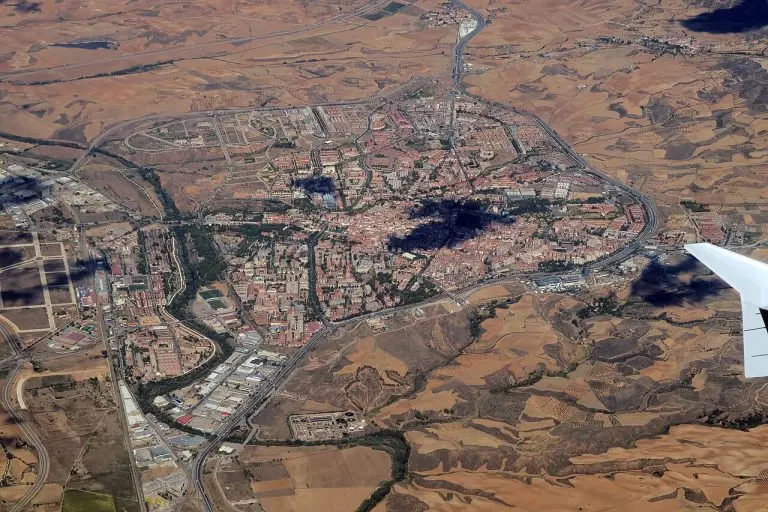
The landscape changes quickly: you leave behind Madrid’s urban sprawl and within minutes you are immersed in the Henares countryside, with gentle hills and cereal fields that hint at the La Alcarria region. The motorway is wide and well maintained, ideal for a short journey that requires little effort.
By train from Madrid to Guadalajara
The direct train between Madrid and Guadalajara is operated by Renfe and offers an extremely high frequency of 78 trains per day, with the fastest journey taking just 29 minutes on the ALVIA and AVE services.
The departure station is Madrid-Puerta de Atocha-Almudena Grandes and the destination is Guadalajara-Yebes. The first train leaves at 05:08 in the morning and the last at 23:45, making it possible to travel at practically any time of day.
The available train types and their daily frequencies are:
- ALVIA: 4 trains per day, 29 minutes duration.
- AVE: 5 trains per day, 29 minutes duration.
- AVE Internacional: 1 train per day, 30 minutes duration.
- Cercanías C2: 52 trains per day, 56 minutes duration. It is the most frequent and economical option for travelling between the two cities.
- Regional Express: 12 trains per day, 75 minutes duration.
- Regional: 4 trains per day, 76 minutes duration.
The time difference between the AVE/ALVIA and the Cercanías or Regional services is notable: while the former leave you in Guadalajara-Yebes in under half an hour, the latter take almost double or triple the time. If you are looking for speed, choose ALVIA or AVE; if you prefer to save money and don’t mind investing a little more time, the Cercanías C2 is an excellent option thanks to its extremely high frequency.
By bus from Madrid to Guadalajara
The direct bus between Madrid and Guadalajara is operated by the companies ALSA and Samar, with a duration of 45 minutes.
The bus is a comfortable and economical alternative to the train, especially if your starting point in Madrid is near the bus stations. Although the exact ticket price is not specified, the journey time is highly competitive with driving your own car and there is no need to worry about parking in Guadalajara.
Buses usually offer several departures throughout the day, allowing for some flexibility. It is advisable to check updated schedules directly on the ALSA and Samar websites before planning your trip.
Where to stay in Guadalajara
Guadalajara offers accommodation concentrated mainly in the historic centre and in the areas near the Guadalajara-Yebes train station, with options ranging from 3- and 4-star hotels to guesthouses and tourist apartments.
The historic centre is the most recommendable area to stay if you want to walk to the main points of interest, such as the Palacio del Infantado (Palace of the Infantado), the Concatedral de Santa María (Co-cathedral of Santa María) or the Plaza Mayor. Here you will find charming hotels in restored buildings, family-run guesthouses and well-rated tourist apartments.
The area near the Guadalajara-Yebes station is practical if you arrive by high-speed train and plan to get around by public transport or hire a car. Prices in Guadalajara are generally lower than in Madrid: a guesthouse can cost around €40-60 per night, a mid-range hotel between €60-90, and a 4-star hotel between €90-130. Tourist apartments usually cost between €70-110 per night.
Where to eat en route
The gastronomy of this journey brings together the best of Madrid’s cuisine with the star products of the La Alcarria region, already in the province of Guadalajara.
Before leaving Madrid, two essential classics:
- Cocido madrileño: A traditional stew of chickpeas with meats such as morcillo (beef shank), chorizo, morcilla and tocino, as well as vegetables. It is served in three courses: first the soup, then the chickpeas with vegetables and finally the meats. It is hearty and perfect for the cold months.
- Bocadillo de calamares: A long bread roll filled with freshly fried calamares a la romana (battered squid rings). It is typical of the Plaza Mayor and Madrid’s taverns, and a quick and tasty option before setting off on the journey.
- Vino de Madrid (DO Vinos de Madrid): Red, white and rosé wines made mainly from Garnacha, Tempranillo and Malvar. The denomination of origin covers the southern area of the Community of Madrid, and it is a good companion for any of the above dishes.
Once in Guadalajara, the La Alcarria region sets the pantry:
- Migas alcarreñas: Fried breadcrumbs with garlic and olive oil, often accompanied by grapes, torreznos or chorizo. It is the most representative dish of the region and a rustic delight served especially in winter.
- Cordero asado alcarreño: Suckling lamb slowly roasted in the oven with potatoes and olive oil. The meat is tender and juicy, and it is one of the most celebrated dishes of the province.
- Miel de La Alcarria: Produced by bees that feed mainly on rosemary and lavender. It has a protected designation of origin and is an excellent product to take home as a souvenir or to enjoy in desserts and breakfasts.
- Aceite de oliva virgen extra de La Alcarria: Obtained from Castellana variety olives, with a designation of origin covering the region. It is an aromatic and balanced oil, perfect for salads and toast.
Frequently asked questions about the Madrid-Guadalajara route
How long does it take to get from Madrid to Guadalajara?
It depends on the transport: by car it takes about 45 minutes to cover the 58 km along the A-2; by ALVIA or AVE train just 29 minutes; on the Cercanías C2, 56 minutes; on the Regional Express, 75 minutes; and on a direct bus, 45 minutes. The high-speed train is the fastest option.
Which is cheaper, the train or the bus?
The bus is usually the most economical option, although the exact price is not specified. Among trains, the Cercanías C2 is the cheapest alternative, with 52 daily departures and a 56-minute journey, while the AVE and ALVIA are more expensive but cut the trip to 29 minutes. If saving money is your priority, the bus or the Cercanías are the best options.
Is it worth renting a car?
Yes, if you plan to explore the La Alcarria region and its villages, since public transport within the province is limited. A car gives you the freedom to make gourmet stops, visit honey or oil producers and travel without timetables. If you are only going to be in the city of Guadalajara, the train or bus are sufficient and more practical.
When is the best time to travel?
Spring and autumn are the best seasons, with mild temperatures for strolling around Guadalajara and La Alcarria without the extreme summer heat or the intense winter cold. In autumn, moreover, the Alcarria landscape is tinged with golden tones and it is the honey and oil harvest season, which enriches the gourmet visit.
💡 ¿Sabías que...?
- ● El nombre Guadalajara proviene del árabe andalusí Wād al-Ḥajarah, que significa 'río de piedras', 'río que corre entre piedras' o 'valle de las fortalezas'. (https://es.wikipedia.org/wiki/Guadalajara_(M%C3%A9xico))
- ● Guadalajara fue fundada en cuatro ocasiones distintas, siendo establecida de forma definitiva el 14 de febrero de 1542 por Cristóbal de Oñate, Beatriz Hernández y algunas familias más. (https://es.wikipedia.org/wiki/Guadalajara_(M%C3%A9xico))
- ● Guadalajara tiene el récord Guinness de la torta ahogada más grande del mundo, que midió 646 metros de longitud. (https://www.aztecajalisco.com/turismo/notas/notas/datos-y-curiosidades-que-no-sabias-de-guadalajara)
- ● Guadalajara es la primera ciudad de México en construir una Ciudad Creativa Digital. (https://www.aztecajalisco.com/turismo/notas/notas/datos-y-curiosidades-que-no-sabias-de-guadalajara)
📍 También te puede interesar
Qué ver en Madrid →
Qué ver en Guadalajara →