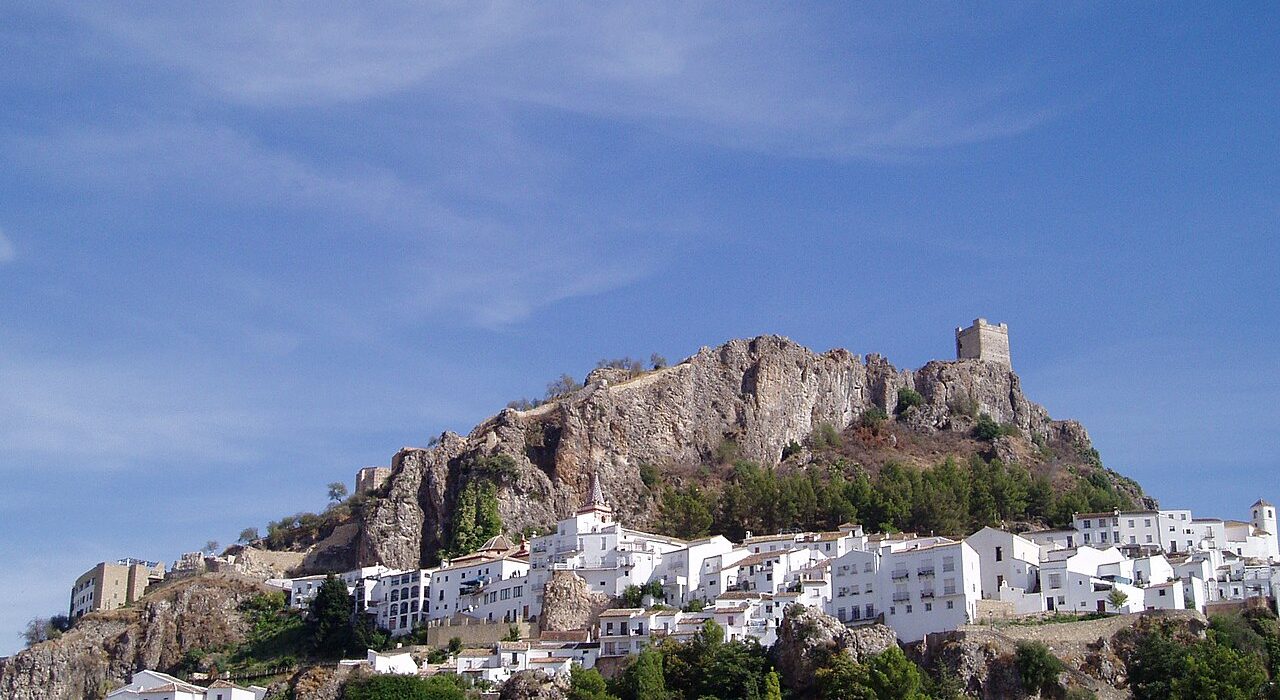
Zahara de la Sierra
AndalucíaClimate
It’s nine in the morning and the sun is starting to warm the whitewashed façades of Plaza de España. The clock on the 16th-century tower strikes the hour while the aroma of freshly baked bread drifts up through the steep, narrow streets of the Casco Antiguo (Old Town), and below, at the foot of the village, the Zahara-El Gastor reservoir shimmers in a turquoise that looks almost painted. You’re in one of the villages officially recognized among the most beautiful in Spain, in the very heart of the Sierra de Grazalema Natural Park, and the day promises one postcard view after another.
The must-seesWhat to see in Zahara de la Sierra: the essentials
Castillo de Zahara de la Sierra
The Castillo de Zahara de la Sierra (Zahara de la Sierra Castle) crowns the slopes of the Sierra del Jaral and, from its ruins, the view takes in the reservoir, the olive groves, and the entire Sierra de Grazalema Natural Park. Wandering its steep lanes reveals charming corners and traditional Andalusian architecture. The village sits on a hillside of the Sierra del Jaral, next to the Zahara-El Gastor reservoir, in a mountain landscape very characteristic of the white villages of the Sierra de Cádiz, in the province of Cádiz, Andalusia. Zahara de la Sierra is one of the villages officially recognized among the most beautiful in Spain, according to the association Los Pueblos Más Bonitos de España (The Most Beautiful Villages of Spain), which it joined in 2018. I recommend going up first thing in the morning: the light is at its best and the heat hasn’t kicked in yet. It doesn’t have a structured museum-style admission fee, but it’s worth asking at the tourist office about visiting hours.
Embalse de Zahara-El Gastor
The Embalse de Zahara-El Gastor (Zahara-El Gastor Reservoir) is probably the most photographed landscape in the Sierra de Cádiz: turquoise waters contrasting with the white of the village’s terraced houses. It’s a reservoir located at the foot of the village, popular for activities like kayaking and fishing, and one of the most outstanding natural sites in the region. It lies in the northeast of the province of Cádiz, on the Guadalete River, belongs to the Guadalete-Barbate River Basin District, and spans land in the municipalities of Zahara de la Sierra and El Gastor, with a total capacity of 222.7 cubic hectometres. In summer you can access the artificial beach on the shore for a swim, so bring a swimsuit, water shoes, and a camera with plenty of battery.
Parque Natural Sierra de Grazalema
The Parque Natural Sierra de Grazalema (Sierra de Grazalema Natural Park) is a protected natural area with Zahara de la Sierra at its center, which makes the village a perfect base for exploring trails, viewpoints, and groves of Spanish fir. This area records some of the highest rainfall in all of Spain, with an annual average of 1675.5 mm according to official data. If you enjoy walking, don’t limit yourself to the town center: the park will reward you with scenes you won’t find anywhere else in Andalusia. Wear hiking footwear, bring water, and set aside a full day.
Iglesia de Santa María de la Mesa
The Iglesia de Santa María de la Mesa (Church of Santa María de la Mesa) is the town’s main church, dedicated to Santa María de la Mesa (also known as Santa María de la Meza). It is an outstanding example of Andalusian religious architecture from the second half of the 18th century, marked by the full flowering of the Baroque and the arrival of the first hints of the Neoclassical style. Inside, it houses devotional images from the local religious heritage. It’s right in the old town, so combine it with a stroll through Plaza de España and the surrounding whitewashed streets.
Garganta Verde Route
The Garganta Verde Route is one of the most spectacular trails in the park: it runs through a karst canyon carved out by the Bocaleones Stream, which has sculpted the rock into gigantic caves and striking formations of great geological value. Griffon vultures nest on its high walls and can be seen soaring very close by, and the lush vegetation at the bottom of the stream gives the area its name. It is a demanding route, so get an early start, bring plenty of water, and wear shoes with good grip. Access is regulated by the Sierra de Grazalema Natural Park, so it is advisable to book a spot in advance.
Former Main Church / Medieval Town Tower
The Medieval Town Tower dates from the 15th century, is built with irregular stonework and courses of brick at varying heights, and features buttresses at each vertex of the hexagon. It is the most visible remnant of the old Christian temple, and currently the only noteworthy part of it, with only the tower preserved as a vestige of the original church.
Chapel of San Juan de Letrán
The Chapel of San Juan de Letrán is a small church built in 1956 that houses bells cast in that same year, and forms part of the heritage ensemble of the historic center. It belongs to the Diocese of Zahara-Olvera, is dedicated to San Juan de Letrán, and its architectural style is neoclassical. It is one of the distinctive chapels of the town’s religious heritage, linked to the 19th-century origins of the original temple of which only the tower survives.
Clock Tower
The Clock Tower dates from the 16th century, is attached to the Chapel of San Juan de Letrán, and stands as the only preserved remnant of the former Hermitage of San Juan de Letrán, with a square floor plan and rounded corners. In ancient times it was used as a bell tower and owes its name to the clock installed in the early 20th century, when a timepiece was fitted to keep all residents informed of the time. It was restored in the 1990s and continues to serve as the town clock, so don’t leave without taking the obligatory photo beneath its clock face.
White Villages Route
The White Villages Route is a tourist-cultural itinerary that travels through the whitewashed towns of the Sierra de Cádiz, of which Zahara de la Sierra is one of the most emblematic. In the province of Cádiz, the route has its own course that passes through 19 localities and is signposted along roads and rural paths, so if you have your own car you can link several villages in a single day.
Pinsapar Route
The Pinsapar Route crosses one of the best-preserved Spanish fir forests in the Sierra de Grazalema Natural Park, with specimens of pinsapo (Abies pinsapo), a relict fir from the Tertiary era. Access is at the junction of the A-372 road, taking the CA-9104 toward Zahara de la Sierra, and one kilometer away there is a rest area with parking that serves as the starting point. The area can also be visited from Benamahoma and Grazalema, and access is regulated by the Sierra de Grazalema Natural Park, so it is advisable to check in advance.
🍂 Otoño
Si visitas Zahara de la Sierra en otoño, te esperan temperaturas agradables para patear sus calles, aunque las lluvias empiezan a ganar presencia tras el verano seco. Es una época perfecta para recorrer el Parque Natural Sierra de Grazalema con sus colores cambiantes y descubrir la Capilla de San Juan de Letrán y la Iglesia de Santa María de la Mesa con tranquilidad. Consejo: consulta el parte meteorológico antes de lanzarte a la Garganta Verde, ya que el caudal puede aumentar.
What to do in Zahara de la Sierra
Zahara de la Sierra offers outdoor activities such as kayaking, fishing, and swimming at the reservoir’s artificial beach during the summer months, as well as hiking routes through the Sierra de Grazalema Natural Park, such as the Garganta Verde Route and the Pinsapar Route. If you’re interested in culture, the Zahara de la Sierra Market Hall, recently renovated with improvements to lighting, climate control, and accessibility, is perfect for buying local products and chatting with residents. In the evenings, getting lost in the Castle Area and the Old Town is practically an activity in itself: every nook holds an unexpected view over the reservoir or the neighboring mountain ranges.
Zahara de la Sierra in one day: express itinerary
- 09:00 — Old Town and Plaza de España. Wander the white streets, grab a coffee with tostada (toasted bread with toppings), and start the day with the Iglesia de Santa María de la Mesa (Church of Saint Mary of the Table) wide open.
- 10:30 — Castillo de Zahara de la Sierra (Zahara de la Sierra Castle). Climb up to the fortress to photograph the reservoir in the best morning light and take in the views of the Sierra de Grazalema Natural Park.
- 12:00 — Torre del Reloj (Clock Tower) and Capilla de San Juan de Letrán (Chapel of Saint John Lateran). Two quick stops right in the center to understand the town’s medieval history.
- 13:30 — Tapas crawl in the center. Book a table and try some gachas (savory porridge) or a tagarnina (wild thistle) stew before the hike.
- 16:00 — Zahara-El Gastor Reservoir and La Playita. If it’s summer, bring your swimsuit; if not, kayaking, fishing, or a stroll along the turquoise shore.
- 19:00 — Town viewpoint at sunset. Walk back up to a high point in the old quarter and watch the sunset over the reservoir.
Where to eat in Zahara de la Sierra: local gastronomy
Where to stay in Zahara de la Sierra
Zona del Castillo de Zahara
Explora las ruinas históricas del castillo nazarí y su torre del homenaje para disfrutar de vistas panorámicas espectaculares del embalse y la Sierra de Grazalema.
Casco Antiguo (Centro del Pueblo)
Recorre las pintorescas calles blancas, la Plaza de España y visita la Iglesia de Santa María de la Mesa, sumergiéndote en la auténtica atmósfera del pueblo.
Embalse de Zahara-El Gastor y La Playita
Disfruta de actividades acuáticas como kayak, pesca, o relájate en la playa artificial (La Playita) durante los meses de verano, rodeado de naturaleza.
How to get to Zahara de la Sierra
The most convenient way to reach Zahara de la Sierra is by road, as the town has no train station. From Jerez Airport (XRY), 80 km away, you can rent a car or take a bus. The main access routes are the A-382, the CA-531, and the A-473.
| Medio | Duración | Precio aprox. | Frecuencia |
|---|---|---|---|
| Coche por A-382 / CA-531 / A-473 | 1,5-2 h desde Jerez, Sevilla o Málaga | Solo peajes y combustible | Libre, según tráfico |
| Bus (Estación de Autobuses de Zahara de la Sierra, compañías Comes y Damas) | Variable según origen | 10-25 € por trayecto | Servicios diarios limitados, consulta horario |
| Aeropuerto de Jerez (XRY) | 80 km hasta el pueblo | Vuelo + traslado | Vuelos regulares según temporada |
How to get around Zahara de la Sierra
Zahara de la Sierra is a small town with steep streets, so the best way to explore it is on foot. The old quarter features a network of pedestrian streets and a pedestrian-only center, so it’s best to leave your car at the entrance to the town. For trips between the old quarter, the castle, and the reservoir area, there is an urban bus service connecting the most relevant points. If you’re planning routes through the Sierra de Grazalema Natural Park, a private car is ideal, or you can book transfers with a local adventure tourism company.
Weather in Zahara de la Sierra
Best time to visit Zahara de la Sierra
Day trips from Zahara de la Sierra
Thanks to its location in the Sierra de Cádiz, Zahara de la Sierra is an excellent starting point for exploring other white villages in the region. From here you can easily connect with the 19 municipalities that make up the Cádiz section of the Ruta de los Pueblos Blancos (White Villages Route), whether via the A-382, the CA-531, or the A-473. Villages such as Grazalema, El Bosque, Prado del Rey, Algodonales, Arcos de la Frontera, and Villamartín are less than an hour away by road and allow you to combine nature, heritage, and gastronomy in a single day. I recommend planning two excursions: one north to visit Algodonales and the Sierra de Líjar, and another west to explore the Arroyo de Bocaleones and the Sierra Margarita, heading toward Prado del Rey and El Bosque.
Things you didn’t know about Zahara de la Sierra
Beneath the white houses of Zahara lies an ancient secret: researchers from the University of Granada have documented a Roman aqueduct in Zahara of at least two kilometers that climbed up to 544 meters in elevation, pointing to the existence of a Roman city whose name remains unknown. Next time you walk through the countryside, look at it with fresh eyes.
The very name of the village is a poem: the toponym Zahara comes, according to several hypotheses, from the Arabic ‘zahra’, meaning ‘flower’, in reference to the abundance of azahar (orange blossom) in its fields. So, without knowing it, every time you say “Zahara” you are saying “flower”.
Its walls have witnessed history: in 1282 the Castilian king Alfonso X the Wise met at the castle of Zahara with the Marinid sultan Abu Yusuf Yaqub ibn Abd al-Haqq to request his help against his rebellious son Sancho IV. A diplomatic summit in the heart of the Sierra de Cádiz.
And if you’re looking for a seal of quality, take note: in 2018 Zahara joined the association Los Pueblos Más Bonitos de España (The Most Beautiful Villages of Spain), placing it in a very select club of localities recognized for their heritage and carefully preserved aesthetics.
Who Zahara de la Sierra is for
Zahara de la Sierra is, above all, a village for lovers of nature, hiking, and photography, as the Sierra de Grazalema Natural Park and the Zahara-El Gastor Reservoir concentrate most of its attractions. It is ideal for couples seeking a romantic weekend in a quiet white village, for families wanting a man-made beach and kayaking in summer, and for history and architecture enthusiasts who enjoy castles, medieval towers, and baroque churches. It is not, however, a destination for nightlife or big shopping: here you come to walk, eat well, and gaze at the horizon.
💡 ¿Sabías que...?
- ● Investigadores de la Universidad de Granada han documentado en Zahara un acueducto romano de al menos dos kilómetros que salvaba hasta 544 metros de altura, lo que apunta a la existencia de una urbe romana de nombre aún ignoto. (https://elpais.com/cultura/2025-09-13/un-acueducto-romano-para-reescribir-la-historia-de-un-pueblo-blanco-de-la-sierra-de-cadiz.html)
- ● El topónimo Zahara procede, según varias hipótesis, del árabe 'zahra', que significa 'flor', en referencia a la abundancia de azahar (flor de naranjo) en sus campos. (https://tourdecastles.com/es/castles/castillo-de-zahara-de-la-sierra/)
- ● En 1282 el rey castellano Alfonso X el Sabio se reunió en el castillo de Zahara con el sultán benimerín Abu Yúsuf Yaqub ibn Abd al-Haqq para solicitar su ayuda contra su hijo sublevado Sancho IV. (https://es.wikipedia.org/wiki/Castillo_de_Zahara_de_la_Sierra)
- ● En 2018 Zahara se incorporó a la asociación Los Pueblos Más Bonitos de España. (https://es.wikipedia.org/wiki/Zahara_de_la_Sierra_(C%C3%A1diz))
Frequently asked questions about Zahara de la Sierra
How many days do I need to see Zahara de la Sierra?
With one full day you have time to see the Old Town, the Castle of Zahara de la Sierra, the Church of Santa María de la Mesa, the Clock Tower and the Zahara-El Gastor Reservoir. If you want to add hiking routes such as the Garganta Verde Route or the Pinsapar Route, two or three days are ideal, especially so you don’t have to rush through the Sierra de Grazalema Natural Park.
What is the best time of year to visit Zahara de la Sierra?
According to AEMET data, the best time runs from June to September, with an average summer temperature of 21.9°C. The rest of the year temperatures are cooler (7.4°C on average in winter) and rain is frequent, with an annual precipitation of 1,675.5 mm, so it’s a good idea to bring an umbrella and warm clothing outside the summer season.
How do I get to Zahara de la Sierra from Madrid?
The most convenient option is a private car via the A-382, the CA-531 or the A-473, with an approximate duration of several hours. You can also fly to Jerez Airport (XRY), located 80 km away, and from there take a bus operated by Comes or Damas to the Zahara de la Sierra Bus Station.
Can you swim in the Zahara-El Gastor Reservoir?
Yes, during the summer months you can access the artificial beach on the shore of the reservoir for swimming. The rest of the year swimming is not permitted, but the spot is still perfect for kayaking, fishing and walks, as well as being one of the most photographed landscapes in the Sierra de Cádiz.
Why is Zahara de la Sierra considered one of the most beautiful villages in Spain?
Because in 2018 it joined the Los Pueblos Más Bonitos de España (The Most Beautiful Villages in Spain) association, which recognises the heritage and aesthetic quality of the white old town, its castle, its towers and its natural surroundings within the Sierra de Grazalema Natural Park. Add to that the contrast between the white of the houses and the turquoise of the reservoir, a sight that is hard to forget.