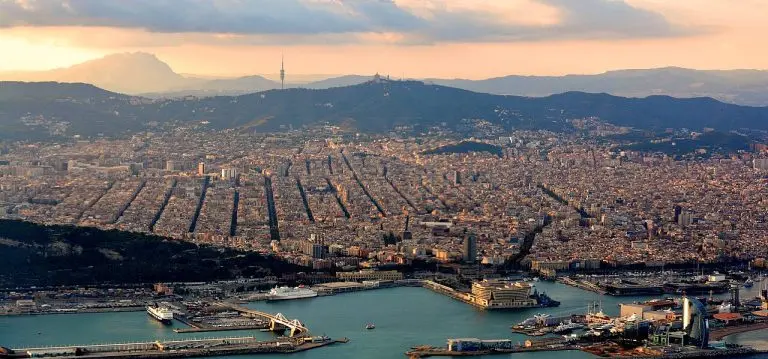
Valencia → Barcelona
349 kmHow to get from Valencia to Barcelona: quick summary
The journey between Valencia and Barcelona can be made by car (349 km on the motorway in about 3h 30min), by direct Renfe Euromed train (from 189 minutes), by ALSA bus (around 240 minutes and tickets from €5) or by Iberia plane (65-minute flight, prices between €27 and €97). For most travellers, the Euromed train is the most balanced option for speed and comfort; the bus is ideal if you’re looking for the lowest price; and the car is worthwhile if you want to stop in Tarragona, Reus or Castellón along the way.
By car from Valencia to Barcelona
The drive between Valencia and Barcelona takes approximately 3 hours and 30 minutes, covering 349 km mainly along the AP-7, the Mediterranean motorway, with no toll on about 250 km of the route. The route begins by leaving Valencia on the V-21 (Avinguda de Catalunya) for about 20 km, then joins the AP-7 as the backbone of the trip. Once in Catalonia, the itinerary continues along the C-32 (Pau Casals motorway) for about 54 km, with a final stretch on the C-31C (11 km) and a brief pass along the A-7 (8 km) before reaching Barcelona. It is a well-signposted route with good service areas, although it’s worth avoiding weekday rush hours when entering Barcelona.
By train from Valencia to Barcelona
Renfe operates direct trains between València-Estació del Nord and Barcelona-Sants, with 13 daily departures and a first train at 06:30 and the last at 19:47. The fastest service is the Euromed, with 7 trains a day and a duration of 189 minutes; there is also Intercity (3 a day, 207 minutes), ALVIA (1 a day, 232 minutes) and Regional Exprés (2 a day, 369 minutes). According to Renfe, the Euromed is the best option if your priority is arriving early with a reserved seat, while the Regional Exprés is only worth it if your schedule is very flexible and you don’t mind taking more than 6 hours.
By bus from Valencia to Barcelona
The direct bus between Valencia and Barcelona takes about 240 minutes and is operated by ALSA, Alsa, Transportes Bacoma S.A. and Hife. ALSA ticket prices range from €5 to €37, making it the cheapest means of transport for this journey. The duration is longer than that of the Euromed, but buses usually have generous schedules and good frequency throughout the day, making it a practical option if you’re travelling with little luggage or want to save as much as possible.
By plane from Valencia to Barcelona
Iberia operates direct flights between Valencia airport (VLC) and Barcelona-El Prat (BCN) with an average duration of 65 minutes, although depending on the source it can vary between 1h 05m and 1h 10m. The lowest price found is €27 for a one-way ticket on a specific date of 6/12, while Iberia’s cheapest direct flight is €97. Iberia covers this direct route 5 days a week; other airlines such as Ryanair, Vueling or easyJet appear on search engines, but do not confirm that they operate this direct route. Bear in mind that, adding airport transfers and security checks, flying rarely saves real time compared with the Euromed.
Recommended stops along the way
The route between Valencia and Barcelona allows for interesting stops without too much of a detour: Tarragona and Reus in Catalonia, Castelló de la Plana in the Valencian Community, and more inland options such as Caspe, Alcañiz or Montblanc. If you’re driving, these stops turn the journey into a little culinary and cultural getaway.
- Tarragona: A city with an important Roman archaeological complex and good places to eat near the sea. It’s the most recommended stop before tackling the final stretch into Barcelona.
- Reus: A Modernista town near Tarragona, ideal for a short break and for trying vermouth or local produce.
- Castelló de la Plana / Castellón de la Plana: The first major stop after leaving Valencia, with a beach and a food scene centred on rice dishes and fish.
- Caspe: An inland stop linked to the Guadalope river, with a quiet, less crowded old town.
- Alcañiz: In Teruel, it stands out for its Calatravan castle and its arcaded main square; a stop with character if you opt for inland routes.
- Montblanc: A walled medieval town in the province of Tarragona, very pleasant for a stroll and a break among vineyards.
- l’Hospitalet de Llobregat: Already in the Barcelona metropolitan area, useful as an entry point if your accommodation is south of the city or near the airport.
Where to stay in Barcelona
Barcelona offers accommodation for every budget, with a wide network of hotels, guesthouses and tourist apartments concentrated in the centre and in the neighbourhoods close to the main transport connections. The most practical areas for those arriving from Valencia are the Eixample, for its central location and good links to Barcelona-Sants; the Barri Gòtic and El Born, if you’re after atmosphere and proximity to the sights; and Gràcia, for a quieter, more residential stay. Prices vary by season: a guesthouse or pension can start at around €40-60 per night, a mid-range hotel between €80 and €150, and superior hotels or central apartments easily exceed €150-200. If you arrive by train, staying near Barcelona-Sants saves you travelling; if you arrive by plane, the Plaça Espanya or l’Hospitalet de Llobregat area can be convenient.
Where to eat along the route
The journey between Valencia and Barcelona is a tour through two of the Mediterranean’s most powerful cuisines: Valencian rice dishes at the start and Catalan seafood stews at the end. These are the specialities to look out for depending on the area.
- Paella valenciana (Valencia): Dry rice cooked in a paella pan with chicken and rabbit stock, green beans, garrofón beans and tomato. It is the most emblematic dish of the Valencian huerta.
- Fideuà (Gandía): A dish of short noodles cooked like a paella with fish stock and seafood. It is served with alioli and lemon.
- Arròs negre (Valencian coast): Rice cooked with squid ink, fish stock and seafood. It takes its characteristic black colour from the ink.
- Valencia wine (Valencia): Red and white wines made from native grapes such as monastrell and bobal. The Valencia DO covers a wide variety of wines.
- Utiel-Requena wine (Utiel-Requena): Mainly red wines from the bobal variety, with their own denomination of origin. The comarca is in the province of Valencia, on the route towards Barcelona.
- Cava wine (Requena): Sparkling wine made by the traditional method with macabeo, xarel·lo and parellada grapes. Requena is one of the cava-producing areas with a DO.
- Calçots (Tarragona): Spring onions grilled over embers and served with romesco sauce. They are typical of the Alt Camp comarca and are eaten in winter season.
- Priorat wine (Priorat): Powerful red wines made mainly from garnacha and cariñena on slate soils. The Priorat DO is one of the most prestigious in Catalonia.
- Montsant wine (Montsant): Red and white wines from garnacha and cariñena, with their own denomination of origin. The comarca surrounds the Priorat DOQ.
- Terra Alta wine (Terra Alta): White wines from garnacha blanca and reds from garnacha, with their own DO. The comarca is in southern Catalonia, near the route towards Barcelona.
- Penedès wine (Penedès): White, red and sparkling wines made with xarel·lo, macabeo and parellada. It is the main cava-producing area.
- Escalivada (Catalonia): A dish of roasted vegetables (aubergine, pepper, onion) dressed with olive oil. It is served as a starter or accompaniment.
- Suquet de peix (Catalan coast): A fish stew with potatoes, tomato and fish stock. It is a traditional fisherman’s dish from the Catalan coast.
Frequently asked questions about the Valencia-Barcelona route
How long does it take to get from Valencia to Barcelona?
It depends on the mode of transport: by car it’s 3h 30min for 349 km on the motorway; on Renfe’s Euromed train, 189 minutes; by bus, around 240 minutes; and by plane with Iberia, 65 minutes in the air, although adding transfers and waiting time the total comes close to that of the train.
Which is cheaper, the train or the bus?
The bus is cheaper: ALSA tickets cost between €5 and €37, while Renfe’s Euromed train usually has higher fares, especially if you buy close to the travel date. The bus is the go-to budget option for this route.
Is it worth renting a car?
It’s worth it if you want to stop in Tarragona, Reus, Castelló de la Plana or Montblanc without depending on train or bus schedules. With 349 km and 3h 30min of driving, a car gives you total flexibility, but if you’re only going to Barcelona and won’t be making stops, the Euromed is more comfortable and quicker in practice.
When is the best time to travel?
The route is pleasant all year round, but the best time is spring and autumn, with mild temperatures for driving or strolling around the stops. In summer, Barcelona and the coast are more crowded; in winter, if you’re interested in food, it’s calçots season in Tarragona and red wine season in Priorat and Montsant.
💡 ¿Sabías que...?
- ● La construcción de la Sagrada Familia ya se prolonga más de 140 años y se esperaba terminarla en 2026, aunque el pronóstico se retrasó por la pandemia. (https://www.abc.es/viajar/abci-diez-curiosidades-barcelona-quiza-desconocias-202202151417_noticia.html)
- ● Las playas de arena de Barcelona se crearon para los Juegos Olímpicos de 1992; antes de esa década no había ninguna. (https://www.getyourguide.com/es-es/explorer/barcelona-ttd45/fun-facts-about-barcelona/)
- ● En 2012, seis turistas quedaron atrapados durante seis horas en lo alto del monumento a Colón y tuvieron que ser evacuados por los bomberos. (https://supercurioso.com/curiosidades-de-barcelona/)
- ● Barcelona fue fundada como Barcino, una pequeña ciudad de fundación romana, entre el 15 a. C. y el 10 a. C. (https://es.wikipedia.org/wiki/Barcelona)
- ● El panot, el adoquín con forma de flor de cuatro pétalos, se originó a principios del siglo XX cuando el Ayuntamiento buscaba un pavimento resistente y uniforme para las calles del Eixample. (https://historia.nationalgeographic.com.es/a/feliz-dia-merce-5-datos-que-quiza-no-conocias-sobre-historia-barcelona_24585)
- ● La Rambla son cinco calles en una: Canaletas, Estudios, San José, Capuchinos y Santa Mónica. (https://www.rtve.es/television/20240514/cinco-curiosidades-sobre-barcelona/16102622.shtml)
📍 También te puede interesar
Qué ver en Valencia →
Qué ver en Barcelona →