Madrid → Sevilla
538 kmHow to get from Madrid to Seville: quick summary
The Madrid-Seville route offers four main transport options. The AVE train is the fastest and most comfortable option, with 15 daily departures covering the journey in 158 minutes. Driving is ideal for those who want to explore stops such as Córdoba or Ciudad Real, with 538 km of toll-free road along the A-4. Flying is competitive on price (from €22) but adds airport transfer times. The bus is the cheapest option but also the slowest, with a journey time of 807 minutes.
Driving from Madrid to Seville
The drive from Madrid to Seville covers 538 km and takes approximately 5 hours and 30 minutes. The main route is the A-4, known as the Autovía del Sur (Southern Motorway), which accounts for about 517 km of the total toll-free journey.
The A-4 is a modern, well-maintained motorway that crosses Castile-La Mancha and Andalusia. The landscape gradually shifts from the Castilian plateau to the Andalusian olive groves, offering a varied visual experience. Driving is comfortable and straightforward, with no need for complex detours.
For drivers in no hurry, the route makes it easy to detour to historic cities such as Córdoba or Ciudad Real. Fuel costs for an average car are around €45-60 per journey, depending on consumption.
By train from Madrid to Seville
The train is the fastest and most frequent option, with 26 direct daily trains operated by Renfe. The fastest service is the AVE, which completes the journey in 158 minutes. The departure station is Madrid-Puerta de Atocha-Almudena Grandes and the arrival station is Sevilla-Santa Justa.
According to Renfe, the offer includes several train types: AVE (15 per day, 158 min), Ouigo (3 per day, 160 min), AVLO (3 per day, 172 min), ALVIA (3 per day, 181 min), Intercity (1 per day, 186 min) and MD (1 per day, 475 min). The first train leaves at 06:55 and the last at 21:05.
Prices vary depending on how far in advance you book and the type of train. AVLO and Ouigo tend to offer cheaper fares, while the AVE has higher prices but greater flexibility. With 26 daily trains, you can travel at practically any time of day.
By bus from Madrid to Seville
The direct bus between Madrid and Seville is operated by FlixBus and Socibus, with a duration of 807 minutes (approximately 13 hours and 27 minutes). Prices range from €27.85 to €122.97 depending on how far in advance you book and demand.
This is the slowest option of all, but also the cheapest at its minimum fare. It is recommended for budget-conscious travellers or for those who prefer to travel overnight and save on a night’s accommodation. The bus departs from bus stations in Madrid and arrives at the Seville bus station.
By plane from Madrid to Seville
The direct flight between Madrid and Seville lasts 70 minutes, with approximately 4 daily flights operated by Iberia, Air Europa and Iberia Express. Departure is from Adolfo Suárez Madrid-Barajas airport (MAD) and arrival is at Seville airport (SVQ).
One-way prices start at €22, while return tickets start from €44. Iberia Express operates 4 direct daily flights. The actual average duration is 1 hour and 10-15 minutes.
Although the flight itself is quick, you need to add the transfer time to Barajas airport, security checks and the transfer from Seville airport to the city centre. In total, door-to-door time is usually comparable to that of the AVE train.
Recommended stops along the way
The Madrid-Seville road route offers eight interesting stops that justify making the trip by car.
Córdoba (Córdoba)
Córdoba is the most outstanding stop on the route, located about 400 km from Madrid. Its Mosque-Cathedral is a UNESCO World Heritage Site and the Jewish quarter is one of the best preserved in Spain. It is an essential stop for any traveller making the journey by car.
Jaén (Jaén)
Jaén is known as the world capital of olive oil. Its Renaissance cathedral and Santa Catalina Castle offer panoramic views of the city. It is an ideal stop to buy extra virgin olive oil directly from local mills.
Miguelturra (Miguelturra)
Miguelturra is a La Mancha municipality near Ciudad Real, famous for its carnival, declared of National Tourist Interest. It is a brief stop to stretch your legs and experience rural La Mancha life.
Ciudad Real (Ciudad Real)
Ciudad Real is the capital of the province of the same name, with a compact historic centre that includes the cathedral of Santa María del Prado and the Museo del Quijote (Quixote Museum). It is a convenient stop halfway between Madrid and Seville.
Almagro (Almagro)
Almagro is famous for its 17th-century Corral de Comedias, the only theatre of its kind preserved in its entirety in Spain. Its arcaded Plaza Mayor and La Mancha architecture make it a stop full of charm.
Gelves (Gelves)
Gelves is a municipality in the Aljarafe area of Seville, just a few kilometres from the Andalusian capital. It is a quiet stop to take a break before entering Seville, with views of the Guadalquivir River.
La Puebla de Montalbán (La Puebla de Montalbán)
La Puebla de Montalbán is a town in Toledo province with a medieval castle and an arcaded main square. It is a stop that sees few tourists but is authentic, ideal for discovering the most rural side of Castile-La Mancha.
Azuaga (Azuaga)
Azuaga is located in the province of Badajoz, in the heart of the Extremaduran countryside. It is a stop to discover the Extremaduran dehesa and its production of acorn-fed Iberian ham. The town has a historic centre with Roman and medieval remains.
Where to stay in Seville
Seville offers accommodation for all budgets, from affordable hostels in the historic centre to boutique hotels in the Santa Cruz district. The most recommended areas to stay are the historic centre (Santa Cruz, Alfalfa, El Arenal), Triana and La Macarena.
Prices vary by season. In low season you can find double rooms from €40-60 per night, while in spring (especially during the Feria de Abril and Semana Santa) prices can exceed €150. Tourist apartments are a good option for stays of several days or for travellers in groups.
Where to eat en route
The Madrid-Seville route crosses three distinct culinary regions: Madrid, Extremadura and Andalusia. Each one offers unique dishes that are well worth trying.
Dishes from Madrid
Cocido madrileño is a traditional chickpea stew with meats (beef shank, chorizo, pork belly) and vegetables. It is served in three courses: first the soup, then the chickpeas and finally the meats. The bocadillo de calamares is a typical appetiser in the capital, with battered squid in crusty bread. Madrid wine, under the DO Vinos de Madrid designation, includes reds and whites made with Tempranillo and Garnacha grapes.
Dishes from Extremadura
Migas extremeñas is a hearty dish of fried breadcrumbs with garlic, paprika and chunks of chorizo or pancetta. Acorn-fed ham from the Extremaduran dehesa is famous for its intense flavour and melt-in-the-mouth texture. Queso de la Serena, made with Merino sheep’s milk, has a soft paste and a slightly spicy flavour.
Dishes from Córdoba
Salmorejo cordobés is a cold soup of tomato, bread, olive oil and garlic, served with hard-boiled egg and ham. The flamenquín is a roll of pork stuffed with serrano ham, breaded and fried. Montilla-Moriles wine includes finos, amontillados and olorosos made with Pedro Ximénez grapes.
Dishes from Seville
Gazpacho andaluz is a cold soup of tomato, cucumber, pepper, garlic, bread and olive oil. Pescaíto frito includes anchovies, squid and dogfish coated in flour and fried in olive oil. Jerez wine, although originally from Cádiz, is widely consumed in Seville and includes finos, manzanillas and olorosos.
Frequently asked questions about the Madrid-Seville route
How long does it take from Madrid to Seville?
The time varies depending on the means of transport. By AVE train it takes 158 minutes (2 hours and 38 minutes). By car, 5 hours and 30 minutes to cover 538 km. By plane, 70 minutes of flight (plus transfers to the airport). By bus, 807 minutes (13 hours and 27 minutes).
Which is cheaper, the train or the bus?
The bus is generally cheaper, with prices from 27.85€. The train can be more economical if booked in advance on AVLO or Ouigo, but standard AVE prices tend to be higher. The plane can be very competitive, with tickets from 22€ per journey.
Is it worth renting a car?
Yes, if you want to make stops in Córdoba, Ciudad Real, Almagro or other towns along the route. The car offers total flexibility and the A-4 is a toll-free motorway. However, if the goal is simply to reach Seville, the AVE train is faster and more comfortable, and avoids the fatigue of driving.
When is the best time to travel?
Spring (March to May) and autumn (September to November) are the best times to travel to Seville, with pleasant temperatures. Summer can be extremely hot, exceeding 40°C. Holy Week and the Feria de Abril are periods of high demand with higher prices for accommodation and transport.
💡 ¿Sabías que...?
- ● La Giralda fue originalmente el minarete de la gran mezquita de la ciudad durante la época almohade y fue construida en el siglo XII. (https://www.sevillaactualidad.com/sevilla/561068-diez-curiosidades-de-sevilla-que-puede-que-no-sepas/)
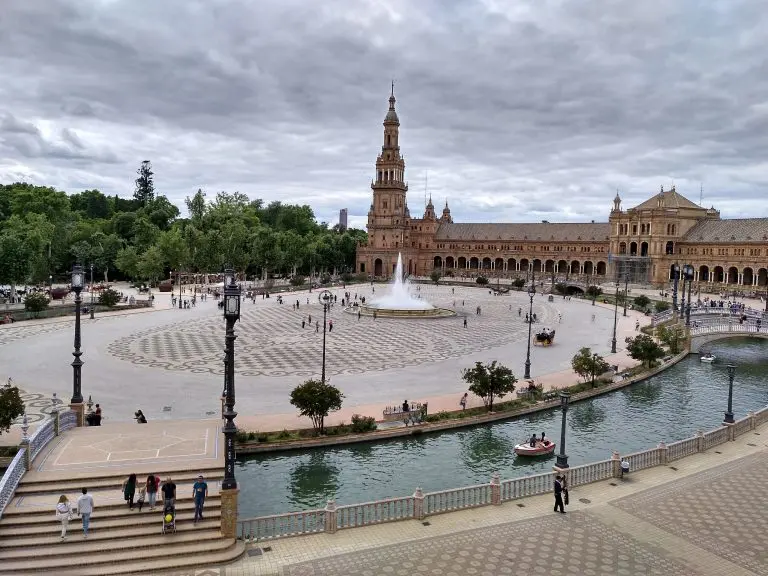
- ● La Plaza de España, construida en 1929 para la Exposición Iberoamericana, ha servido de escenario en películas de Hollywood como Star Wars: Episodio II y Lawrence de Arabia. (https://www.sevillaactualidad.com/sevilla/561068-diez-curiosidades-de-sevilla-que-puede-que-no-sepas/)
- ● El Puente de Isabel II (Puente de Triana) es una copia de un puente de París situado junto a Notre-Dame, aunque el puente parisino original, el Pont du Carrousel, fue destruido en 1931. (https://www.andaluciamia.com/es/sevilla-insolita-y-secreta/)
- ● Sevilla tiene más de 25.000 naranjos que fueron traídos de China, en su momento por pensar que era un árbol que atraía la felicidad. (https://www.20minutos.es/viajes/destinos/curiosidades-sevilla-que-ver-historia-cultura-5167910/)
- ● Se asegura que el origen de la tapa se remonta al siglo XVI, bajo el reinado de Alfonso XIII, cuando el monarca pidió un Jerez y un camarero improvisó un bocado con una loncha de jamón. (https://www.20minutos.es/viajes/destinos/curiosidades-sevilla-que-ver-historia-cultura-5167910/)
- ● En 1511 se estableció en la calle Pajaritos la primera imprenta que existió en Sevilla, traída por el alemán Iacome (Jacobo) Cromberger. (https://desevillalomejor.com/curiosidades-de-sevilla/)
- ● Según la leyenda recogida por los primeros historiadores, Spal (la actual Sevilla) fue fundada por Hércules. (https://es.wikipedia.org/wiki/Historia_de_Sevilla)
📍 También te puede interesar
Qué ver en Madrid →
Qué ver en Sevilla →