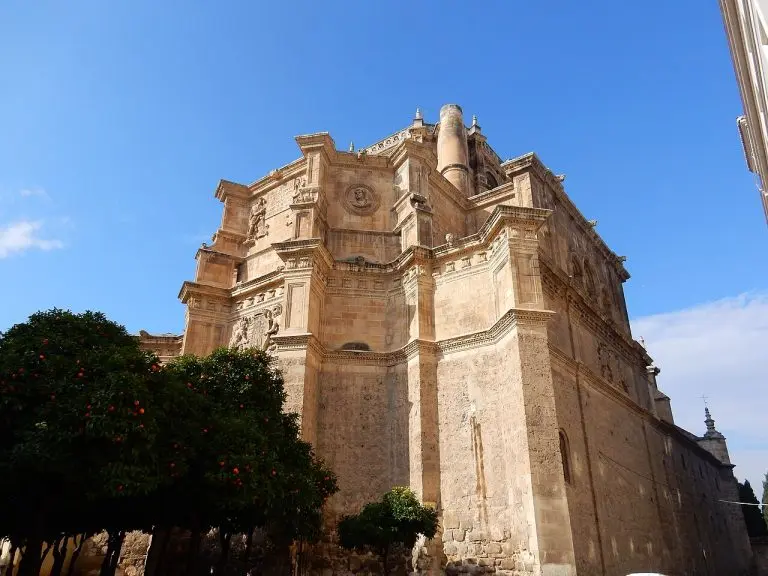
Madrid → Granada
435 kmThere is something deeply Mediterranean about the way the landscape gradually sheds the meseta and surrenders, kilometre by kilometre, to the white light and olive-covered hills of Granada. Whether you’re watching La Mancha roll by from the window of an AVE or driving along the A-4 with the promise of a free tapa at the end of the road, this journey is a slow descent from the very heart of Spain to its most Andalusian corner.
How to get from Madrid to Granada: quick summary
There are four direct ways to cover the 435 km separating Madrid from Granada: Renfe’s AVE train is the fastest and most comfortable option for most travellers, with journeys of between 203 and 221 minutes; the ALSA bus is the budget alternative, with tickets between €10.80 and €36 and a journey time of 270 minutes; the Iberia flight takes around 70 minutes direct, with fares from €24; and driving yourself lets you go at your own pace in about 4 hours and 15 minutes along toll-free motorways. If time and comfort are your priority, take the AVE; if you want to save money, the bus; if you want the freedom to stop off in Daimiel or Almagro, the car is unbeatable.
Driving from Madrid to Granada
The drive between Madrid and Granada covers 435 km along toll-free motorways and takes approximately 4 hours and 15 minutes. The main route combines the A-4, known as the Autovía del Sur, for some 282 km, followed by the A-44 for approximately 115 km, and finishes on the GR-30, Granada’s ring road, over the last 13 km of the journey. It is a straightforward, well-signposted route: leave Madrid on the A-4 towards Córdoba, continue to Bailén and there join the A-44 towards Jaén and Granada, then circle the city on the GR-30 to whichever access point best suits your accommodation. The road surface is in good condition and, with no tolls, the cost of the trip is limited to fuel. Bear in mind that the A-4 passes through areas of heavy lorry traffic in some sections and that summer temperatures in La Mancha can be extreme, so check the air conditioning before setting off.
By train from Madrid to Granada
Renfe operates direct trains between Madrid-Puerta de Atocha-Almudena Grandes and Granada, with a frequency of 4 trains a day. The fastest option is the AVE, which covers the journey in 203 minutes, with 3 daily departures; the fourth service is an ALVIA that takes 221 minutes. The first train leaves at 07:20 and the last at 19:50, making it easy to plan the trip for either the morning or the afternoon. Prices vary depending on how far in advance you book and the class you choose, but as this is a high-speed service it’s worth booking weeks ahead to secure the best fares. The arrival station in Granada is well connected to the centre by public transport and taxi. For those who value their time, the AVE is unbeatable: in just over three hours you’re in the heart of Granada without airport security checks or traffic to worry about.
By bus from Madrid to Granada
ALSA offers direct buses between Madrid and Granada with a journey time of 270 minutes, that is, 4 and a half hours. Ticket prices range from €10.80 to €36 depending on how far in advance you buy, the time of day and the class chosen. It is the cheapest option for travelling between the two cities, especially if you book with flexible dates or travel at less popular times. Buses leave from Madrid’s main stations and arrive at Granada’s bus station, located close to the centre. Although it takes longer than the train or plane, the bus saves you money and, if you bag a window seat, treats you to views of La Mancha and the olive groves of Jaén that are worth seeing at least once.
By plane from Madrid to Granada
Iberia operates direct flights between Adolfo Suárez Madrid-Barajas Airport (MAD) and Federico García Lorca Granada-Jaén Airport (GRX). The flight duration is 70 minutes, although Iberia advertises journeys of between 1h10 and 1h15 depending on conditions. There are approximately 3 flights a day, which offers some scheduling flexibility. The lowest advertised price is €24 one way, while the usual range in euros sits between €24 and €47; bear in mind that round-trip fares can vary and that platforms such as Kayak show typical round-trip prices of between €50 and €115. Although the flight is short, you have to add the travel time to Barajas, the security check and the transfer from Granada airport to the city centre, so in real door-to-door time the AVE usually comes out ahead. Even so, if you arrive in Madrid on a connecting flight, flying to Granada can be the most practical option.
Recommended stops along the way
The road route between Madrid and Granada allows for stops in charming towns without too much of a detour. These are the verified stops, ordered from north to south along the A-4 and A-44.
Coslada
Coslada is located very close to Madrid, practically at the start of the journey. It is not a classic tourist stop, but it can be useful for refuelling, grabbing a coffee or doing a last bit of shopping before hitting the road. Its proximity to the capital makes it more of a logistical point than a sightseeing destination.
Pinto
Pinto is about 20 km south of Madrid, next to the A-4. It is a convenient stop for breakfast or to stretch your legs without losing time. It has service areas and quick access from the motorway, which makes it a practical option for early risers who want to avoid the crowds at the service stations.
Valdemoro
Valdemoro follows Pinto on the route south. It is another town in southern Madrid with direct access from the A-4. Its urban centre has some pleasant corners, but its main value for the traveller is the convenience of its rest areas and the possibility of a brief stop without deviating from the route.
Ciempozuelos
Ciempozuelos is the last of the Madrid towns on this list before heading into Castile-La Mancha. It sits right by the A-4 and offers basic provisioning services. If you leave Madrid early, this is where you can make the first proper stop to recharge before the La Mancha stretch.
Aranjuez
Aranjuez does deserve a longer stop. Its Royal Palace and gardens, declared a UNESCO World Heritage Site, are just a step away from the A-4. It is an ideal place for a cultural break of one or two hours, a stroll along the Tagus or a drink under its arcades. The detour is minimal and the contrast between the bustle of the motorway and the calm of its gardens is a gift.
Daimiel
Daimiel, now in the province of Ciudad Real, is known for the Las Tablas de Daimiel National Park, a wetland of great ecological value. A visit to the park can take anywhere from an hour to half a day, depending on your interest. It is one of the most recommendable stops for nature lovers, especially in spring and autumn, when the landscape is at its most alive.
Bolaños de Calatrava
Bolaños de Calatrava is also in Ciudad Real, near Daimiel and Almagro. It is a quiet La Mancha town, with a castle and a modest historic centre. It can serve as a brief stop to discover an authentic La Mancha village without the tourism of other better-known towns.
Almagro
Almagro is probably the most beautiful stop on the entire route. Its Plaza Mayor, with green arcades, and its 17th-century Corral de Comedias more than justify a stop of a couple of hours. It is just a few kilometres from the A-4 and offers a quick immersion in the essence of La Mancha. If you only make one stop on the whole trip, make it this one.
Where to stay in Granada
Granada offers accommodation for every budget, from guesthouses and pensions in the Albaicín to upscale hotels in the city centre. The most practical area for a short stay is the centre, near the cathedral and Calle Navas, thanks to its proximity on foot to most points of interest and to the tapas bars. The Albaicín is ideal for those seeking a bohemian atmosphere and views of the Alhambra, although its steep, cobbled streets can be awkward with heavy suitcases. The Realejo, the old Jewish quarter, is a middle-ground option: central, full of character and somewhat quieter. Prices vary greatly depending on the season: a night in a guesthouse can cost around €40-70, while a mid-range hotel ranges between €70 and €120. In spring and autumn, and especially during Holy Week and the Festival of Music and Dance, it is advisable to book well in advance.
Where to eat en route
The route between Madrid and Granada crosses several culinary regions with dishes that deserve a stop. Although some of the dishes listed belong to areas of Segovia or Burgos, far from the direct route, others are perfect to enjoy along the way or upon arrival in Granada.
Dishes from Castile and León (if the route is extended)
Roast suckling pig from Segovia, judiones de La Granja (large white beans), roast lamb from Aranda de Duero and cured sheep’s cheese are classics of Castile and León. Also noteworthy are the wines of the DO Ribera del Duero and the whites of the DO Rueda. They are not on the direct Madrid-Granada route, but if the traveller plans a prior getaway through that area, they are unmissable.
Dishes from La Mancha
The A-4 runs straight through La Mancha, so these are the culinary stops most consistent with the journey. Migas manchegas (fried breadcrumbs), Manchego cheese, pisto manchego (vegetable stew) and the wines of the DO Valdepeñas can be found in towns such as Daimiel, Almagro or Bolaños de Calatrava. They are hearty dishes, ideal for refuelling before tackling the final stretch towards Andalusia.
Dishes from Granada and Jaén
As you approach Granada, the extra virgin olive oil of the DO Sierra de Cazorla, in Jaén, is an excellent product to buy en route. Once in Granada, habas con jamón (broad beans with ham) and the tortilla del Sacromonte are two dishes with real personality. Habas con jamón are typical in spring and served hot; the tortilla del Sacromonte, made with brains and sweetbreads, is a singular dish from the gypsy quarter. The wines of the DO Granada, fruity reds and fresh whites, pair well with any of these options.
Frequently asked questions about the Madrid-Granada route
How long does it take to get from Madrid to Granada?
It depends on the mode of transport. By car, the 435 km can be covered in about 4 hours and 15 minutes. On Renfe’s AVE train, the fastest journey takes 203 minutes, while the ALVIA takes 221 minutes. On an ALSA bus, the trip takes 270 minutes. On an Iberia plane, the direct flight takes 70 minutes, although airport time and transfers must be added.
Which is cheaper, the train or the bus?
The ALSA bus is clearly cheaper, with prices between €10.80 and €36. The Renfe AVE train tends to be more expensive, although prices vary depending on how far in advance you book and the class. If you book weeks ahead, the train can come close to competitive fares, but overall the bus wins on price.
Is it worth renting a car?
It depends on your travel plans. If you’re only going to Granada and want to get around the city, public transport (train or bus) is enough and more economical. If you want to make stops along the way such as Almagro, Daimiel or Aranjuez, or explore the province of Granada freely, a car is highly recommended. The route along the A-4 and the A-44 is straightforward and toll-free.
When is the best time to travel?
The best time to travel to Granada is spring and autumn, when temperatures are mild and the city is best enjoyed on foot. Summer can be very hot, especially in La Mancha and in Granada itself, and winter can bring intense cold on the plateau. If you travel during Semana Santa (Holy Week) or during the Festival de Música y Danza (Music and Dance Festival), it’s advisable to book accommodation and tickets well in advance.
💡 ¿Sabías que...?
- ● La Alhambra fue el único monumento español que tuvo posibilidades de convertirse en una de las «nuevas» siete maravillas del Mundo Moderno en 2007, aunque finalmente no entró en la lista. (https://www.abc.es/viajar/abci-diez-curiosidades-granada-quizas-no-sabias-incluso-granadinos-202202231358_noticia.html)
- ● Según una leyenda, el día que la mano de Fátima toque la llave en la Puerta de la Justicia significará que ha caído la Alhambra y anunciará el fin del mundo. (https://quevergranada.com/curiosidades-de-granada/)
- ● La Alhambra, el Generalife y el barrio del Albaicín son Patrimonio Mundial de la Unesco. (https://historia.nationalgeographic.com.es/a/antes-y-despues-alhambra-joya-nazari-que-custodia-a-granada_22972)
- ● Eugenia de Montijo, emperatriz consorte de los franceses como esposa de Napoleón III, nació en Granada el 5 de mayo de 1826. (https://www.ideal.es/granada/201511/16/granadinos-ilustres-historia-20151113111620.html)
- ● El nombre de Granada podría provenir del latín «granatum» (granado), el árbol que da el fruto de la granada. (https://www.abc.es/viajar/abci-diez-curiosidades-granada-quizas-no-sabias-incluso-granadinos-202202231358_noticia.html)
- ● La Alhambra tiene 740 metros de largo y 220 de ancho. (https://historia.nationalgeographic.com.es/a/antes-y-despues-alhambra-joya-nazari-que-custodia-a-granada_22972)
📍 También te puede interesar
Qué ver en Madrid →
Qué ver en Granada →