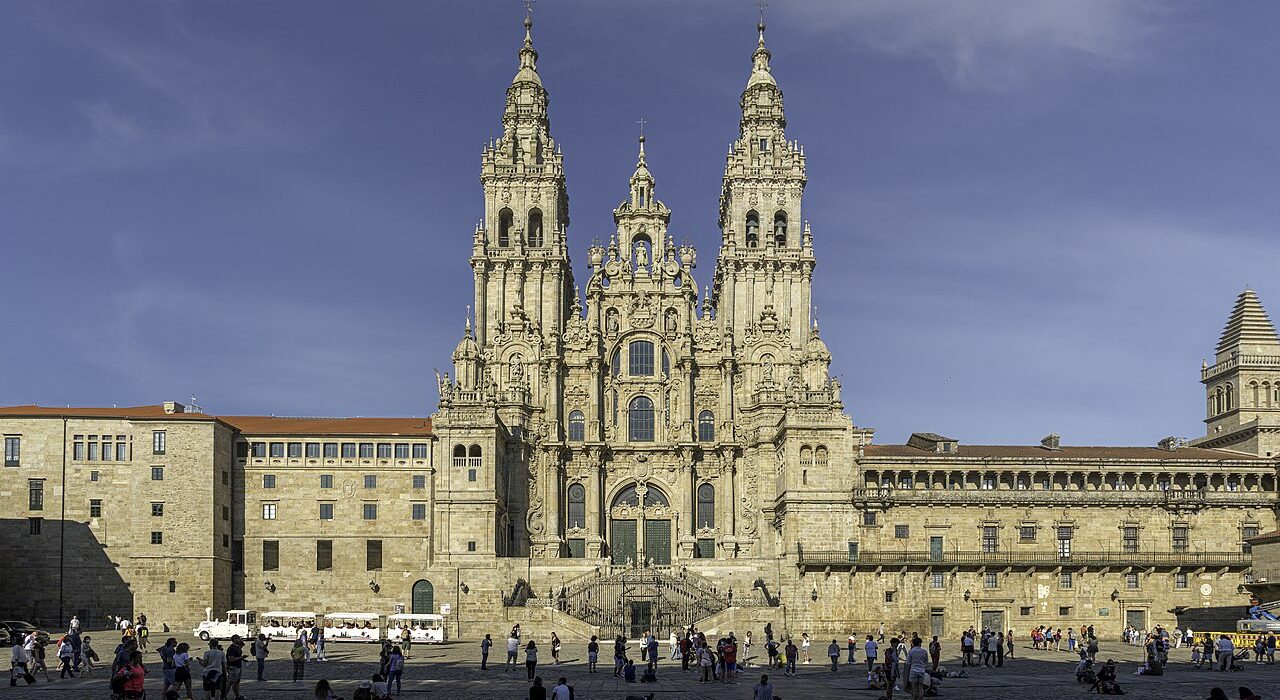
Madrid → Santiago de Compostela
615 kmImagine crossing the Castilian plateau under an infinite sky until the intense green of Galicia begins to appear on the horizon, marking the end of a journey of more than 600 kilometers filled with history and changing landscapes. Traveling from Madrid to Santiago de Compostela is not just moving from point A to point B; it is delving into the heart of the Iberian Peninsula to end up in one of Europe’s most fascinating pilgrimage and cultural destinations, where the speed of the AVE competes with the freedom of the open road.
How to Get from Madrid to Santiago de Compostela: Quick Overview
The fastest and most comfortable option to reach Santiago is undoubtedly the AVE train, which covers the distance in just over 3 hours, although driving your own car offers you total freedom to explore the network of free highways and make stops at your leisure. If your priority is budget, the bus presents itself as an economical alternative with prices around 55 euros, ideal for travelers who are not in a hurry. For the tourist seeking efficiency and comfort, the train is the top recommendation, while for the roadtripper wanting to enjoy the scenery door-to-door, the car is the winning choice.
By Car from Madrid to Santiago de Compostela
Driving from Madrid to Santiago de Compostela involves covering a distance of 615 km, which is completed in an estimated time of 6 hours and 15 minutes of effective driving. One of the great advantages of this route is that you can do it using an extensive network of autovías (highways) and national roads that, according to verified data, have no tolls, making the trip much more economical than is usual on other European routes. The backbone of this journey is usually the A-6 or Autovía del Noroeste (Northwest Highway), which takes you out of the capital towards the northwest, finally connecting with the A-52 or Autovía de las Rías Baixas (Rías Baixas Highway) for the triumphant entry into Galicia.
However, the available road infrastructure is very broad and allows you multiple variants if you decide to explore surrounding areas. Among the verified toll-free roads that are part of this connection network or are available for strategic detours are the A-66 (Autovía Ruta de la Plata), the A-5 (Autovía del Suroeste), and the A-50 (Autovía Ávila-Salamanca), which are crucial if you decide to touch the Castile and León area. You also have at your disposal the A-11 (Autovía del Duero) and the A-62 (Autovía de Castilla) for movements through the north of the plateau. If your route takes you further east or you need to connect with other areas before turning northwest, the network includes the A-2 (Autovía del Nordeste), the A-3 (Autovía del Este), and the A-4 (Autovía del Sur), although these are less common for a direct journey. For the final stretches and local connections in Galicia and the north, you will have the A-54 (Autovía Lugo-Santiago de Compostela), the A-73, and the A-1 (Autovía del Norte). Even national roads such as the N-623 (Burgos to Santander) and the N-122 (Zaragoza to Portugal via Zamora) are listed as toll-free routes available in the general network.
By Train from Madrid to Santiago de Compostela
The train is the fastest option for this journey, with a single operator, Renfe, offering a high-frequency, high-quality service. According to Renfe data, there are 9 daily trains connecting the origin station, Madrid-Chamartín-Clara Campoamor, with the destination station, Santiago de Compostela. The jewel in the crown is the AVE, which makes the trip in a record time of between 182 and 205 minutes, that is, in just over 3 hours. Within the high-speed offer, you can choose between the AVLO service, which has 3 daily departures and completes the journey in 182 minutes, or the standard AVE, with 6 frequencies per day and the same travel time of 182 minutes. The schedule is very convenient for the traveler, with the first train leaving at 7:14 in the morning and the last at 20:23, allowing you to choose between arriving in Santiago for lunch or enjoying a quiet afternoon in the capital before departing.
By bus from Madrid to Santiago de Compostela
The bus is the budget alternative par excellence for those who prioritize savings over speed, with established companies like FlixBus and ALSA operating the direct route. Although travel time can vary depending on traffic and intermediate stops, the highlight of this option is its competitive price. Tickets range from 55.47€ to 64.97€, making it a very attractive choice for students or travelers on a tight budget who don’t need the immediacy of the train. When choosing this option, you should bear in mind that you’re opting for a longer road journey, but in return you get a significantly lower cost than other means of transport.
Recommended stops along the way
If you decide to turn this journey into a slow travel experience and deviate slightly to explore the cultural richness of the area, especially towards the Portuguese side, there are several verified stops that deserve a special mention on your itinerary. Although geographically they represent a detour, visiting these cities greatly enriches the trip:
- Viseu: A Portuguese city with undeniable historical charm, ideal for stretching your legs and enjoying its cathedral and old-town atmosphere.
- Braga: Known as the city of archbishops, it offers impressive religious architecture and cobbled streets perfect for a cultural stroll.
- Vila Real: A strategic spot combining nature and history, making it an excellent stop if you’re looking to get away from the more conventional tourist routes.
- Bragança: Located in the far northeast of Portugal, it is famous for its imposing castle and its connection to the history of the Trás-os-Montes region.
- Lamego: Famous for its baroque staircase and its wines, this stop is a must for photography and wine lovers.
- Mangualde: A smaller town but with plenty of character, perfect for a quick technical stop and enjoying local cuisine without the crowds.
- Tondela: Offers a tranquil breather on the route, allowing the traveler to experience everyday Portuguese life far from the major urban centers.
Where to sleep in Santiago de Compostela
Upon arriving at your destination, you’ll find a very varied accommodation offer to suit all budgets, although booking in advance is recommended due to high tourist and pilgrim demand. The most recommended areas to stay are the Casco Histórico (Old Town), where you’ll be just steps from the Cathedral and can enjoy the medieval atmosphere at night, and the Zona Universitaria (University District), which usually offers cheaper prices and a more vibrant nightlife. In terms of accommodation types, you can find everything from shared hostels ideal for backpackers, to four-star hotels with all the comforts for a luxury trip. Price ranges vary considerably depending on the season; in low season you can find double rooms from 50-60€, while in high season or during religious festivities, prices can easily double, exceeding €120 per night in centrally located establishments.
Frequently asked questions about the Madrid-Santiago de Compostela route
How long does it take to get from Madrid to Santiago de Compostela?
Travel time depends entirely on the means of transport you choose: by car the journey takes approximately 6 hours and 15 minutes covering 615 km, while the AVE high-speed train drastically reduces the time to between 182 and 205 minutes.
Which is cheaper, the train or the bus?
The bus is considerably cheaper, with prices ranging from €55.47 to €64.97 on companies like ALSA or FlixBus, whereas the AVE train, although faster, usually has higher fares that are not specified in this low budget range.
Is it worth renting a car?
Yes, it is worth it if you plan to go sightseeing along the way and visit recommended stops such as Braga or Viseu, as you have at your disposal a network of toll-free motorways like the A-6 and the A-52 that make getting around easy without extra road costs.
When is the best time to travel?
The best time to travel is during the spring or autumn months to avoid the summer crowds of pilgrims and enjoy more reasonable accommodation prices, although the train offers consistent frequencies all year round with 9 daily departures.
📍 También te puede interesar
Qué ver en Madrid →
Qué ver en Santiago de Compostela →