Madrid → Salamanca
212 kmHow to get from Madrid to Salamanca: quick summary
The route between Madrid and Salamanca offers three main options: private car (212 km, about 2h 15min), direct Renfe train (between 97 and 188 minutes depending on the type) and direct bus with MonBus or Avanza (165 minutes, between 14.16 and 26.30 €). For those seeking speed and comfort, the ALVIA train is unbeatable with its 97-minute journey. If you prefer flexibility and want to make stops in Segovia or Ávila, the car is your best ally. The bus, for its part, is the cheapest option for travellers with no rush.
By car from Madrid to Salamanca
The car journey from Madrid to Salamanca covers 212 km and takes approximately 2 hours and 15 minutes, combining free motorways and toll sections.
The main route starts in Madrid on the A-6, the Autovía del Noroeste, for about 35 km with no toll. It then links up with the AP-6, the Autopista del Noroeste, which adds about 42 km of toll road and saves time by avoiding built-up areas. Next, the AP-51 connects with the A-50 over a stretch of about 23 km, also tolled, serving as a transition to the main motorway.
The heart of the journey is provided by the A-50, the Autovía Ávila-Salamanca, with about 100 km of toll-free road that crosses Castilian landscapes of holm oaks and cereal fields. On reaching Ávila, the AV-20, the city’s ring road, allows you to skirt around it in about 7 km without needing to enter the urban centre, ideal for continuing your journey smoothly.
The total cost in tolls varies by season and section, but it is worth carrying cash or a card for the AP-6 and the AP-51. The road surface is in good condition and there are enough service areas to refuel or take a break.
By train from Madrid to Salamanca
According to Renfe, there is a direct train between Madrid and Salamanca with a frequency of 15 trains per day, operated by Renfe, and the fastest journey is covered by the ALVIA in 97 minutes.
The departure station is Madrid-Chamartín-Clara Campoamor and the destination is Salamanca. The first train leaves at 07:40 and the last at 21:11, which gives you room both to travel early and to arrive in time for dinner.
There are two types of train available. The ALVIA, with 5 daily services, is the fastest: 97 minutes of travel. The MD (Media Distancia) train, with 10 daily services, takes 159 minutes. The time difference is notable, so if your priority is to arrive early, choose ALVIA. The MD may be cheaper and makes more intermediate stops, which may interest you if you want to get off in one of the towns along the route.
Prices vary depending on how far in advance you book, the class and the type of train, so it is worth checking the Renfe website for specific fares. The route is heavily used by university students, so booking in advance usually guarantees better prices and a seat.
By bus from Madrid to Salamanca
The direct bus between Madrid and Salamanca takes 165 minutes and is operated by the companies MonBus and Avanza, with prices ranging from 14.16 to 26.30 €.
It is the cheapest option for travelling between the two cities. Buses usually leave from central stations in Madrid and arrive at Salamanca’s bus station, well connected with the rest of the city. The duration is longer than that of the ALVIA train, but the savings can make up for it on a tight budget.
Frequency is good throughout the day, although lower than that of the train. It is worth buying tickets in advance on the MonBus or Avanza websites, especially at weekends, on long weekends or during university exam periods, when demand rises considerably.
Recommended stops along the way
The road route between Madrid and Salamanca allows for up to eight interesting stops without too much of a detour, each with its own character, ranging from historic heritage to the natural surroundings of the mountains.
- Segovia: The most essential stop. Its Roman aqueduct, the Alcázar and the cathedral justify a visit of several hours. It is reached by deviating slightly from the main route and is ideal for eating roast suckling pig (cochinillo asado) before continuing.
- San Lorenzo de El Escorial: Famous for the Monastery of El Escorial, declared a UNESCO World Heritage Site. It is a first-rate cultural stop in the Madrid mountains, with a well-kept historic centre and a peaceful atmosphere.
- Alpedrete: A mountain village in the Community of Madrid, with a quarrying tradition and good views of the Sierra de Guadarrama. It is a brief stop, useful for stretching your legs or having a coffee away from the crowds.
- El Escorial: The municipality that gives its name to the monastery, surrounded by woodland and with a dining scene centred on meats and hearty spoon dishes. Its natural surroundings invite a short stroll before getting back on the motorway.
- Villanueva del Pardillo: A residential town northwest of Madrid, quiet and with green spaces. It is a practical stop to refuel or do a quick shop before heading out onto the open road.
- Torrelodones: A charming village in the Madrid mountains, known for its medieval tower and its range of restaurants. It is very close to the start of the route, so it works well as a first stop for breakfast.
- Colmenar Viejo: A town with a standout basilica and a traditional livestock-farming setting. It lies somewhat further north of the main route, but may appeal to those looking for a quiet and authentic detour.
- Moralzarzal: Another mountain municipality with good views and nearby hiking trails. Its relaxed atmosphere contrasts with the bustle of Madrid and serves as a stop to unwind before continuing on to Salamanca.
Where to stay in Salamanca
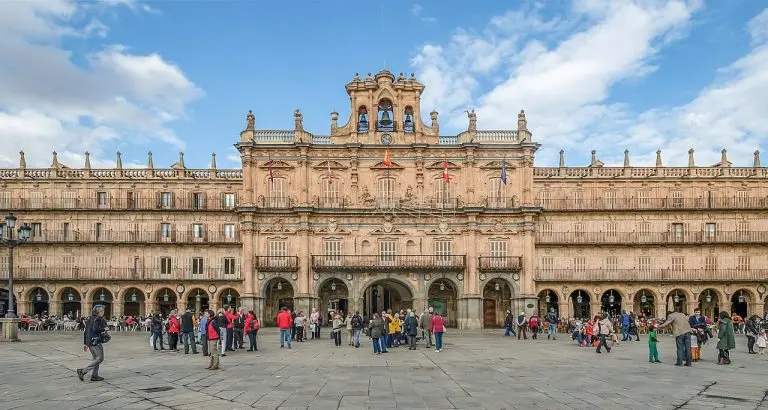
The best area to stay in Salamanca is the historic centre, next to the Plaza Mayor, because it allows you to explore the city on foot and enjoy the university atmosphere without depending on a car or public transport.
The historic centre has the largest concentration of hotels, guesthouses and tourist apartments. Prices vary by season: guesthouses and pensions tend to be the cheapest option, while 3- and 4-star hotels offer more amenities at mid-range prices. There are also tourist apartments ideal for longer stays or group trips.
Another recommended area is the San Bernardo neighbourhood, near the train station and the university, with more affordable accommodation and a lively student atmosphere. If you are travelling by car, it is worth checking whether your accommodation offers parking, as the historic centre has restricted traffic access.
Where to eat along the route
The food along the Madrid-Salamanca route is one of its great attractions, with hearty Castile and León dishes that vary depending on the area you pass through.
- Cochinillo asado (area: Segovia): Segovia’s most famous dish. It is a whole suckling pig slow-roasted in a wood-fired oven, with ingredients as simple as the pig itself, pork lard, salt and water. The skin comes out crispy and the meat tender, and it is traditionally carved with the edge of a plate.
- Judiones de La Granja (area: La Granja de San Ildefonso, Segovia): A hearty stew made with large white beans, chorizo, morcilla, pancetta and pork ear. It is cooked slowly until the beans are tender and the broth is thick. It is the quintessential winter dish.
- Sopa de ajo (area: Castile and León, Segovia and Ávila): A traditional soup of bread, garlic, paprika and stock, often with a poached egg. It is served hot and is typical of winter, perfect for warming up before a main course.
- Chuletón de Ávila (area: Ávila): A cut of beef from the Avileña-Negra Ibérica breed, grilled and served rare. It is seasoned with coarse salt and is usually very large, ideal for sharing.
- Patatas revolconas (area: Ávila): A purée of boiled and mashed potatoes with paprika, garlic and olive oil, often accompanied by torreznos. It is a humble and tasty dish, typical of Ávila’s popular cuisine.
- Hornazo (area: Salamanca): A bread-dough pie filled with pork, ham and hard-boiled egg. It is eaten especially during Holy Week, although today it can be found year-round in Salamanca’s bakeries and bars.
- Rueda wine (area: Rueda, Valladolid): A white wine made mainly from the Verdejo grape. It has fruity and herbaceous aromas and is produced in the Rueda DO. It pairs very well with fish, rice dishes and light meals.
- Ribera del Duero wine (area: Ribera del Duero, Valladolid, Burgos, Soria and Segovia): A red wine made mainly from the Tempranillo grape, also called Tinta del País. It is characterised by its intense colour and flavours of red fruit and spices. It accompanies red meats and stews to perfection.
Frequently asked questions about the Madrid-Salamanca route
How long does it take from Madrid to Salamanca?
It depends on the means of transport. By car, the 212 km journey takes about 2 hours and 15 minutes. By train, the ALVIA takes 97 minutes and the MD 159 minutes. By bus, the trip lasts 165 minutes. The ALVIA train is the fastest option, followed by car and bus.
Which is cheaper, the train or the bus?
The bus is cheaper, with prices between 14.16 and 26.30 € depending on the company and how far in advance you book. The train has variable prices depending on type (ALVIA or MD), class and how far in advance you buy, but it is usually more expensive than the bus, especially on ALVIA. For tight budgets, the bus is the best economical option.
Is it worth renting a car?
It depends on your travel plan. If you are only going to Salamanca and don’t plan to move around the city, the train or bus are more practical and avoid the parking problem in the historic centre. If you want to make stops in Segovia, Ávila or the mountain villages of Madrid, the car is the only flexible option, since public transport does not connect all the recommended stops directly.
When is the best time to travel?
Spring and autumn are the best times to do this route, with mild temperatures and fewer crowds than in summer. Winter can be cold in Castile and León, but spoon dishes and roasts gain appeal. In summer, Salamanca receives many tourists and the heat can be intense, although the evenings are pleasant for strolling.
💡 ¿Sabías que...?
- ● La calle Tentenecio debe su nombre a una leyenda según la cual San Juan de Sahagún detuvo a un toro embravecido gritando '¡Tente, necio!'. (https://diarium.usal.es/blanca_sa/salamanca/curiosidades-de-salamanca/)
- ● En la fachada de la Universidad de Salamanca hay una rana sobre una calavera; según la tradición, el estudiante que no la ve suspende el curso. (https://diarium.usal.es/blanca_sa/salamanca/curiosidades-de-salamanca/)
- ● El Mariquelo es un personaje típico de Salamanca que cada año en víspera de Todos los Santos sube al campanario de la catedral nueva para conmemorar que el terremoto de Lisboa de 1755 apenas afectó a su estructura. (https://diarium.usal.es/blanca_sa/salamanca/curiosidades-de-salamanca/)
- ● El origen de la ciudad de Salamanca se remonta a hace unos 2700 años, en la primera Edad del Hierro. (https://www.esdiario.com/castilla-y-leon/251219/124078/salamanca-curiosidades-historicas.html)
- ● El dicho 'salir por la puerta grande' nació en la Universidad de Salamanca, cuando un estudiante pasaba con éxito su examen de grado y salía por la puerta grande. (https://www.esdiario.com/castilla-y-leon/251219/124078/salamanca-curiosidades-historicas.html)
- ● En la Plaza Mayor de Salamanca se pueden encontrar hasta 15.477 balcones. (https://supercurioso.com/curiosidades-de-salamanca/)
- ● La Universidad de Salamanca, creada en 1218 por Alfonso IX de León, es la universidad en activo más antigua de España. (https://www.patrimoniocastillayleon.com/es/salamanca)
- ● La Real Academia de la Historia incluye a 505 nacidos en Salamanca en su Diccionario Biográfico Electrónico. (https://www.elnortedecastilla.es/salamanca/huella-historia-salmantinos-20210221132314-nt.html)
📍 También te puede interesar
Qué ver en Madrid →
Qué ver en Salamanca →