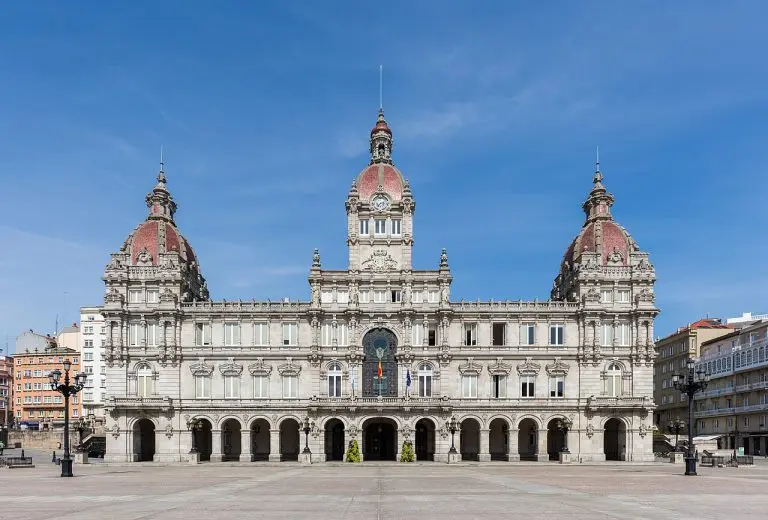
Madrid → A Coruña
604 kmHow to get from Madrid to A Coruña: quick summary
There are four main ways to cover the 604 km separating Madrid from A Coruña: private car (6h 15min via motorway and toll road), direct high-speed train (216-243 minutes with Renfe), direct bus (around 410 minutes with ALSA or FlixBus) and direct flight (80-minute flight with Iberia or Air Europa). If speed is your priority and budget is no concern, the plane is unbeatable; if you’re looking for a balance between price and comfort, the AVLO or AVE train is the most sensible option; and if you want the freedom to stop for suckling pig in Segovia or take photos on the Castilian plateau, the car is your best ally.
By car from Madrid to A Coruña
The road journey covers 604 km and takes approximately 6 hours and 15 minutes, traffic and stops permitting. The backbone of the route is the A-6, the Autovía del Noroeste (Northwest Motorway), which accounts for some 496 km of the total and has no tolls. This road takes you from the outskirts of Madrid to the approaches of Galicia through the heart of Castile and León, with wide stretches and a landscape that shifts from the plateau steppe to the green mountains of the northwest of the peninsula.
On the initial stretch, the AP-6, the Autopista del Noroeste (Northwest Toll Motorway), covers about 70 km and does have tolls. It serves as a fast alternative to the A-6 on the approach to the Sierra de Guadarrama, especially useful for avoiding the mountain pass on days of heavy traffic or adverse weather. Once in Galicia, the AP-9, the Autoestrada do Atlántico (Atlantic Motorway), provides the final 14 km of the route and also has tolls, connecting the state road network with the metropolitan area of A Coruña.
If you’re travelling without rushing, the A-6 route is perfect for making food stops in Segovia, Aranda de Duero or León without deviating too much. Bear in mind that the AP-6 and AP-9 tolls are paid separately, so it’s worth carrying cash or a card and checking current rates before setting off.
By train from Madrid to A Coruña
The direct train is the most balanced option: Renfe operates 5 daily trains between Madrid-Chamartín-Clara Campoamor and A Coruña, with a duration ranging from 216 to 243 minutes depending on the type of service. The fastest trains are the AVLO, with 2 daily departures and a journey time of 216 minutes, while the AVE adds 3 daily departures and completes the journey in 217 minutes. The first train leaves at 06:30 and the last at 20:23, making it possible to organise the trip for either the morning or the evening.
The departure station is Madrid-Chamartín-Clara Campoamor, in the north of the capital, and the destination is A Coruña station, located close to the city centre. Prices vary depending on how far in advance you book, class and demand, but as this is a high-speed route with competition between AVLO and AVE, cheap tickets are often available if you book weeks ahead. For last-minute or high-season journeys, prices rise considerably.
By bus from Madrid to A Coruña
The direct bus is the cheapest alternative for those in no hurry: ALSA and FlixBus cover the route with a duration of approximately 410 minutes, that is, just under 7 hours. Prices range from €25.40 to €87.98, a wide spread that depends on how far in advance you buy, the season and the type of seat chosen. It’s the recommended option for budget-conscious travellers or for those who prefer to avoid the stress of driving, although the journey time is noticeably longer than by train or plane.
Buses usually depart from Madrid’s main stations and arrive at A Coruña bus station, which is well connected to the rest of the city. Some services may include intermediate stops, so it’s worth checking the exact itinerary when booking.
By plane from Madrid to A Coruña
Flying is by far the fastest way to get there: the direct flight between Adolfo Suárez Madrid-Barajas airport (MAD) and A Coruña airport (LCG) lasts an average of 80 minutes, with actual times ranging from 1h 18min to 1h 20min. Iberia and Air Europa operate direct flights, with a frequency of around 7 flights per day according to Omio, which offers plenty of flexibility in terms of timing. One-way prices start from €25 on search engines such as Opodo and can reach €61 for the cheapest direct ticket on Kayak, although the final price depends on how far in advance you book, the season and the fare chosen.
A Coruña airport is just a few kilometres from the city centre, so the final transfer is quick by taxi, bus or rental car. If you add check-in time, security checks and transfers to the airport, flying is still the most agile option for weekend trips or short stays.
Recommended stops along the way
The road route between Madrid and A Coruña crosses one of the areas with the highest concentration of historical and culinary heritage on the peninsula, so it is well worth planning at least one or two stops. These are the towns verified along the route:
- Viseu: a Portuguese city in the interior, with a well-preserved old town and a laid-back atmosphere. It is a pleasant stop to stretch your legs and have a coffee before continuing north.
- Braga: one of Portugal’s oldest cities, famous for its religious heritage and its university atmosphere. Ideal for a half-day cultural stop if you make a slight detour from the main route.
- Vila Real: located in the Trás-os-Montes region, it stands out for its mountain landscape and its proximity to the Douro valley. A good option for wine tourism lovers and panoramic views.
- Bragança: a walled city in north-eastern Portugal, with a medieval castle and a very photogenic historic centre. It is a less touristy stop but full of charm.
- Lamego: known for its baroque sanctuary and monumental staircase, it is a brief but very rewarding stop for those interested in religious architecture.
- Mangualde: a small Portuguese town with no major monuments, but useful as a rest point on a quiet rural stretch.
- Tondela: another discreet municipality in the Portuguese interior, surrounded by green landscapes and vineyards. Perfect for a quick, uncrowded break.
Bear in mind that some of these stops involve detours into Portugal, so it is worth checking the exact route and the additional time before adding them to your itinerary.
Where to stay in A Coruña
The best area to stay in A Coruña is the city centre, especially around Plaza de María Pita, the marina and the Ciudad Vieja (Old Town). From there you can walk to most points of interest, such as the Torre de Hércules (Tower of Hercules), the seafront promenade or the urban beaches of Riazor and Orzán. There is a good range of hotels, guesthouses and tourist apartments, with prices varying by season: guesthouses and pensions tend to fall into budget ranges, while mid-range and higher-category hotels go up in summer and at weekends.
Another recommended area is the Riazor neighbourhood, near the beach and the stadium, ideal for those looking for a sporty atmosphere and sea views. For longer stays or family trips, tourist apartments in the Ensanche area offer more space and their own kitchen. In general, booking in advance in July and August is essential, as tourist demand in Galicia soars.
Where to eat en route
The journey from Madrid to A Coruña is a genuine culinary corridor. If you’re travelling by car, you can sample local specialities in each of the autonomous communities you pass through:
- Cochinillo asado (Segovia): whole suckling pig slow-roasted in a wood-fired oven with pork lard, salt and water. The skin comes out crispy and the meat falls apart. It’s a classic stop in Segovia itself.
- Judiones de La Granja (La Granja de San Ildefonso, Segovia): a hearty stew of large white beans with chorizo, morcilla, pancetta and pig’s ear, cooked slowly until the broth thickens. Perfect for refuelling in winter.
- Lechazo asado (Aranda de Duero, Burgos): milk-fed lamb oven-roasted with nothing but lard and salt, no other seasoning. The meat is tender and juicy, with crispy skin. A must if you pass through the Ribera region.
- Morcilla de Burgos (Burgos): a sausage made from pig’s blood, rice, onion and spices, stuffed into natural casing. It’s eaten fried or grilled and is a typical starter across the province.
- Cecina de León (León): cured and smoked beef, dark red in colour with an intense flavour, made from the hind legs with salt and wood smoke. It’s served thinly sliced as an appetiser.
- Pulpo a la gallega (Galicia): boiled octopus sliced into rounds, served with boiled potatoes, paprika, coarse salt and olive oil. It’s the star dish at Galician fairs and romerías.
- Empanada gallega (Galicia): bread dough filled with tuna, meat or vegetables, baked until golden. There are local variations throughout the region and it’s ideal to take on a picnic.
- Ribera del Duero wine (Aranda de Duero and region): a red made mainly from Tempranillo grapes, with intense colour, aromas of ripe fruit and barrel ageing. It pairs perfectly with lechazo and morcilla.
- Bierzo wine (El Bierzo, León): a red made from Mencía grapes, with fruity and floral aromas and balanced acidity. The Bierzo DO covers municipalities in the Leonese region.
- Ribeiro wine (Ribeiro, Ourense): a white made from Treixadura, Godello and Albariño, fresh and fruity. The Ribeiro DO is located in northwest Ourense, close to the route towards A Coruña.
Frequently asked questions about the Madrid–A Coruña route
How long does it take to get from Madrid to A Coruña?
It depends on the mode of transport. By car, the road journey covers 604 km and takes around 6 hours and 15 minutes. By direct train, the AVLO takes 216 minutes and the AVE 217 minutes, with 5 trains per day. By bus, the journey lasts around 410 minutes. By plane, the direct flight takes 80 minutes on average, with actual times ranging from 1h 18min to 1h 20min.
Which is cheaper, the train or the bus?
The bus is generally cheaper, with prices between 25.40 € and 87.98 € depending on ALSA or FlixBus. The train can be competitive if booked in advance, especially on AVLO, but prices rise in high season or at the last minute. Flying can be surprisingly affordable, with tickets from 25 € on search engines such as Opodo, although the final price depends on how far in advance you book and the fare.
Is it worth renting a car?
Yes, if you want to make food and cultural stops along the way. The route along the A-6 lets you detour to Segovia, Aranda de Duero or León without losing too much time. What’s more, once in A Coruña, a car makes it easier to explore the Galician coast and the Rías Altas (Upper Estuaries). If your only priority is getting there quickly, the train or the plane are better options.
When is the best time to travel?
The best time to travel from Madrid to A Coruña is between May and October, when the Galician weather is milder and the days are longer. In summer, tourist demand is high and accommodation prices rise, but the atmosphere in the city and on the beaches is unbeatable. In winter, the road journey may be affected by fog or rain on the plateau and in the Galician mountains, although the train and plane operate as normal.
📍 También te puede interesar
Qué ver en Madrid →
Qué ver en A Coruña →