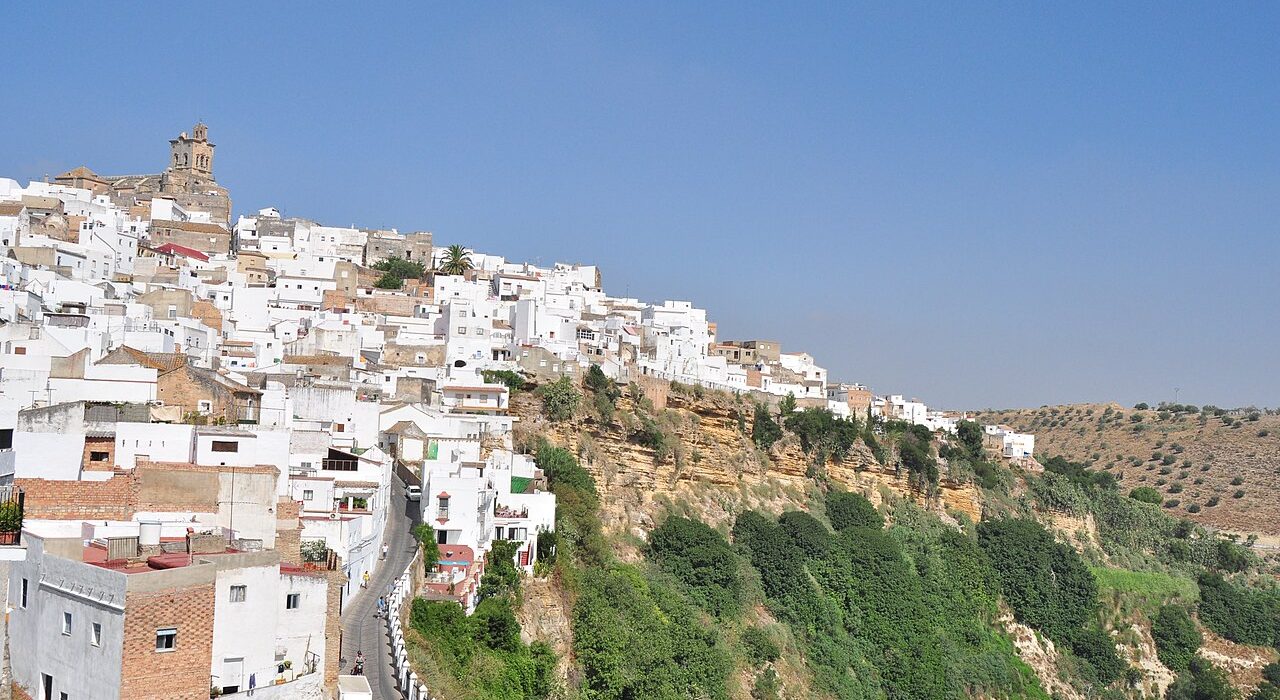
Arcos de la Frontera
AndalucíaClimate
Daily budget
The cool breeze rising from the Guadalete River gently brushes your face as you lean over the Mirador de la Peña Nueva (Peña Nueva Viewpoint), offering a dizzying panorama more than 100 meters above the gorge that defines the city’s medieval silhouette. This sensation of controlled vertigo, mixed with the aroma of freshly baked bread and spices filtering up from the narrow streets of the old town, is the perfect welcome to a destination where history is lived at ground level on limestone. With a population of 31,000, this municipality in the province of Cádiz, Andalusia, is not just a cluster of whitewashed houses, but a living stage where religious and military heritage merge at every corner.
The must-seesWhat to see in Arcos de la Frontera: the essentials
Arcos de la Frontera offers a dense and varied monumental heritage, centered on its old town, declared a Historic-Artistic Ensemble, and its defensive fortifications.
Basilica of Santa María de la Asunción
Built on the foundations of the former Great Mosque, this basilica dominates the Plaza del Cabildo as the main landmark of Arcos’ urban skyline. Its architecture is a living testament to local history, fusing Gothic-Mudéjar and Baroque styles in a structure that preserves historical altarpieces of great value. For visitors, the highlight is its tower, which offers unparalleled panoramic views over the river and the countryside, although it is crucial to check official heritage channels before ascending, as opening hours vary according to the liturgical season. It is the key monument of the religious heritage and the natural starting point for any cultural route.
Ducal Castle of Arcos
This quadrangular fortress with four crenellated towers originates from a Muslim military alcázar reformed in the 14th and 15th centuries. Although it is private property with limited access, its exterior is imposing, preserving primitive elements such as a horseshoe arch at the western entrance and sections of the wall to the southwest. Visually striking features include the Torre del Secreto (Tower of Secrets), the Aljibe del Patio de Armas (Cistern of the Parade Ground) visible from certain angles, and the pyramidal merlons crowning the structure. Above its main portal, the coat of arms of the Dukes of Arcos can be appreciated, recalling its noble past.
Convent of the Encarnación
This is a conventual foundation from the first half of the 16th century that previously functioned as a chapel and hospital, showing a fascinating architectural evolution. The works were directed by Alonso de Baena, who left a Plateresque portal and another in Flamboyant Gothic style that deserve detailed contemplation. Access is free to admire its historic façade located in the Callejón de las Monjas (Nuns’ Alley), although the interior is not open to general tourism and is only accessible during Mass at scheduled times. It is a perfect example of the Baroque and Gothic architecture that enriches the old town.
Castle of Arcos de la Frontera (Town Hall)
The town hall building borders directly onto the Plaza del Cabildo according to the original layout of the historic center, integrating perfectly into the surroundings. Its façade contributes significantly to the monumental setting of the visit’s starting point, serving as an architectural frame for the arcaded square. Although its function is administrative, its visual presence is inseparable from the city’s iconic image and the heritage route traversing the upper area.
Convents and Chapels
Several convents and chapels enrich the old town of Arcos de la Frontera with their artistic and traditional value, notably the Convent of the Mercedarias. These historic buildings are mandatorily included in the town’s religious heritage route, displaying a variety of styles ranging from Baroque to Gothic. Their constant presence recalls the city’s deep spiritual roots and offers points of visual interest in every alleyway of the itinerary.
Other Points of Interest
- Palacio Conde del Águila (Count of the Eagle Palace): A stately building that adds value to the urban landscape of the historic center.
- Iglesia de San Pedro (Church of Saint Peter): Located in Plaza del Cabildo, it borders the Ducal Castle and the Town Hall, forming the medieval historic core with 15th-century Gothic-Mudéjar architecture declared a National Monument.
- Palacios y Casas Nobles (Palaces and Noble Houses): The urban landscape preserves palaces and noble houses, highlighting the Palacio del Mayorazgo as an architectural gem in the historic center, blending with the popular architecture of whitewashed houses.
- Arte Sacro (Sacred Art): Museum that complements the cultural visit with pieces of religious value.
- Iglesia de San Miguel (Church of Saint Michael): A Gothic-Mudéjar temple built during the 15th century on the foundations of an old Muslim mosque, located in the upper area with a fortified tower.
- Puerta Matrera (Matrera Gate): A 14th-century structure reconstructed in the 17th and 18th centuries that connected the old town with the Barrio Bajo, of which only the left tower or Torre del Homenaje remains.
- Ruinas romanas (Roman Ruins): Archaeological remains that testify to the antiquity of the settlement.
- Casa Palacio de García de Veas (García de Veas Palace House): Monument that is part of the city’s noble architecture ensemble.
- Belén artístico El Camborio (El Camborio Artistic Nativity Scene): Monument of cultural and religious interest.
- Balcón de Arcos (Arcos Balcony): Establishment in Plaza del Cabildo that operates as a hotel and privileged balcony over the Guadalete River with a terrace and restaurant.
- Mirador de Abades (Abades Viewpoint): Panoramic point distributed along the edge of the gorge with views of the river valley and free access.
- Mirador Pueblos Blancos (White Villages Viewpoint): Another privileged enclave to contemplate the white architecture of the region.
- Mirador de la Peña Nueva (Peña Nueva Viewpoint): Natural balcony over the gorge more than 100 meters high that defines the medieval silhouette, offering panoramic views of the Guadalete River and the vega from Plaza del Cabildo.
- Calle Corredera (Corredera Street): Main street that leads directly to the monumental area from the lower part, on whose ascending route lies the Iglesia de San Miguel.
- Recinto Amurallado (Walled Enclosure): The remains of the medieval wall are preserved integrated into the urban layout alongside the towers that defended the accesses to the village within the walk through the old town.
- Palacio del Mayorazgo (Mayorazgo Palace): Palace built in the 17th century with a sumptuous Herrerian façade and two columned courtyards, currently an institutional headquarters with a two-body portal and Tuscan columns.
- Murallas Defensivas (Defensive Walls): Medieval fortifications of Almohad and Christian origin situated on the rocky promontory, forming part of the Castle’s defensive system with limestone structures.
- Plaza del Cabildo (Cabildo Square): A 16th-century porticoed square that serves as access to the Basilica of Santa María and the Mirador de la Peña, preserving semicircular arches and marble columns.
- Río Guadalete (Guadalete River): Set of panoramic points distributed along the edge of the gorge with views of the river valley, recommended at sunset to contemplate the white architecture.
🍂 Otoño
El otoño trae consigo un aire más fresco y menos turistas para explorar los miradores con calma. La luz dorada de esta estación es perfecta para fotografiar sus blancas calles empinadas. Consulta siempre la previsión meteorológica por si acaso necesitas un paraguas.
What to do in Arcos de la Frontera
Arcos de la Frontera offers immersive cultural activities such as the Belén Viviente (Living Nativity) in December and solemn processions during Holy Week, in addition to strolls through its three distinctive neighborhoods.
The highlight is the Belén Viviente (Living Nativity) in December, which recreates the birth of Jesus within the unique setting of its historic center, recognized as one of the best in Spain. In spring, Semana Santa (Holy Week, March/April) transforms the city with solemn religious processions featuring artistic floats and sacred music winding through the old town. For a more relaxed experience, it is recommended to explore the Casco Antiguo (Old Town), ideal for tourists seeking narrow, steep streets with stunning views, or visit the Barrio Bajo, the most modern and flat area at the foot of the hill where daily life concentrates. Families can enjoy El Santiscal, a residential development next to Lake Arcos with an artificial beach and a nautical club for water activities.
Arcos de la Frontera in one day: express itinerary
This one-day itinerary covers the 4-5 main attractions to make the most of the visit during an average stay of 1.94 nights.
- 10:00 AM – Plaza del Cabildo: Start at this 16th-century arcaded square, a meeting point for tourist routes with free access, marble columns, and semicircular arches.
- 11:00 AM – Basílica de Santa María de la Asunción: Visit the main landmark of the urban skyline, built on the site of the former great mosque, checking liturgical hours in advance.
- 13:00 PM – Mirador de la Peña Nueva: Enjoy the natural balcony overlooking the gorge of over 100 meters to capture the most iconic photo with views of the Guadalete River.
- 14:30 PM – Lunch at Mercado de Abastos de Las Nieves: Try fresh local products at the main municipal market before continuing.
- 16:30 PM – Castillo Ducal and Calle Corredera: Walk up the main street toward the monumental area to see the quadrangular fortress and the Church of San Miguel.
Where to eat in Arcos de la Frontera: local gastronomy
Where to sleep in Arcos de la Frontera
Casco Antiguo
El centro histórico declarado Monumento Histórico-Artístico, famoso por sus calles estrechas y empinadas, arcos y vistas impresionantes.
Barrio Bajo
La zona más moderna y llana a los pies del cerro, donde se concentra gran parte de la vida cotidiana y comercial de los locales.
El Santiscal
Urbanización junto al Lago de Arcos que cuenta con una playa artificial y un club náutico, ideal para actividades acuáticas y familias.
How to get to Arcos de la Frontera
The main access to the city is via La Ina Airfield or through land connections from cities in the region.
| Medio | Duración | Precio aprox. | Frecuencia |
|---|---|---|---|
| Aeródromo de La Ina | Variable según origen | Consultar aerolínea | Según programación |
| Autobús / Coche | Variable desde ciudades de la región | Variable | Diario |
Getting Around Arcos de la Frontera
The available urban transport is the city bus, which connects the different areas of town.
To get between the Old Town (Casco Antiguo), the Lower Quarter (Barrio Bajo), and El Santiscal, the city bus is the available public option. Given the city’s topography, with steep streets in the monumental area, this service is useful for saving physical effort, especially when visiting the Mirador de la Peña Nueva viewpoint or the Basilica from the lower part. Walking is also a viable option in the historic center due to its compact layout, but the bus facilitates mobility between neighborhoods.
Weather in Arcos de la Frontera
Best Time to Visit Arcos de la Frontera
Day Trips from Arcos de la Frontera
From Arcos, it is possible to take day trips to other cities in the region to complement your visit.
The city holds a strategic position between the Jerez countryside and the mountain range, facilitating connections with regional cities. As Arcos is the most populous and extensive municipality in the Sierra de Cádiz comarca, it serves as an excellent base for exploring the Andalusian surroundings. The 9,610 annual travelers (INE) who visit the city often combine their stay with routes through the province of Cádiz, taking advantage of proximity to other tourist destinations in Andalusia.
Who Is Arcos de la Frontera For?
Arcos de la Frontera is an ideal destination for history lovers, families, and cultural tourists seeking an authentic heritage setting.
It is perfect for history lovers due to its Ducal Castle, defensive walls, and Gothic-Mudéjar architecture. Families will find El Santiscal a great space for water activities and relaxation. Foodies will enjoy the local gastronomy with dishes such as Alboronía (a vegetable stew) and Abajao (a garlic soup). With an average stay of 1.94 nights and 23% foreign visitors (INE), it is a welcoming place for travelers who value authenticity over mass tourism, offering everything from budget hostels to luxury hotels.
Frequently Asked Questions about Arcos de la Frontera
How many days do I need to see Arcos de la Frontera?
The average stay is 1.94 nights according to the INE, suggesting that 2 days are sufficient to see the main attractions such as the Basilica, the Castle, and the Viewpoints.
Is Arcos de la Frontera expensive?
Not necessarily; indicative prices show average meals costing €12–18 and hostels from €18–30/night, although 4- and 5-star hotels can reach €200/night.
What is the best time to visit Arcos de la Frontera?
The best time is from April to October, with average summer temperatures of 25.3°C, avoiding winter which records averages of 11.6°C.
How do I get to Arcos de la Frontera from Madrid?
You can arrive via regional cities connected by road or using the La Ina Airfield if connections are available, although the most common option is overland from the region.