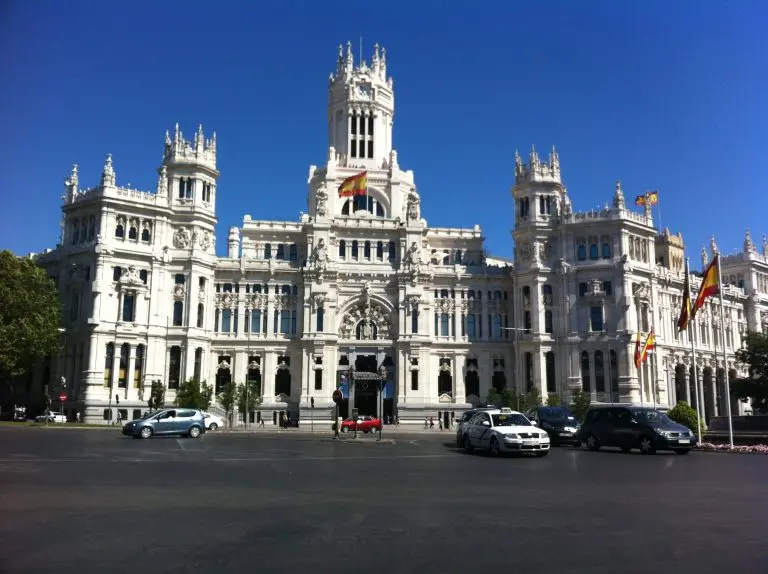
Toledo → Madrid
75 kmLeaving behind Toledo’s cobbled lanes and landing in the very heart of Madrid in just over half an hour is one of those luxuries only Castile-La Mancha can offer. The journey is a trip between two worlds: the imperial city overlooking the Tagus and the capital that never sleeps, separated by barely 75 kilometres of motorway, high-speed rails and the occasional detour with a village feel.
How to get from Toledo to Madrid: quick summary
The fastest way to travel from Toledo to Madrid is Renfe’s AVANT train, which covers the route in 34-38 minutes with 16 daily departures; the ALSA or Samar bus is the cheapest option (€5-6 per journey), while driving yourself gives you the freedom to explore stops such as Navalcarnero or Móstoles in about 55 minutes via the A-42.
If your priority is reaching central Madrid as soon as possible, the train is unbeatable. If you’re travelling on a tight budget, the bus gets you into Madrid for less than the price of a set lunch. And if you want to use the route for food tourism or to visit charming towns, the car is your best ally.
Driving from Toledo to Madrid
The drive between Toledo and Madrid takes about 55 minutes along the A-42, the Autovía de Toledo, which covers around 66 of the route’s total 75 kilometres with no tolls at all.
The A-42 is a comfortable, well-maintained motorway that connects the exit from Toledo directly with the south of the Madrid metropolitan area. It’s the natural route for anyone travelling in their own or a rental car, and its main advantage is that there are no extra toll costs, something to be grateful for on short journeys.
The scenery along the A-42 alternates between Castilian farmland and the steadily thickening urban sprawl as you approach the Community of Madrid. It’s best to avoid rush hour on weekdays, especially between 7:30 and 9:30 in the morning, when access to Móstoles, Alcorcón and Leganés can slow traffic down.
By train from Toledo to Madrid
The direct train from Toledo to Madrid is the fastest option on the corridor: Renfe’s AVANT covers the route in 34-38 minutes, with 16 trains a day between 6:25 and 21:37.
The departure station is Toledo’s, a Neo-Mudéjar building that is worth a visit in its own right, and the arrival station is Madrid-Puerta de Atocha-Almudena Grandes, perfectly connected to the rest of the city by metro and Cercanías. According to Renfe, all services available on this route are AVANT, medium-distance high-speed trains that don’t require check-in or the strict security controls of long-distance AVE services.
The frequency of 16 trains a day makes it easy to travel early for a day of work or sightseeing and return in the afternoon without any stress. Once you arrive at Atocha, you’re a stroll away from the Museo del Prado (Prado Museum), El Retiro Park or the buzz of Lavapiés.
By bus from Toledo to Madrid
The direct bus from Toledo to Madrid takes about 50 minutes and costs between €5 and €6, operated by the ALSA and Samar companies.
It’s the cheapest alternative for getting between the two cities, with a journey time that’s highly competitive compared with driving. Buses leave from Toledo’s bus station and arrive at Madrid’s main terminals, making it easy to connect with urban transport.
For travellers with bulky luggage, the bus can be more practical than the train, since there’s no hauling suitcases along platforms or going through security checks. That said, it’s worth booking ahead at peak times or weekends, especially if your trip coincides with public holidays or long weekends.
Recommended stops along the way
If you’re driving, the route along the A-42 lets you detour to several towns in southern and western Madrid; these are the eight verified stops you can add without straying too far from the main journey.
Pozuelo de Alarcón is one of the most elegant localities in the western metropolitan area. Its green spaces, residential tranquillity and dining scene make it a pleasant stop for a coffee or a stroll before heading into the bustle of the capital.
Boadilla del Monte surprises with its Palacio del Infante Don Luis (Palace of the Infante Don Luis), surrounded by gardens and with a neoclassical air that contrasts with the recent urban development. It’s a brief stop but one with historic charm.
Navalcarnero is perhaps the most authentic stop on the route. Its Plaza de Segovia, arcaded and distinctly Castilian, invites you to get out of the car and have a drink on one of the terraces. It’s a town with a strong winemaking and culinary tradition, ideal for a break along the way.
Villanueva de la Cañada is home to the campus of a well-known university and has a restored castle that’s worth a photo. Its student atmosphere gives it a young, dynamic feel.
Fuenlabrada is a large, lively city with a strong commercial fabric and a wide range of leisure options. If you’re looking to refuel or do some quick shopping, it’s a practical stop.
Alcorcón is another well-established urban hub in southern Madrid, with shopping centres and easy access from the A-42. A good option for a logistical pause without straying too far.
Móstoles has a lively pedestrian centre and an interesting cultural offering, with museums and performance venues. Its proximity to the motorway makes it a convenient stop with more life than many expect.
Leganés is the last major city before entering the central heart of Madrid. Its Leganés Norte neighbourhood and green spaces offer a breather before the final stretch.
Where to stay in Madrid
Madrid offers accommodation for every budget: from hostels and guesthouses in the historic centre for 50-80 € a night, to four- and five-star hotels in areas such as Salamanca or Chamberí that exceed 150 €.
If you arrive by train at Atocha, the triangle formed by Lavapiés, Huertas and the Paseo del Prado is ideal for getting around on foot. For short stays, the centre (Sol, Ópera, La Latina) puts you in the middle of everything, although nighttime noise can be a drawback. Neighbourhoods such as Malasaña or Chueca work very well if you’re after an alternative vibe and a good selection of bars.
If you’re travelling by car, consider staying in areas with their own parking or nearby public car parks, such as Arganzuela or the area around Méndez Álvaro, well connected to the centre by metro or bus.
Where to eat along the route
The food along this route is one of its great draws: Toledo and La Mancha contribute hearty dishes and wines with character, while the Community of Madrid adds its own winemaking tradition.
Migas are the quintessential spoon dish of the Toledo area. They are made with shredded stale bread, sautéed with garlic, paprika and pieces of pancetta or chorizo. They are served hot and are especially comforting in the cold months.
Carcamusas are an emblematic stew from the city of Toledo. They contain chopped pork cooked with tomato, onion, garlic, bay leaf and peas. It is a dish that rarely leaves anyone indifferent and is usually served in a small clay pot.
Manchego cheese, made with milk from Manchega breed sheep, has a firm texture and an intense flavour, slightly spicy in its cured version. It is the perfect companion for a local wine.
Pisto manchego is a stew of tomato, pepper, courgette and onion, all chopped and sautéed in olive oil. It is served on its own or with egg, and is a lighter option without sacrificing flavour.
Asadillo manchego is a salad of roasted red peppers, tomato and garlic, dressed with olive oil and cumin. Typical as a tapa or side dish, it refreshes the palate between courses.
To drink, Vino de la Tierra de Castilla offers reds, whites and rosés made from varieties such as Tempranillo, Garnacha or Airén. For its part, Vino de Madrid, with its own DO, also covers reds, whites and rosés, with the Malvar variety as a local hallmark.
Frequently asked questions about the Toledo-Madrid route
How long does it take from Toledo to Madrid?
It depends on the mode of transport: by car, the journey along the A-42 takes about 55 minutes for 75 kilometres; on the Renfe AVANT train, between 34 and 38 minutes; and by ALSA or Samar bus, about 50 minutes. There is no direct flight between the two cities.
Which is cheaper, the train or the bus?
The bus is clearly cheaper, with tickets between 5 and 6 € per journey. The AVANT train is faster but its price is higher, especially if you buy at short notice or during peak hours.
Is it worth renting a car?
It depends on your plan. If you are only going to move around the centre of Madrid, public transport is more practical and avoids parking problems. But if you want to stop in Navalcarnero, Móstoles, Alcorcón or other towns along the way, the car gives you a freedom that neither train nor bus offers.
When is the best time to travel?
The route is comfortable throughout the year, but it is advisable to avoid peakhours on weekdays by car along the A-42, especially between 7:30 and 9:30. By train, the first AVANT leaves at 6:25 and the last at 21:37, so you have room to choose the slot that best suits your pace.
💡 ¿Sabías que...?
- ● Madrid es la capital más alta de la Unión Europea, situada a 657 metros sobre el nivel del mar. (https://www.timeout.es/madrid/es/que-hacer/12-curiosidades-de-madrid-que-seguro-que-desconocias)
- ● Madrid fue fundada a mediados del siglo IX por el emir Mohamed I de Córdoba como un pequeño asentamiento militar, y es la única capital europea erigida por los árabes. (https://elpais.com/elviajero/2020/04/08/actualidad/1586349868_603259.html)
- ● El nombre de Madrid procede del árabe Mayrit, que significa fuentes o cursos de agua. (https://elpais.com/elviajero/2020/04/08/actualidad/1586349868_603259.html)
- ● El 17 de octubre de 1919, Alfonso XIII inauguró la primera línea de metro de Madrid, en la que se decidió que los trenes circularan por la izquierda como lo hacían los carruajes. (https://www.elconfidencial.com/viajes/2021-05-12/10-secretos-de-madrid-que-probablemente-no-conoces_3072931/)
- ● La parroquia de San Antonio de la Florida alberga los restos de Francisco de Goya, excepto su calavera, y pinturas al fresco del pintor en la bóveda. (https://www.elconfidencial.com/viajes/2021-05-12/10-secretos-de-madrid-que-probablemente-no-conoces_3072931/)
📍 También te puede interesar
Qué ver en Toledo →
Qué ver en Madrid →