Girona → Cadaqués
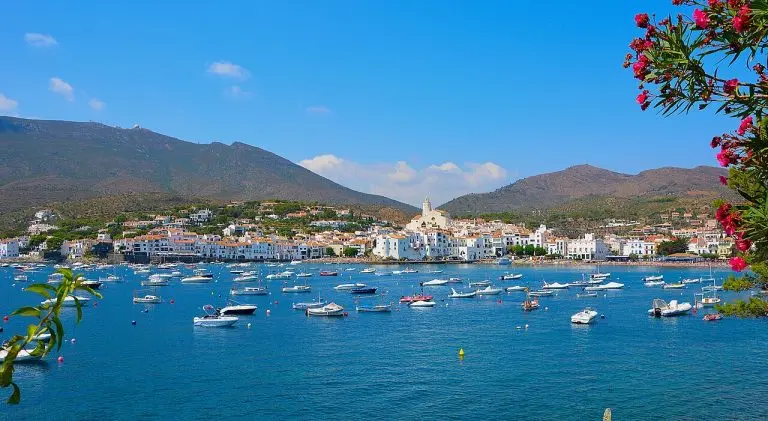
75 kmSome roads are meant to be driven, and others are meant to be felt—and the one linking Girona to Cadaqués undoubtedly belongs to the latter. In just over an hour you go from the city’s golden stone to the white light of the Mediterranean, with the Empordà unfolding on both sides like a painting that changes brushstrokes: vineyards, medieval villages, marshes and, at the end, the promise of a white village wrapped around a bay. It’s not just a journey; it’s the gateway to the most authentic Costa Brava.
How to get from Girona to Cadaqués: quick summary
The route between Girona and Cadaqués can be done mainly by car (75 km, 1 hour) or by direct bus (105 minutes, between €10 and €17). There is no direct train or train station in Cadaqués, so the bus is the only public transport option without transfers. For travellers who want to stop in Figueres, l’Escala or Roses, the car is clearly the best option; for those looking for a cheap, hassle-free choice, the SARFA bus (Moventis Sarfa, line 4) fits the bill perfectly.
By car from Girona to Cadaqués
The drive from Girona to Cadaqués covers 75 km and takes roughly 1 hour along a combination of motorway and secondary roads that cut through the heart of the Empordà. The main route starts on the AP-7 (Autopista de la Mediterrània), of which about 34 km are covered toll-free, heading towards Figueres. Then you take the C-260 (Carretera Olot a Roses) for about 15 km, which brings the journey closer to the coast, and further on the GI-614 (Avinguda de Caritat Serinyana) for about 17 km, the road that already winds between hills and coves all the way to Cadaqués itself. You also drive a short stretch of the N-II (Carretera Madrid-Barcelona-Frontera Francesa), about 6 km and toll-free, around Figueres. It’s worth taking it easy on the final stretch: the GI-614 is narrow and winding, but it rewards you with gorgeous views of Cap de Creus.
By bus from Girona to Cadaqués
There is indeed a direct bus between Girona and Cadaqués, operated by SARFA (Moventis Sarfa, line 4), lasting 105 minutes and priced between €10 and €17. The journey usually passes through villages of the Empordà, letting you take in the scenery without worrying about the steering wheel. It’s the most recommended option if you don’t have a car, since there is no direct train or train station in Cadaqués, and the bus covers the entire route without the need for transfers. Timetables vary by season, so it’s worth checking in advance on the Moventis Sarfa website.
Recommended stops along the way
Between Girona and Cadaqués there are at least five stops that are reason enough on their own to stretch the trip by a couple of hours or even half a day. All of them lie on the route or involve only a very small detour, and they let you combine art, gastronomy, Greco-Roman ruins and fishing villages.
Figueres
Figueres is the capital of the Alt Empordà and the most obvious stop for art lovers: Salvador Dalí was born here, and so was his Theatre-Museum, one of the most visited museums in Spain. The centre is compact, with the Rambla, the plaça de l’Ajuntament and an inland-town atmosphere that contrasts with the nearby coast. If you’re driving, it’s a natural stop just after leaving the AP-7.
l’Escala
l’Escala is a fishing village famous for its anchovies and for sitting right next to the Greco-Roman ruins of Empúries, the most important archaeological site in Catalonia. Strolling along its seafront promenade, stepping into a traditional fish-canning factory or stopping by the Rec del Molí beach are all things you can do in an hour or two. It’s an ideal stop for lunch or to buy L’Escala anchovies before heading north.
la Bisbal d’Empordà
la Bisbal d’Empordà is known as the capital of ceramics: dozens of workshops and pottery shops dot its old town, dominated by a medieval castle-palace. Although it isn’t exactly on the straight line to Cadaqués, it’s only a short detour off the C-260 and well worth it to see living craftwork, buy clay pieces and have a coffee in one of its arcaded squares. The atmosphere is far more local than in the coastal villages.
Roses
Roses is the gateway to the Cap de Creus Natural Park and the last major town before tackling the final stretch to Cadaqués. It has a wide seafront promenade, a beautiful bay and plenty of restaurants and ice-cream shops. From Roses you can head up to the Puig Rom viewpoint or visit the Ciutadella, a Renaissance fortress with remains of the ancient Greek colony of Rhode. It’s a good stop to stretch your legs before the final 17 km along the GI-614.
Torroella de Montgrí
Torroella de Montgrí is a medieval town at the foot of the Montgrí massif, with an old town of cobbled streets, remains of the town walls and a lively arcaded main square. From the town you can walk or drive up to the Montgrí castle, an unfinished 13th-century fortress with panoramic views over the Baix Empordà and the Medes Islands. It’s a stop somewhat further from the direct route, but perfect for anyone travelling without haste and wanting to add heritage and history to the journey.
Where to stay in Cadaqués
Cadaqués concentrates most of its accommodation in three areas: the old town, the seafront promenade and the hills surrounding the bay. The old town, with its cobbled streets and white houses, is ideal for anyone wanting to soak up the village atmosphere, but bear in mind that many houses have no lift and parking is tricky. The seafront promenade offers hotels and guesthouses with sea views, perfect for waking up with the bay in front of you, though they tend to be the most expensive. The surrounding hills and residential developments, such as sa Conca or Portlligat, have apartments and rental houses with more space and peace and quiet, often with a terrace and views. Prices vary widely depending on the season: in summer and on spring weekends, accommodation can exceed 150-250 € per night, while in low season it’s possible to find double rooms for 60-100 €. There are no big hotel chains: family-run guesthouses, boutique hotels, tourist apartments and rural houses predominate. Booking in advance is essential in July and August.
Where to eat along the route
The cuisine of the Empordà is one of the great reasons to take this route without rushing. From humble dishes such as escalivada or pa amb tomàquet to seafood stews like suquet de peix, the journey between Girona and Cadaqués can become a journey of flavour.
- Escalivada (Gironès / Empordà): A dish of oven-roasted or grilled vegetables, typically aubergine, red pepper, onion and tomato, peeled and dressed with olive oil and salt. It is served as a starter or side dish, and is a perfect way to begin a meal built on quality produce.
- Pa amb tomàquet (Catalonia, Girona, Empordà): Sliced payés bread rubbed with ripe tomato, dressed with extra virgin olive oil and salt. It is a staple side in Catalan cuisine and tends to appear on almost any table, from breakfast through to dinner.
- Suquet de peix (Costa Brava, Empordà, Girona): A seafood stew of fish and shellfish with potatoes, tomato, garlic, parsley and sometimes ñora or an almond picada. It is cooked slowly until the broth thickens, and it is the perfect dish for a day by the sea.
- Arròs a la cassola (Empordà / Girona): Dry rice cooked in a clay pot with a sofrito of tomato, onion and garlic, sausages such as butifarra or pork rib, and sometimes seafood or mushrooms. It is baked or finished over the heat until creamy, and it is a hearty inland recipe that pairs very well with the region’s wines.
- Anchoas de L’Escala (L’Escala, Alt Empordà): Fresh anchovies cured in brine and preserved in olive oil, typical of the Alt Empordà coast. They are served as a tapa or starter, prized for their intense flavour and firm texture. Buying them directly in l’Escala is almost obligatory.
- Gambas de Palamós (Palamós, Baix Empordà): Red prawn of the species Aristeus antennatus, fished in the waters off Palamós, boiled or grilled. It stands out for its sweet flavour and firm texture, and is one of the most prized seafoods of the Costa Brava.
- Vino Empordà (Empordà): Red, white and rosé wines made in the Empordà region, with varieties such as garnacha, cariñena, macabeo and moscatel. They pair well with local fish, rice dishes and meats, and many wineries offer visits and tastings in the area.
Frequently asked questions about the Girona-Cadaqués route
How long does it take to get from Girona to Cadaqués?
By car, the journey between Girona and Cadaqués takes approximately 1 hour to cover the 75 km of road. By direct bus, the duration is 105 minutes (1 hour and 45 minutes) with the companies SARFA / Moventis Sarfa (line 4). There is no direct train, so the car is the fastest option and the bus is the only public transport alternative without transfers.
Which is cheaper, the train or the bus?
There is no direct train between Girona and Cadaqués, nor a train station in Cadaqués, so the real comparison is between bus and car. The direct SARFA bus (Moventis Sarfa, line 4) costs between 10 and 17 € per journey, which makes it the most economical option. The car, adding fuel and possible tolls (although the AP-7 stretch indicated is toll-free), usually works out more expensive if travelling alone, but it can pay off if shared between several people or if you want to make stops along the way.
Is it worth renting a car?
It depends on the type of trip. If you only want to go to Cadaqués and not move from there, the direct bus is enough and cheaper. But if you want to make stops in Figueres, l’Escala, Roses, la Bisbal d’Empordà or Torroella de Montgrí, renting a car is well worth it: the route along the AP-7, the C-260 and the GI-614 lets you stop at your own pace, and the final stretch to Cadaqués is one of the most beautiful on the Costa Brava. What’s more, with a car you can explore the Cap de Creus and the nearby coves, something almost impossible on public transport.
When is the best time to travel?
The best time to do the Girona-Cadaqués route is spring (April-June) and autumn (September-October), when the weather is mild, there are fewer crowds than in summer and accommodation and bus prices stay in lower ranges. In summer, Cadaqués fills up and traffic on the GI-614 can be heavy, especially at weekends. In winter, many accommodation options and restaurants close, but the town has a very special quiet, lonely charm.
💡 ¿Sabías que...?
- ● El primer documento que menciona Cadaqués data del año 814, cuando la comunidad local rescató las reliquias de los santos Abdón y Senén de un naufragio. (https://visitacadaques.com/cadaques-historia-y-tradicion-de-un-pueblo-unico-en-la-costa-brava/)
- ● En 1444, un ataque de 22 galeras de moros destruyó el pueblo, incluyendo el archivo municipal. (https://visitacadaques.com/cadaques-historia-y-tradicion-de-un-pueblo-unico-en-la-costa-brava/)
- ● Una de las teorías sobre el origen del nombre «Cadaqués» sugiere que proviene de «Cabo de Quers», que se traduce como cabo de rocas. (https://visitacadaques.com/cadaques-historia-y-tradicion-de-un-pueblo-unico-en-la-costa-brava/)
- ● El municipio ha sido escenario de películas como 'Miss Dalí' (2018) y 'Tierra de cañones' (1999). (https://todopueblos.es/municipio/cadaques-17032/visitar/)
- ● Joan Escofet y Palau (Cadaqués, 1720 – 1810) fue ingeniero militar y arquitecto, y donó al pueblo un edificio para uso público conocido como la antigua marmosseria. (https://www.visitcadaques.org/?lang=es&sec=cultura&sub=pers)
- ● Esperança Llorens (Cadaqués, s. XVIII – XIX) fue una heroína durante el asedio de Gerona. (https://www.visitcadaques.org/?lang=es&sec=cultura&sub=pers)
- ● Frederic Trémols y Borrell (Cadaqués, 1831- Barcelona, 1900) recolectó plantas por toda Cataluña, reuniendo un herbario de 25.000 ejemplares. (https://www.visitcadaques.org/?lang=es&sec=cultura&sub=pers)