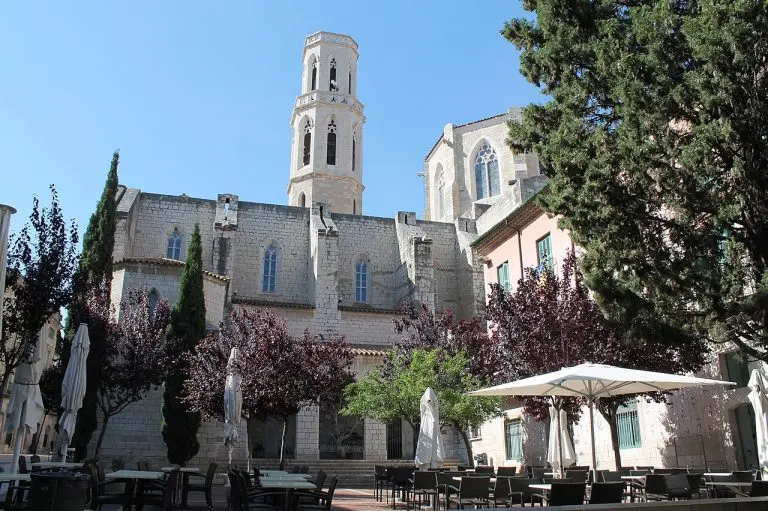
Girona → Figueres
38 kmA journey of just half an hour that takes you from the student bustle of Girona to the epicentre of Surrealism in Figueres, with the Empordà unfolding before you like a painting. Whether you speed along the motorway or let yourself be carried by a high-speed train, this route is the perfect excuse for a day trip that ends, inevitably, at the door of the Dalí Theatre-Museum.
How to get from Girona to Figueres: quick summary
The route between Girona and Figueres is extremely simple and quick, with a distance of just 38 km by road. The fastest option is undoubtedly Renfe’s AVANT train, which covers the journey in 13 minutes; the car is the most flexible alternative, with a travel time of about 30 minutes along the AP-7 motorway. For those looking for the cheapest option who don’t mind investing a little more time, the direct Barcelona Bus takes 55 minutes. There are no direct flights between these two Catalan cities.
By car from Girona to Figueres
Driving from Girona to Figueres is the most practical option if you plan to explore the surroundings or make spontaneous stops, with a total journey of 38 km that is completed in about 30 minutes. The main route is mostly along the motorway, which makes it very smooth and toll-free.
The most direct itinerary is as follows:
- AP-7 (Autopista de la Mediterrània): You’ll take this motorway for most of the route, about 34 km of the total. It is a fast and comfortable road, toll-free on this stretch, which will allow you to enjoy a relaxed drive with views of the Empordà landscape.
- N-IIa (Avinguda de Salvador Dalí i Domènech): The last 7 km of the journey run along this national road, which takes you directly into the urban centre of Figueres. It is the main access artery to the city and leaves you just a step from the centre.
The combination of these two roads makes the car journey direct and hassle-free, ideal for families or groups who want to carry luggage without restrictions.
By train from Girona to Figueres
The train is the fastest and most efficient way to travel from Girona to Figueres, with Renfe’s AVANT service covering the distance in just 13 minutes. The frequency is extremely high, with about 90 trains a day connecting Girona station with Figueres-Vilafant, giving you total flexibility to plan your getaway.
These are the key details of the rail service:
- Operator: Renfe.
- Departure station: Girona.
- Destination station: Figueres-Vilafant.
- Timetable: The first train leaves at 07:17 and the last at 23:47, covering practically the whole day.
- Frequency: 90 trains a day.
- Train types and duration:
- AVANT: 17 trains a day, 13 minutes (the fastest option).
- EUROMED: 1 train a day, 14 minutes.
- AVE: 9 trains a day, 14 minutes.
- AVE INT: 2 trains a day, 14 minutes.
- MD (Media Distancia): 20 trains a day, 29 minutes.
- Rodalies R11: 21 trains a day, 29 minutes.
- REGIONAL: 12 trains a day, 36 minutes.
- Rodalies RG1: 8 trains a day, 39 minutes.
With such a variety of services, you can choose between the maximum speed of an AVANT or the cheaper option of a Rodalies train, which adds barely a few minutes to the journey.
By bus from Girona to Figueres
There is indeed a direct bus between Girona and Figueres, operated by Barcelona Bus, with a journey time of 55 minutes. It is a comfortable and often the cheapest alternative for getting between the two cities, especially if you are not in a hurry and want to avoid the hassle of a car or the transfer to the high-speed train station.
The bus journey lets you enjoy the scenery without worrying about driving, and it is usually a popular option among budget-conscious travellers. Although the travel time is longer than by train or car, the difference is not excessive for a day trip.
Where to stay in Figueres
Figueres is a compact city, so staying in the historic centre or near the Dalí Theatre-Museum is the most recommendable option to make the most of your visit. Accommodation is concentrated in 3- and 4-star hotels, guesthouses and tourist apartments, with prices that usually range between €60 and €120 per night in mid-season.
The best areas to stay are:
- Historic centre: Ideal for walking to all the points of interest, with a wide variety of restaurants and local atmosphere. It is the most sought-after area, so it is worth booking in advance.
- Surroundings of Figueres-Vilafant station: Practical if you arrive by high-speed train and plan to move on the next day, although it is somewhat further from the old town (about 15-20 minutes on foot).
- Rambla area: Perfect for those seeking a lively atmosphere, with terraces and shops right on the street.
There are no major luxury chains, but the offer is sufficient and of good quality, with a very friendly, personal touch in most of the accommodations.
Where to eat along the route
Food is one of the great attractions of this trip, with a larder that ranges from sweet to savoury and represents the best of the Gironès and Alt Empordà. Take advantage of the route to try products with denomination of origin and traditional recipes.
These are the essential dishes and products you will find along the way:
- Botifarra dolça (Gironès): A sweet sausage typical of the Gironès region, made with pork, sugar and spices such as cinnamon and lemon. It is perfect for a hearty breakfast or as a tapa with payés bread.
- Xuixo (Girona): Girona’s most famous sweet. It is a fried pastry filled with Catalan cream, made with puff pastry and coated in sugar. It is a must-try in one of the pastry shops in the old town before setting off for Figueres.
- Arròs de Pals (Baix Empordà): A round-grain rice with a creamy texture, grown in the Baix Empordà, ideal for dishes such as black rice or casserole rice. If you make a slight detour towards Pals, you will find restaurants that cook it masterfully.
- Pèsol negre de Llavaneres (Maresme): A variety of dark-coloured pea with a sweet flavour, grown in the Maresme region. It is eaten fresh or dried and is a delicacy that appears in seasonal stews and rice dishes.
- Anxoves de L’Escala (Alt Empordà): Salted and cured anchovies typical of the Alt Empordà coast, made with fresh anchovies and sea salt. They are a classic to snack on with bread and tomato or as a star ingredient in salads.
- Vino Empordà (Alt Empordà): Wines with denomination of origin from the region, made mainly with Garnacha and Cariñena grapes. They pair perfectly with the previous dishes and are the ideal finishing touch to any meal along the route.
Frequently asked questions about the Girona-Figueres route
How long does it take to get from Girona to Figueres?
Travel time depends on the mode of transport. By car, the journey along the AP-7 and the N-IIa takes around 30 minutes to cover the 38 km distance. By train, Renfe’s AVANT is the fastest option at 13 minutes, although other services such as MD or Rodalies R11 take 29 minutes, and regional trains can take 36-39 minutes. By bus, the direct Barcelona Bus service takes 55 minutes.
Which is cheaper, the train or the bus?
In general, the bus tends to be the most economical option for travelling from Girona to Figueres, although the exact price is not specified in the data provided. The train offers a price range depending on the type of service: Rodalies trains (R11 and RG1) and REGIONALES tend to be cheaper than the AVANT, AVE or EUROMED. If you’re looking to save money, compare prices between the bus and the commuter trains; if speed is your priority, the AVANT is unbeatable.
Is it worth renting a car?
It depends on your travel plans. If you’re only going to visit Figueres and its centre, the train is so fast and frequent that a car offers little advantage. However, renting a car is worth it if you want to make food stops along the way (for example, in Pals to try arròs de Pals, or in L’Escala to buy anchovies) or if you’re planning to explore other villages in the Alt Empordà, such as Cadaqués or Besalú, which are not well connected by public transport.
When is the best time to travel?
The route is pleasant throughout the year, but the best time to travel from Girona to Figueres is in spring (April-June) and autumn (September-October), when temperatures are mild and there are fewer tourist crowds. Summer is ideal for combining a visit to Figueres with the Alt Empordà coast, but trains and the city centre can be busier. Winter is quiet and perfect for enjoying the local cuisine at a leisurely pace.
💡 ¿Sabías que...?
- ● El Castillo de Sant Ferran, en Figueres, es la mayor fortaleza de Europa construida en su época, con más de 320.000 metros cuadrados de superficie construida. (https://www.eldiario.es/viajes/castillos-geometrico-mundo-girona-clave-historia-pm_1_12236858.html)
- ● La construcción de la fortaleza de Sant Ferran en Figueres se inició el 4 de septiembre de 1753. (https://www.raco.cat/index.php/AnnalsEmpordanesos/article/download/342505/433697/)
- ● Narcís Monturiol, inventor del submarino, nació en Figueres, y el primer monumento que tuvo la ciudad, inaugurado en 1918, le rinde homenaje en la Rambla. (https://patrimoni.gencat.cat/es/articulo/figueres-una-ciudad-que-mira-mas-alla-de-dali)
- ● El rey Jaime I convirtió Figueres en ciudad real y le concedió la carta puebla, y hay un monumento en la Rambla en su honor. (https://patrimoni.gencat.cat/es/articulo/figueres-una-ciudad-que-mira-mas-alla-de-dali)