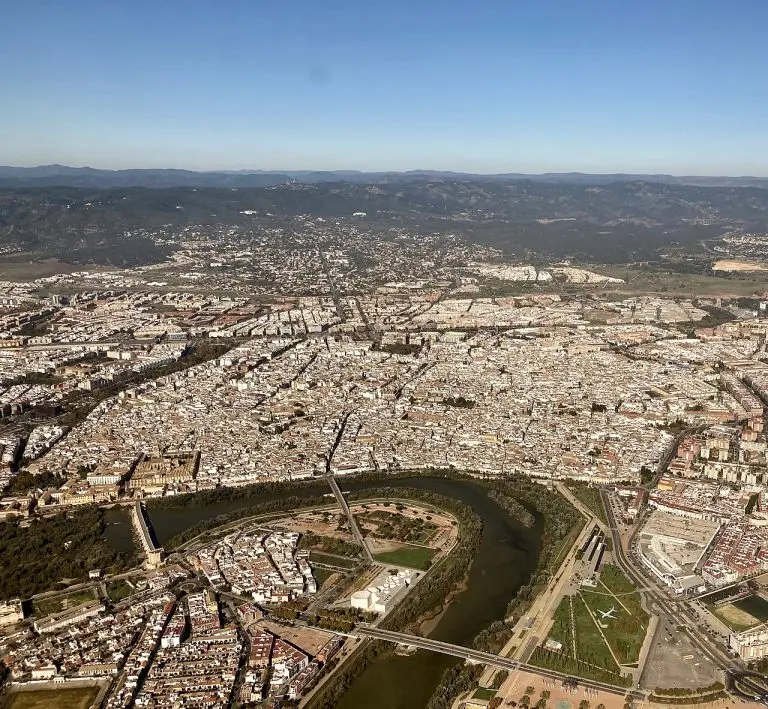
Madrid → Córdoba
399 kmHow to get from Madrid to Córdoba: quick summary
The most efficient option for most travelers is the AVE train, which connects Madrid-Puerta de Atocha with Córdoba in just 104 minutes, with up to 25 daily services. If you’re looking for the cheapest option, the direct Socibus or Secorbus bus costs between €9 and €43, though it takes 255 minutes. Driving is ideal if you want to make stops in places like Almagro or Ciudad Real, with a 399 km journey along the A-4 with no tolls. Flying exists but is the least practical option: direct flights operate only on certain days of the week, and the data can be confused with Córdoba airport in Argentina.
Driving from Madrid to Córdoba
The drive between Madrid and Córdoba covers 399 km and takes approximately 4 hours along the A-4, known as the Autovía del Sur (Southern Motorway). This motorway covers about 381 km of the total route and has no tolls, making it a comfortable and affordable option for those traveling with their own or a rental car.
The A-4 crosses the heart of La Mancha and offers a landscape that alternates between cereal plains, vineyards and olive groves, especially as you approach Despeñaperros and enter Andalusia. As a main motorway, it has frequent service areas, gas stations and restaurants where you can take a break without leaving the road.
For those planning a relaxed trip, the route makes it easy to detour to recommended stops such as Miguelturra, Ciudad Real, Almagro or Puertollano, all accessible from the A-4 or its connecting roads. Remember to check traffic conditions during peak hours, especially when leaving Madrid or entering Córdoba.
By train from Madrid to Córdoba
The direct train operated by Renfe is the fastest way to travel between Madrid and Córdoba, with the AVE covering the journey in just 104 minutes according to official schedules. The frequency is extremely high: 41 trains a day run between the two cities, with the first train departing at 06:55 and the last at 21:20.
The departure station is Madrid-Puerta de Atocha-Almudena Grandes and the arrival station is Córdoba-Julio Anguita. The types of trains available are varied: the AVE with 25 daily services in 104 minutes, ALVIA with 5 trains a day also in 104 minutes, Ouigo with 5 daily services in 104 minutes, Intercity with 1 daily train in 112 minutes, and AVLO with 5 trains a day in 117 minutes.
This variety lets you choose between different price ranges and comfort levels. AVLO and Ouigo trains tend to offer cheaper fares, while AVE and ALVIA include more onboard services. For same-day round trips, the frequency of 41 daily trains makes it perfectly feasible to visit Córdoba from Madrid without needing to stay overnight.
By bus from Madrid to Córdoba
The direct bus between Madrid and Córdoba is the cheapest alternative, with prices ranging from €9 to €43 depending on the company and how far in advance you book. The companies operating this route are Socibus and Secorbus, both with direct services and no transfers.
The bus journey takes 255 minutes, that is, 4 hours and 15 minutes. Although it’s slower than the train, the bus can be a good option for budget-conscious travelers or for those who prefer to avoid transfers to train stations. Buses usually have reclining seats, air conditioning and, in many cases, free wifi.
It’s advisable to buy tickets in advance to get the lowest fares, as prices can vary significantly depending on the season and occupancy. The bus is also an interesting option for those traveling with bulky luggage, since there are no restrictions as strict as on the train or plane.
By plane from Madrid to Córdoba
There is a direct flight between Madrid and Córdoba operated by Air Europa, Iberia and LATAM Airlines, with a duration of 70 minutes and prices ranging from €50 to €1070. The departure airport is Adolfo Suárez Madrid-Barajas (MAD) and the arrival airport is Córdoba (COR).
However, you need to be very careful with this option: search results mix up the COR airport in Córdoba (Argentina) with the Spanish city. Some of the data that appears in search engines, such as durations of 12h 55min, distances of 10,140 km or prices of hundreds of euros, correspond to the transatlantic flight to Córdoba in Argentina, not to a domestic flight within Spain.
One result indicates a direct flight of 1h 10min with Iberia between Madrid and Córdoba (Spain), and Kayak mentions direct flights with Air Europa 4 days a week. It is important to verify that direct flights operate only some days a week, not daily. For most travellers, the AVE train at 104 minutes is clearly superior in terms of frequency, comfort and value for money.
Recommended stops along the way
The route between Madrid and Córdoba offers several interesting stops, especially if you are travelling by car and want to discover the interior of La Mancha and its surroundings. These are the verified stops on the journey:
Miguelturra
A La Mancha town located very close to Ciudad Real, known for its quiet atmosphere and its proximity to the provincial capital. It is a short stop, ideal for stretching your legs and grabbing something before continuing south.
Ciudad Real
A provincial capital with a compact and pleasant historic centre. Its Gothic cathedral and the Puerta de Toledo (Toledo Gate), an old fortified entrance, stand out. It is a practical stop for lunch or refuelling, with numerous bars and restaurants serving La Mancha cuisine.
Almagro
One of the most beautiful villages in La Mancha, famous for its arcaded Plaza Mayor and its 17th-century Corral de Comedias (theatre courtyard), the only one preserved intact in Spain. Almagro is an essential cultural stop if you are interested in classical theatre and traditional La Mancha architecture.
La Puebla de Montalbán
A town in the province of Toledo with an interesting historical heritage, such as the castle of the Counts of Montalbán and the parish church. It is a less touristy stop but with rural charm, ideal for those seeking authenticity.
Puertollano
An industrial and mining city with a past linked to coal, today converted into an important communications hub. It offers full services and is a useful stop to refuel or rest before tackling the final stretch towards Andalusia.
Pozuelo de Alarcón
Although it is very close to Madrid, Pozuelo de Alarcón can be an initial stop for those leaving the capital and wanting to avoid urban traffic. It is a residential area with extensive green spaces and shopping centres.
Boadilla del Monte
Another town in the Madrid metropolitan area, known for its palace of the Infante Don Luis and its natural surroundings. It is a brief stop for breakfast or buying provisions before starting the long journey along the A-4.
Navalcarnero
A historic town southwest of Madrid, famous for its wines and its arcaded main square. It is an interesting gastronomic stop to try Castilian cuisine before venturing into La Mancha.
Where to stay in Córdoba
The best area to stay in Córdoba is the historic centre, especially around the Mezquita-Catedral (Mosque-Cathedral) and the Judería (Jewish Quarter), where most of the charming hotels, converted courtyard houses and boutique guesthouses are concentrated. This area lets you explore the main monuments on foot and soak up the nightlife atmosphere of the narrow streets.
Another practical option is the area near the Córdoba-Julio Anguita train station, ideal for those arriving by AVE who want to minimise transfers. Here you’ll find national and international chain hotels with more standardised prices and good public transport links.
Prices vary by season: in spring and autumn, coinciding with the Festival de los Patios (Courtyards Festival) and the Feria, accommodation rates rise considerably. In summer, the extreme heat means many hotels offer lower rates. For tighter budgets, there are hostels and guesthouses from around €40-60 per night, while mid-range hotels range between €80 and €150, and paradores or luxury accommodation can exceed €200.
Where to eat along the route
The food between Madrid and Córdoba is a journey in itself, with dishes ranging from Extremaduran cuisine to Andalusian classics. These are the typical dishes you can find along the route:
Migas extremeñas
A traditional dish made with crumbled stale bread, garlic, paprika and olive oil, to which torreznos, chorizo or pancetta are added. It is served hot and is typical for breakfasts and winter meals. It is a hearty dish, perfect for refuelling on a long journey.
Gazpacho extremeño
A cold soup of tomato, cucumber, pepper, garlic, bread, olive oil and vinegar, similar to Andalusian gazpacho but with less bread and sometimes with onion. It is consumed especially in summer and is refreshing for stops during the hot months.
Torta del Casar
A soft, creamy cheese made with raw sheep’s milk, vegetable cardoon rennet and salt. Its interior is creamy and it is usually eaten spread on bread. It is a product with protected designation of origin, originally from Cáceres, in Extremadura.
Jamón ibérico de bellota
Cured ham from Iberian pigs raised free-range in montanera and fed on acorns. It is characterised by its marbling, intense aroma and deep flavour. Both Salamanca and Extremadura are reference producing regions, and it is a must at any gastronomic stop.
Salmorejo cordobés
A cold cream made with tomato, bread, garlic, olive oil and salt, served with pieces of serrano ham and hard-boiled egg. It is thicker than gazpacho and very typical in summer. In Córdoba it is the star dish of any menú del día.
Rabo de toro
A stew of oxtail braised with red wine, onion, carrot, garlic and spices until the meat is tender. It is served with fried potatoes or bread. It is a traditional Córdoba dish found in tabernas and classic restaurants in the city.
Flamenquín
A roll of pork filled with serrano ham and cheese, breaded and fried. It is a hearty dish and very popular in bars and tabernas in Córdoba, ideal for an informal meal or a tapas dinner.
Vino fino de Montilla-Moriles
A fortified white wine aged under a veil of flor in oak barrels, with an almond aroma and a dry finish. It is produced in the Montilla-Moriles region, very close to Córdoba, and is the perfect accompaniment to Córdoba tapas.
Vino de Ribera del Guadiana
Red, white or rosé wine made with varieties such as Tempranillo, Garnacha or Cayetana. It is the main wine denomination of origin in Extremadura and a good option to pair with the Extremaduran dishes along the route.
Frequently asked questions about the Madrid-Córdoba route
How long does it take to get from Madrid to Córdoba?
The time varies depending on the mode of transport. By AVE train, the fastest option, it takes 104 minutes (1h 44min). By car, the 399 km journey along the A-4 is completed in approximately 4 hours. By bus, the duration is 255 minutes (4h 15min). By plane, the direct flight lasts 70 minutes, but you have to factor in check-in time and transfers to the airport, which makes it less practical than the train.
Which is cheaper, the train or the bus?
The bus is clearly cheaper, with prices between €9 and €43 depending on the company (Socibus or Secorbus) and how far in advance you book. The AVE train, although more expensive, offers much greater frequency (41 trains per day) and reduces travel time to 104 minutes. AVLO and Ouigo trains tend to have lower fares than the conventional AVE, but they still generally cost more than the bus. For very tight budgets, the bus is the best option.
Is it worth renting a car?
It depends on your travel plans. If you’re only going to visit Córdoba city, the train is faster and more comfortable, and it avoids parking problems in the historic centre. However, renting a car is worth it if you want to make stops in places like Almagro, Ciudad Real or Puertollano, or if you’re planning to explore the surroundings of Córdoba (Montilla, Medina Azahara, etc.). The route along the A-4 is toll-free and well signposted, which makes travelling by car easy.
When is the best time to travel?
The best time to travel to Córdoba is in spring (April-May) and autumn (September-October), when temperatures are pleasant and events such as the Festival of the Patios take place in May. Summer can be extremely hot, with temperatures exceeding 40°C, which makes strolling around the city less pleasant. Winter is mild but there may be a higher chance of rain. If you travel by train, the high frequency of 41 trains per day lets you choose convenient times throughout the year.
📍 También te puede interesar
Qué ver en Madrid →
Qué ver en Córdoba →