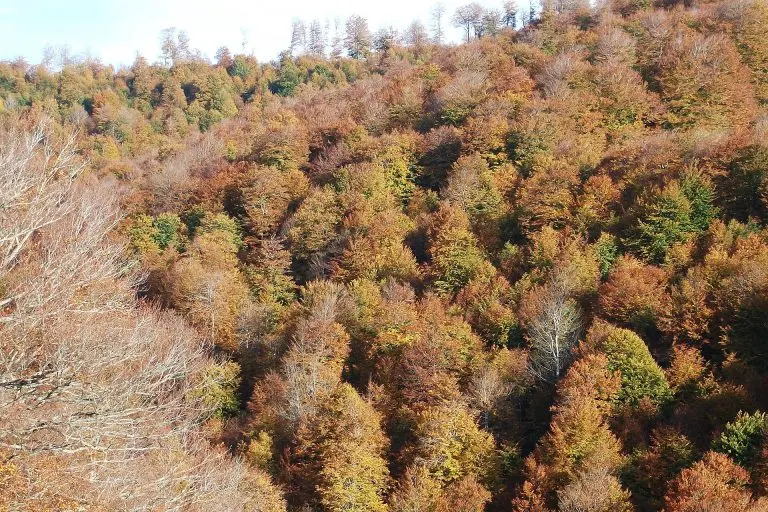
The best autumn getaways in Spain are found in the beech and chestnut forests of the northern half of the country and the southern mountain ranges, and the sweet spot runs from mid-October to mid-November. The Selva de Irati, the Hayedo de Tejera Negra, the chestnut grove of El Tiemblo and Málaga’s Bosque de Cobre are safe bets, but almost all of them come with a catch: access is regulated on autumn weekends, and some require a booking just to get in.
That’s the detail usually missing from lists of “the most beautiful forests.” You show up on a Saturday in November at eleven in the morning and find the road closed or the car park full. This guide ranks the destinations by what you really need to know before leaving home: when each forest is at its peak, what you need to book and how far in advance, and which autumn festivals have fixed dates in 2026.
The essentials
- Colour arrives first in the Pyrenees and the Cantabrian Mountains (late October) and later in the south: Málaga’s Bosque de Cobre holds out well into November.
- The Hayedo de Montejo can only be visited with a free guided pass; Tejera Negra requires booking a parking space online on autumn weekends and public holidays.
- The chestnut grove of El Tiemblo requires advance entry from Friday to Sunday and on public holidays, from 12 October to 25 December. From Monday to Thursday you can enter without one.
- Muniellos admits 20 people per day and applications open every 15 December: to go in autumn you have to apply almost a year ahead.
- Two festivals with fixed dates this month: the Feria del Jamón de Aracena (16 to 25 October) and the Rosa del Azafrán de Consuegra (23 to 25 October).
Autumn getaways at a glance: where to go and what to book
This table summarises the destinations in the guide. The column that will save you grief is the last one.
| Bosque | Provincia | ¿Hay que reservar? |
|---|---|---|
| Selva de Irati | Navarra | No, pero el acceso en coche se corta cuando se llenan los aparcamientos |
| Hayedo de Montejo | Madrid | Sí, siempre. Pase guiado gratuito con cupo |
| Hayedo de Tejera Negra | Guadalajara | Sí, la plaza de aparcamiento, en fines de semana y festivos de otoño |
| Fageda d’en Jordà | Girona | No |
| Valle de Ordesa | Huesca | No, pero en fechas de mucha afluencia se sube en autobús desde Torla |
| Castañar de El Tiemblo | Ávila | Sí, entrada anticipada de viernes a domingo y festivos |
| Bosque de Cobre (Valle del Genal) | Málaga | No |
| Bosque de Muniellos | Asturias | Sí, autorización para 20 personas al día |
When to go: the autumn calendar, week by week
Autumn doesn’t reach all of Spain at once. The colour change begins in late September at high elevations in the north and works its way down in altitude and latitude until November. As a rule, beech forests are at their best in late October and the chestnut groves of the south a few weeks later. Each year it shifts by a few days depending on rainfall and when the cold arrives, so it’s worth checking recent photos of the spot before setting out.
Second half of October
This is the starting gun. The beeches of the Navarrese and Aragonese Pyrenees begin to turn yellow and there are still plenty of daylight hours. Two festivals with fixed dates coincide: the Feria del Jamón de Aracena, from 16 to 25 October, and the Fiesta de la Rosa del Azafrán in Consuegra, from 23 to 25.
Late October and early November
The most sought-after moment, and also the busiest. The beech forests of the north and the Sistema Central are at their peak and the All Saints’ weekend draws crowds to the same spots. If those are the only days you can go, book whatever can be booked well in advance and get an early start.
November
A good month for anyone avoiding the queues. The chestnut groves take over: Málaga’s Bosque de Cobre and the valleys of northern Cáceres still have colour when the mountain beech forests have already lost their leaves. On the 11th, St Martin’s Day, Ourense celebrates the Magosto.
Until early December
The long programmes in Extremadura — the Otoño Mágico del Valle del Ambroz and the Otoñada del Valle del Jerte — usually stretch until the December long weekend.
The beech forests: five woods and how to get into each one
Selva de Irati (Navarre)
It is one of the largest and best-preserved beech-fir forests in Europe: more than 17,000 hectares in the Navarrese Pyrenees, with three nature reserves inside (Mendilatz, Tristuibartea and Lizardoia, the latter fully protected). In autumn the yellow and orange of the beeches blend with the green of the firs, which do not lose their needles.
It has two entrances. From the Salazar valley you climb from Ochagavía to Casas de Irati along the NA-2012; from the Aezkoa valley, from Orbaizeta to the Irabia reservoir dam along the NA-2030. On autumn weekends and public holidays the access points are regulated: when the car parks fill up, cars are stopped and access reopens as spaces become available. The car parks are paid. The solution is simple: go on a weekday or arrive first thing.
The natural base for sleeping is the valley itself, and the reference city is Pamplona. If you want to extend the trip, there is a four-day itinerary through Navarre.
Hayedo de Montejo (Madrid)
One of the southernmost beech forests in Europe, in the Sierra del Rincón, and a UNESCO World Heritage Site. You cannot enter on your own: there are only guided group visits with environmental educators. They are free, but you need to book in advance and bring your ID or passport.
In autumn the places sell out in minutes and you cannot book more than three months ahead. The booking is validated at the Information Centre of the Biosphere Reserve, in Montejo de la Sierra, half an hour before the slot. There is a lesser-known route: some of the passes are reserved for those staying in the villages of the Sierra del Rincón. If you cannot get a place online, sleeping in the area is your best bet. All the information is on the official Madrid tourism page.
Hayedo de Tejera Negra (Guadalajara)
On the other side of the Sierra de Ayllón, in Cantalojas, is the sibling of the Montejo one, also a World Heritage Site. Here you can walk on your own, along signposted trails such as the Senda de Carretas. What you book is the parking space: on autumn weekends and public holidays it is essential to get one in advance on the nature park’s website. The car park is paid, a few euros per car.
If you are left without a space, there is an alternative: you can enter on foot or by bicycle from the Interpretation Centre without a booking, in exchange for a considerably longer walk.
Fageda d’en Jordà (Girona)
A beech forest growing on volcanic terrain, next to Olot, in La Garrotxa. It is the forest painted by the artists of the Olot School, and one of the few beech forests on this list where you do not need to book anything. It combines well with a visit to Girona or with a few days in inland Catalonia.
Valle de Ordesa (Huesca)
In the Ordesa y Monte Perdido National Park the beech forest climbs the slopes of the valley as you walk beside the river towards the Cola de Caballo. In low season you can drive as far as the Pradera de Ordesa. On the busiest dates access is closed to private vehicles and you go up by shuttle bus from Torla. The bus timetable changes every year, so check it before you go: the Torla-Ordesa Town Council publishes it.
To organise the trip, the Huesca guide and the seven-day itinerary through the Pyrenees will come in handy.
The chestnut groves: autumn in the south and west
Castañar de El Tiemblo (Ávila)
A chestnut grove with centuries-old specimens, among them «El Abuelo», a chestnut tree over 500 years old. The classic route is the Sendero de El Castañar, a 4.4-kilometre circular trail that starts from the El Regajo recreation area and is easy to do with children.
The town council regulates access from 12 October to 25 December. On Fridays, Saturdays, Sundays and public holidays you need to buy a ticket in advance; from Monday to Thursday on non-holidays you can enter without one. The fee applies to vehicles. Entering on foot or by bicycle is free. It is close to Ávila and at a comfortable distance for a day trip from Madrid.
Bosque de Cobre, in the Valle del Genal (Málaga)
Andalusia has autumn too. In the Serranía de Ronda, the chestnut groves of the Valle del Genal cover the slopes and turn copper-coloured between late October and early November, with the white villages hanging in the middle: Pujerra, Igualeja, Júzcar, Parauta, Faraján, Genalguacil, Jubrique.
The best viewpoints are between Júzcar and Pujerra, and on the MA-7306 road that links Parauta with Cartajima. Another well-known route starts from Igualeja, where the river Genal rises. Pujerra celebrates its chestnut festival in November. There is nothing to book and the logical base is Ronda.
Sierra de Aracena (Huelva)
Chestnut trees, cork oaks and dehesa. Autumn here is also the time of the montanera, when the Iberian pig feeds on acorns in the countryside. The date for your calendar is the Feria Regional del Jamón y del Cerdo Ibérico de Aracena (Regional Ham and Iberian Pig Fair of Aracena), which in 2026 takes place from 16 to 25 October: two weekends of tastings, a ham-carving competition and cooking demonstrations. From the capital you have the guide to Huelva.
Valle del Ambroz and Valle del Jerte (Cáceres)
Two neighbouring valleys in northern Extremadura that have turned autumn into a programme. The Otoño Mágico del Valle del Ambroz (Magic Autumn of the Valle del Ambroz), with Hervás as its reference town, is a Festival of International Tourist Interest and spreads hiking routes, guided visits, concerts, theatre and markets over several weeks. The Otoñada del Valle del Jerte (Autumn in the Valle del Jerte) does the same in the valley that in spring fills with cherry blossom, with nature and food activities and chestnut gathering as the excuse.
Both programmes run, roughly, from late October to early December. The exact 2026 dates are worth checking on each valley’s tourism website before booking. The gateway is Plasencia, and it fits into a five-day itinerary through Extremadura.
Muniellos, the forest you have to request a year in advance
The Reserva Natural Integral de Muniellos, in south-western Asturias, is the largest oak forest in Spain. Only 20 people a day are allowed in, with a named permit from the Principality. The application is free and is made online.
The window opens every 15 December for the whole of the following year, and autumn days are the first to go. After that you have to confirm the visit between 15 and 23 days before the date, and on the day of entry the warden will ask for your printed authorisation and your ID. The steps are in the official Tourism of Asturias guide.
The practical reading: for this autumn all that is left is to try your luck with a cancellation. If you fancy it for 2027, set an alarm for 15 December. In the meantime, Oviedo and the five-day itinerary through Asturias give you plenty of autumn without a permit.
Autumn festivals with dates in 2026
| Fiesta | Dónde | Cuándo |
|---|---|---|
| Feria Regional del Jamón y del Cerdo Ibérico | Aracena (Huelva) | Del 16 al 25 de octubre de 2026 |
| Fiesta de la Rosa del Azafrán | Consuegra (Toledo) | Del 23 al 25 de octubre de 2026 |
| Magosto de San Martiño | Ourense | 11 de noviembre |
| Otoño Mágico | Valle del Ambroz (Cáceres) | De finales de octubre a principios de diciembre; fechas de 2026 por confirmar |
| Otoñada | Valle del Jerte (Cáceres) | De mediados de octubre a principios de diciembre; fechas de 2026 por confirmar |
La Rosa del Azafrán, in Consuegra
Consuegra has held the festival since 1963, on the last full weekend of October, when the saffron of La Mancha is harvested. The 2026 edition is the 64th. The setting is the Cerro Calderico, the hill with the windmills and the castle, and the programme mixes demonstrations of saffron stripping and toasting, gastronomic competitions, a national folklore festival and an artisan market. Entry is free. Details are in the Turespaña calendar, and it combines effortlessly with a visit to Toledo.
El Magosto, in Ourense
11 November is San Martiño, the city’s patron saint’s day and a local holiday. That day Ourense lights bonfires to roast chestnuts and taste the new wine, with celebrations spread across the neighbourhoods. Throughout November there are popular magostos in the villages of the province.
How to plan your autumn getaway
Choose the day before the forest. A Tuesday in November in Irati and a Saturday on a long weekend in Irati are two different trips. If you have flexibility, go midweek: in El Tiemblo you don’t even need a ticket.
Book in this order. First whatever has a quota (the Montejo pass, the Tejera Negra car park, the El Tiemblo ticket). Then accommodation, which fills up quickly in small villages on autumn weekends. The car, last.
Factor in the hours of daylight. The clocks change on the last weekend of October and it gets dark earlier. Plan short routes, set off early and leave margin to get back to the car in daylight.
Keep a plan B handy. If the road is closed or the car park is full, there’s almost always another forest nearby: Tejera Negra and Montejo are in the same mountain range, and the Ambroz and the Jerte are neighbouring valleys.
Respect what you’re going to see. The chestnuts in a privately owned chestnut grove don’t belong to whoever passes by, and mushroom picking is regulated in many woodlands. Ask beforehand at the tourist office or the town hall.
If your idea of autumn is to stretch out summer, that getaway exists and it’s in the south: take a look at the ten days in the Canary Islands.
Frequently asked questions
What is the best time to see the beech forests in autumn in Spain?
As a general rule, from late October to early November. Mountain beech forests in the Pyrenees and the Cantabrian Mountains peak earlier; the chestnut groves of the south, such as the Bosque de Cobre (Copper Forest) in Málaga, arrive later and last through November. The exact date changes every year with the rain and the cold.
Do you have to book to visit the Hayedo de Montejo?
Yes, always. Entry is only allowed with a guided tour, which is free but has a limited number of places. In autumn spots sell out very quickly and you cannot book more than three months in advance. A portion of the passes is reserved for those staying in the villages of the Sierra del Rincón.
Can you enter the Selva de Irati without a reservation?
Yes. There is no cap on the number of people, but at weekends and on autumn public holidays car access is cut off when the car parks fill up — they are paid — and reopened as spaces become available. Arriving early or going on a weekday avoids the problem.
What autumn forests are there near Madrid?
The Hayedo de Montejo, in the Sierra del Rincón (Madrid); the Hayedo de Tejera Negra, in Cantalojas (Guadalajara); and the chestnut grove of El Tiemblo (Ávila). All three regulate access in autumn: a guided pass in Montejo, a parking space in Tejera Negra and advance entry from Friday to Sunday in El Tiemblo.
Where can you see autumn in Andalusia?
In the Valle del Genal, in the Serranía de Ronda (Málaga), where the chestnut groves form the so-called Bosque de Cobre between late October and November, and in the Sierra de Aracena (Huelva), which also holds its Feria del Jamón (Ham Fair) from 16 to 25 October 2026.
How do you get a permit to visit Muniellos?
With a free online application to the Principality of Asturias. Only 20 people a day are authorised. The application period opens every 15 December for the following year and you must confirm the visit between 15 and 23 days before the date.
In summary
Autumn is probably the best season to explore inland Spain: fewer people than in summer, temperatures made for walking and forests that look like this for only a few weeks. The difference between a great getaway and a traffic jam at the entrance to a car park comes down to three decisions: going in the right week, booking whatever has a cap on numbers and, if you can, avoiding Saturday.
Choose your forest, check the access conditions on its official website the day before and build the rest of your trip with our city guides and our regional itineraries.
Dates and access rules checked on 13 October 2026 on the official and tourism websites linked in the text. Conditions can change: confirm them before you travel.