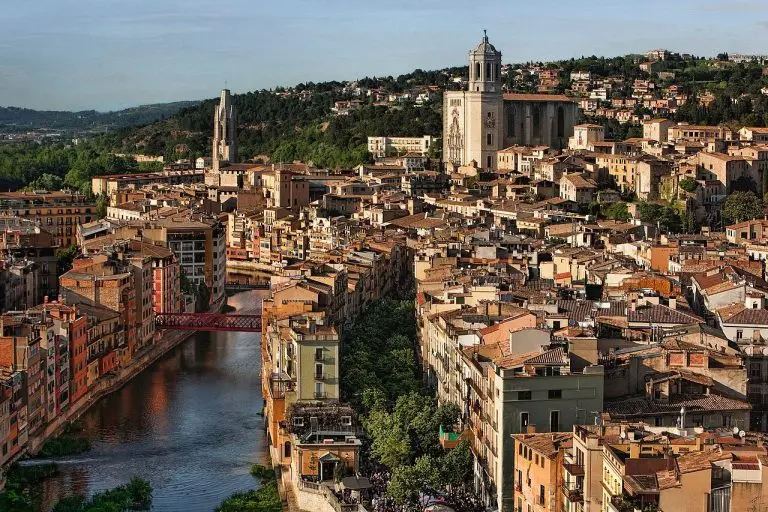
Figueres → Girona
38 kmHow to get from Figueres to Girona: quick summary
The fastest option is the high-speed train, which covers the journey in just 14 minutes according to Renfe, while driving takes about 30 minutes along the AP-7 motorway. The direct Barcelona Bus service is the most leisurely alternative, with a 50-minute journey. For most travellers, the train is unbeatable for frequency (93 trains a day) and speed; the car is worth it if you plan to explore the coves or villages of the Empordà before reaching Girona.
Driving from Figueres to Girona
The road route is 38 km, covered in about 30 minutes without stops, combining the AP-7 motorway and a final stretch along the N-IIa. It is a comfortable, toll-free route that drops you in the centre of Girona with room to detour if you fancy it.
Most of the journey runs along the AP-7 (Autopista de la Mediterrània), roughly 31 km. It is a wide, well-signposted road that crosses the gentle landscape of the Alt Empordà and the Gironès, with the Montgrí massif rising to the east on clear days. There is no toll on this stretch, which makes it the most direct option.
The last 6 km are along the N-IIa, on the Avinguda de Salvador Dalí i Domènech section, which eases you into Girona progressively. This national road passes through peri-urban areas and industrial estates before connecting with the access roads to the centre. Pay attention to roundabouts and urban signage on this final stretch.
If you travel during weekday rush hour, allow an extra 10 to 15 minutes to enter Girona via the N-IIa, especially between 8:00 and 9:30. The rest of the day traffic flows smoothly and there are rarely significant hold-ups on the AP-7.
By train from Figueres to Girona
The direct train is the fastest and most frequent option: 93 trains a day link Figueres-Vilafant with Girona, with departures from 05:28 to 20:49 and a minimum journey time of 14 minutes on high-speed services.
Renfe’s offering on this corridor is enormous and covers every type of traveller. EUROMED (2 a day), AVE (5 a day), AVANT (16 a day) and AVE INT (3 a day) trains complete the journey in just 14 minutes. They are the ideal choice if you want speed and comfort, with numbered seats and air conditioning.
For tighter budgets, medium-distance and commuter trains are an excellent alternative: MD (21 a day) and Rodalies R11 (21 a day) take 31 minutes; REGIONAL (17 a day) takes 33 minutes; and Rodalies RG1 (8 a day) arrives in 41 minutes. The time difference compared with the AVE is minimal and the price is usually considerably lower.
The departure station is Figueres-Vilafant, located on the outskirts of Figueres and well connected to the centre by taxi or city bus. The destination station is Girona, next to the historic centre and about 15-20 minutes’ walk from the Cathedral. You don’t need to print a ticket if you have the QR code on your phone.
By bus from Figueres to Girona
The direct Barcelona Bus service covers the route in 50 minutes and is a comfortable option for those in no hurry or who prefer not to depend on a car. The exact price is not confirmed, so it is worth checking the company’s website before travelling.
The main advantage of the bus is that it usually has more central stops than Figueres-Vilafant train station, which can save you onward transfers. Frequency is lower than the train, so check timetables in advance, especially at weekends and on public holidays.
For last-minute trips or if you are travelling with bulky luggage, the bus can be more practical than the commuter train, as the hold allows large suitcases without cabin space restrictions.
Where to stay in Girona
The best area to stay is the Barri Vell (old town), next to the Cathedral, the city walls and the Jewish quarter, with options ranging from simple hostels and guesthouses to boutique hotels in restored palaces. It is the most atmospheric choice, although driving access can be tricky due to the narrow streets and restricted traffic zones.
The Eixample and the area around the train station are practical alternatives: well connected, with easier parking and somewhat more moderate prices. Here you’ll find mid-range chain hotels, tourist apartments and functional hostels.
As for prices, a double room in a hostel or guesthouse can cost around €50-80 per night; a mid-range hotel, between €80 and €130; and a boutique hotel in the Barri Vell, from €120-160. In high season (May to September) and during the Temps de Flors festival, prices rise and it’s worth booking weeks in advance.
Where to eat along the route
The cuisine of this stretch is one of the great rewards of the trip: from the Empordà to Girona, a succession of garden, sea and mountain produce that deserves a leisurely stop.
In Figueres and around, escalivada is the quintessential vegetable dish: aubergine, red pepper, onion and tomato roasted over embers or on the grill, dressed with olive oil and salt, sometimes topped with anchovies. It’s a fresh, smoky starter that sums up the character of Empordà cooking.
Pà amb tomàquet is the omnipresent accompaniment throughout Catalonia: toasted or untoasted country bread, rubbed with ripe tomato and dressed with oil and salt. You’ll see it on every table, from roadside bars to white-tablecloth restaurants.
Botifarra amb mongetes is the quintessential tavern dish: grilled pork sausage served with white beans sautéed with garlic and parsley. It’s hearty, flavoursome and perfect for refuelling before or after visiting the Dalí Museum or Girona Cathedral.
Once on the Costa Brava and in Girona, suquet de peix is the seafood stew you shouldn’t miss: rockfish or market fish cooked with potatoes, a tomato sofrito, garlic, onion and sometimes ñora pepper or an almond picada. It’s a spoon dish with the taste of the sea that shines in the restaurants of the Girona coast.
Arròs a la cassola is the traditional dry rice of Girona and its counties: cooked in a clay pot with sofrito, fish or meat stock, and seafood, chicken or botifarra. It’s the Girona version of creamy rice, with that socarrat touch that makes it unmistakable.
To drink, the wines of the DO Empordà —reds, whites and rosés made from Garnacha, Cariñena and Macabeo— are the natural pairing for all this food. In Figueres and around you’ll find wineries and wine shops where you can try them by the glass.
Frequently asked questions about the Figueres-Girona route
How long does it take to get from Figueres to Girona?
It depends on the transport: by car it’s 38 km and about 30 minutes via the AP-7 and the N-IIa. On the high-speed train (AVE, AVANT, EUROMED or AVE INT) the journey takes 14 minutes. The MD and Rodalies R11 trains take 31 minutes, the REGIONAL 33 and the Rodalies RG1 41. By bus with Barcelona Bus, 50 minutes.
Which is cheaper, the train or the bus?
We don’t have the exact price of the Barcelona Bus, so a reliable comparison isn’t possible. By train, the Rodalies services (R11 and RG1) and the MD are usually the cheapest options, while the AVE and the AVANT cost more in exchange for their 14-minute journey. It’s advisable to compare fares on the Renfe and Barcelona Bus websites for the specific travel date.
Is it worth renting a car?
If your plan is just to go from Figueres to Girona and get around the centre of both cities, you don’t need one: the train is very fast and very frequent. A car does pay off if you want to stop in villages of the Empordà, coves of the Costa Brava or wineries of the DO Empordà, since public transport doesn’t reach rural or coastal areas with the same flexibility. The toll-free AP-7 makes the journey very comfortable.
When is the best time to travel?
Spring (April to June) and autumn (September to October) are the best seasons: mild temperatures, fewer crowds than in the height of summer and especially beautiful landscapes. In May, Girona holds the Temps de Flors festival, which fills courtyards and monuments with flowers but also pushes up accommodation prices. Summer is ideal for combining the route with the beach, although it’s hot and there are more tourists.
💡 ¿Sabías que...?
- ● La Catedral de Girona tiene una de las naves góticas más anchas del mundo, con casi 23 metros de luz, solo superada por la Basílica de San Pedro del Vaticano. (https://tocatdelbolet.cat/20-curiositats-sobre-girona-que-potser-no-sabies/)
- ● La Plaça dels Raïms es considera la plaza más pequeña de Europa, con solo unos 24 metros cuadrados. (https://tocatdelbolet.cat/20-curiositats-sobre-girona-que-potser-no-sabies/)
- ● El puente de hierro sobre el río Onyar, conocido como Pont de les Peixateries Velles, fue diseñado por la compañía de Gustave Eiffel en 1877. (https://tocatdelbolet.cat/20-curiositats-sobre-girona-que-potser-no-sabies/)
- ● La ciudad de Girona fue fundada como plaza fuerte romana (oppidum) hacia el año 77 a.C. por orden del general Pompeyo Magno. (https://tocatdelbolet.cat/20-curiositats-sobre-girona-que-potser-no-sabies/)
- ● El topónimo Gerunda tiene etimología debatida; tradicionalmente se interpreta de origen íbero con el significado de «entre el Undarius», en referencia al río Onyar. (https://tocatdelbolet.cat/20-curiositats-sobre-girona-que-potser-no-sabies/)
- ● Los Baños Árabes de Girona no son árabes, sino una construcción románica cristiana del siglo XII. (https://tocatdelbolet.cat/20-curiositats-sobre-girona-que-potser-no-sabies/)
- ● Carlemany, aunque es un personaje muy popular en Girona y se le atribuye haber liberado la ciudad de los sarracenos en el año 785, nunca pisó la ciudad. (https://www.timeout.cat/girona/ca/que-fer/curiositats-i-secrets-de-girona)
- ● El Tarlà es una figura típica de Girona que se cuelga en el carrer d'Argenteria; según la leyenda, un vecino llamado Tarlà distraía a los vecinos durante la peste haciendo volteretas. (https://web.girona.cat/culturapopular/llegendes)