Burgos → Salamanca
214 kmCrossing the heart of Castile and León along the A-62 is one of those routes to be savoured without haste: golden plains, Ribera del Duero vineyards and the constant temptation to detour to Segovia or Valladolid to stretch the trip out by a couple of hours.
How to get from Burgos to Salamanca: quick summary
The Burgos-Salamanca route can be done by car (214 km, 2h 15min via the A-62), by direct train with Renfe (Intercity, 163 minutes, 1 train per day) or by bus with ALSA (210 minutes, €13-28). The car is the most flexible and fastest option, ideal if you want to stop in Segovia or Valladolid. The bus is the cheapest alternative and has good frequency. The direct train exists but with a single daily departure at 20:21, which considerably limits its practical usefulness for most travellers.
By car from Burgos to Salamanca
The drive between Burgos and Salamanca covers 214 km and takes approximately 2h 15min without stops. The main route runs along the A-62, the Autovía de Castilla, which connects both cities with no tolls along its roughly 230 km of total length.
The A-62 is a comfortable, well-maintained motorway that crosses the Castilian plateau landscape. The layout is mostly straight with little gradient, which makes for relaxed driving and moderate fuel consumption. As it is a toll-free road, the cost of the journey is limited to fuel and possible vehicle wear.
The natural route passes close to Valladolid, making it easy to detour and visit the capital of the Pisuerga without adding barely any kilometres. It is also feasible to stop in Peñafiel, famous for its castle and its Ribera del Duero wineries, or in Tordesillas if you are after a history-filled break along the way. Signposting on the A-62 is clear and service areas are well distributed along the route.
By train from Burgos to Salamanca
There is a direct train between Burgos and Salamanca operated by Renfe, with an Intercity service that completes the journey in 163 minutes. Frequency is limited: only 1 train per day, departing at 20:21 from Burgos-Rosa Manzano station and arriving at Salamanca station.
The single departure time of 20:21 means arriving in Salamanca after 23:00, which can be inconvenient for those travelling for tourism and needing to check in at their accommodation. However, for travellers who live in Salamanca or who prefer to make the most of the day in Burgos before moving on, this option is perfectly valid. The Intercity offers comfortable seats and adequate air conditioning for a journey of almost three hours.
The departure station, Burgos-Rosa Manzano, is the main railway station in the city of Burgos and is well connected to the urban centre. In Salamanca, the station is a short distance from the historic centre, making it easy to reach the monumental area and the main accommodation districts.
By bus from Burgos to Salamanca
The direct bus between Burgos and Salamanca is operated by ALSA (also referred to as Alsa), with a duration of 210 minutes and prices ranging from €13 to €28 depending on how far in advance you book, seat type and demand.
This is the cheapest option for getting between the two cities and, unlike the train, it usually has more than one daily service, offering greater flexibility in terms of schedule. ALSA buses on long-distance routes generally include air conditioning, reclining seats and, in many cases, free wifi and on-board entertainment.
The lower price range (€13) usually corresponds to tickets bought in advance at a promotional rate, while the higher range (€28) reflects flexible fares or last-minute purchases. For travellers on a tight budget or without a driving licence, the bus offers the best value for money on this route.
Recommended stops along the way
The route between Burgos and Salamanca offers at least eight recommended stops, all accessible from the A-62 or with short detours, which allow you to turn a 2h 15min journey into a full day of discovery.
Segovia
Segovia is the most spectacular stop on the route, although it involves a significant detour from the A-62. Its Roman aqueduct, the Alcázar and the cathedral are reason enough on their own for a half-day visit. The city is a UNESCO World Heritage Site and offers one of the most impressive concentrations of monuments in Castile and León. If travelling by car, it is worth dedicating at least 3-4 hours to it before getting back on the road to Salamanca.
Valladolid
Valladolid lies practically at the halfway point of the route and is the most natural and accessible stop. The capital of Castile and León, it offers a historic centre with the Plaza Mayor, the cathedral and the National Sculpture Museum. It is ideal for a food stop or to stretch your legs strolling through its pedestrian streets. As it sits directly on the A-62, it adds no significant kilometres to the journey.
Arévalo
Arévalo is a small town in the province of Ávila located south of the A-62, known for its Mudéjar architecture and its castle. It is a brief, quiet stop, perfect for those seeking a break in the journey without tourist crowds. Its arcaded square and red-brick churches offer an authentic Castilian scene.
Benavente
Benavente, although more associated with the route to Galicia or Zamora, can be an interesting stop if you take a detour west. Its castle-palace of the Counts of Benavente and its old town are worth a brief visit. It is a less usual option on the Burgos-Salamanca route, but a valid one for those looking to explore beyond the main itinerary.
Peñafiel
Peñafiel is an essential stop for wine lovers. Its elongated castle on a hill dominates the Duero valley and houses the Provincial Wine Museum. The town is one of the nerve centres of the Ribera del Duero DO, with numerous wineries open to visitors in the surrounding area. The detour from the A-62 is short and the vineyard landscape alone justifies the stop.
Arroyo de la Encomienda
Arroyo de la Encomienda is a municipality in the metropolitan area of Valladolid, located next to the A-62. It is not a tourist destination in itself, but it can serve as a rest area, refuelling point or budget overnight stop on the outskirts of the Valladolid capital. It has shopping centres and service areas that are practical for the traveller passing through.
La Cistérniga
La Cistérniga is another municipality in the surroundings of Valladolid, located east of the city and very close to the A-62. Like Arroyo de la Encomienda, it functions as a services and rest area rather than a tourist destination. It is useful for refuelling, grabbing a quick bite or avoiding traffic in central Valladolid if you are only looking for a brief pause.
Tudela de Duero
Tudela de Duero is a town in the province of Valladolid located south of the capital, on the banks of the Duero. It is known for its wine-making tradition and its natural setting beside the river. For the traveller who does not want to deviate too far, it offers a pleasant riverside walk and a few bars where you can try local produce before continuing on to Salamanca.
Where to stay in Salamanca
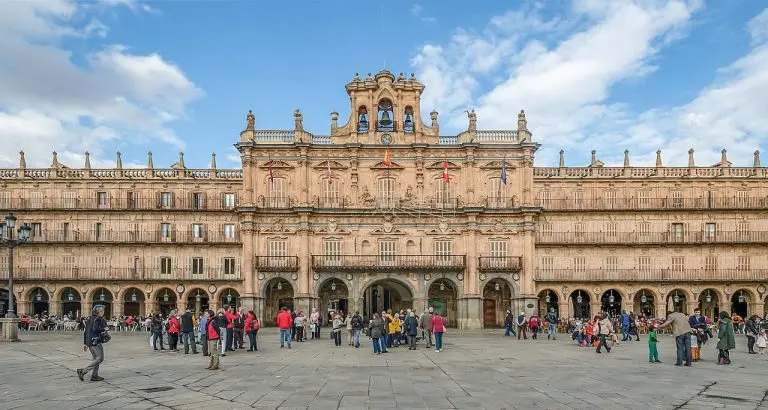
The best area to stay in Salamanca is the historic centre, where the Plaza Mayor, the University and the two cathedrals are concentrated. Prices vary depending on the season: in low season you can find double rooms from 50-60€ per night, while in high season or during university festivities prices can exceed 100-120€.
The Barrio del Oeste, on the other side of the Tormes river, offers cheaper accommodation and an alternative atmosphere with bars and terraces frequented by students. It is a good option for long stays or tight budgets, although it means crossing the Roman bridge to reach the monumental centre.
The areas near the train and bus stations have functional hotels and guesthouses at moderate prices, ideal for those arriving late in the day or having to leave early. Overall, Salamanca is a compact city and easy to get around on foot, so any accommodation within a 2 km radius of the centre is practical.
Where to eat along the route
The gastronomy of this route is one of its great attractions, with hearty dishes and products with denomination of origin that can be enjoyed both in Burgos and at the intermediate stops and in Salamanca.
Roast suckling lamb
Roast suckling lamb is the star dish of the province of Burgos. It is made with suckling lamb roasted in the oven with lard and salt, with no other additives, and is traditionally served with salad and potatoes. The meat is tender and juicy, with crispy skin that is the delight of diners. It is a dish to share and enjoy without haste.
Morcilla de Burgos
Morcilla de Burgos is a sausage made with pork blood, rice and onion, seasoned with spices and stuffed into natural casing. It is eaten both fried and boiled, and is a must at any tapas session in Burgos. Its creamy texture and spiced flavour distinguish it from other Spanish morcillas.
Queso de Burgos
Queso de Burgos is a fresh sheep’s milk cheese, with a soft paste and mild flavour, typical of the province. It is eaten both fresh and cured, and is commonly served with honey, walnuts or quince paste as a dessert or snack. Its lightness contrasts with the heartiness of other dishes in the area.
Ribera del Duero wine
The Ribera del Duero DO covers parts of Burgos, Valladolid, Soria and Segovia, and is one of the most prestigious denominations in Spain. Its red wines are made mainly with Tempranillo grapes (Tinta del País) and are usually aged in barrel, which gives them structure, body and notes of ripe fruit and spices. Peñafiel is an excellent place to taste them at source.
Roast suckling pig
Roast suckling pig is the most emblematic dish of the province of Segovia. It is a suckling pig roasted in the oven with lard and salt, with crispy skin and extremely tender meat. It is traditionally cut with a plate to demonstrate its texture. It is a mandatory culinary stop if you visit Segovia.
Judiones de La Granja
Judiones de La Granja is a hearty stew made with large white beans, chorizo, morcilla and bacon, cooked slowly. It is typical of La Granja de San Ildefonso, in the province of Segovia, and represents Castilian spoon cooking at its finest.
Rueda wine
The Rueda DO, which covers areas of Valladolid, Segovia and Ávila, produces white wines made mainly with Verdejo grapes. They are fresh, aromatic wines with good acidity, ideal for accompanying fish, seafood or simply for refreshing the palate between hearty dishes.
Toro wine
The Toro DO extends through Zamora and part of Valladolid, and produces powerful red wines from Tinta de Toro grapes, a Tempranillo variety adapted to the extreme climate of the area. They are wines with body, high alcohol content and great ageing potential.
Tierra del Vino de Zamora wine
The Tierra del Vino region, in the south of Zamora, produces red and white wines made with native grapes. It is a lesser-known denomination but with a deep winemaking tradition, well worth exploring for those who deviate towards the west of the route.
Hornazo
Hornazo is a bread-dough pie filled with pork, ham and hard-boiled egg, typical of the province of Salamanca. It is eaten as a main course or as a tapa, and is especially popular in the celebrations of Lunes de Aguas. It is the perfect bite to recharge your batteries on arriving in Salamanca.
Arribes wine
The Arribes del Duero DO, which covers municipalities in Salamanca and Zamora, produces red and white wines made with native grapes such as Juan García and Rufete. They are singular wines, the fruit of an extreme terroir alongside the canyons of the Duero, and an excellent way to round off the culinary experience of the route.
Frequently asked questions about the Burgos-Salamanca route
How long does it take from Burgos to Salamanca?
By car, the 214 km journey along the A-62 takes approximately 2h 15min. On a direct Renfe train, the Intercity takes 163 minutes (2h 43min). By bus with ALSA, the duration is 210 minutes (3h 30min). The car is the fastest option, followed by the train and then the bus.
Which is cheaper, the train or the bus?
The ALSA bus is cheaper, with prices between 13 and 28€ per journey. The Renfe Intercity train tends to be more expensive, especially if booked at short notice. For tight budgets, the bus is clearly the best value option.
Is it worth renting a car?
Yes, renting a car is worth it if you want to make the most of the recommended stops along the route such as Segovia, Valladolid or Peñafiel. Direct public transport (train and bus) doesn’t allow you to hop on and off at intermediate points, whereas the car offers total freedom to explore. What’s more, the drive along the A-62 is quick and toll-free, which means the extra cost of the rental is offset by the flexibility you gain.
When is the best time to travel?
The best time to do this route is spring (April-June) and autumn (September-October), when temperatures are mild and the Castilian landscape is at its best. Summer can be very hot on the plateau, with temperatures exceeding 35°C, while winter offers a stark landscape but with the risk of fog and frost on the A-62. If travelling by train, bear in mind that there is only one daily departure at 20:21, regardless of the season.
💡 ¿Sabías que...?
- ● La calle Tentenecio debe su nombre a la leyenda de San Juan de Sahagún, quien detuvo a un toro embravecido gritando «¡Tente, necio!». (https://diarium.usal.es/blanca_sa/salamanca/curiosidades-de-salamanca/)
- ● La rana esculpida en la fachada de la Universidad de Salamanca tiene la fama de que el estudiante que no la ve suspende el curso. (https://diarium.usal.es/blanca_sa/salamanca/curiosidades-de-salamanca/)
- ● Cada víspera de Todos los Santos, el Mariquelo sube al campanario de la catedral nueva para conmemorar que el terremoto de Lisboa de 1755 apenas afectó a su estructura. (https://diarium.usal.es/blanca_sa/salamanca/curiosidades-de-salamanca/)
- ● La Plaza Mayor de Salamanca tiene 15.477 balcones. (https://supercurioso.com/curiosidades-de-salamanca/)
- ● La Universidad de Salamanca fue la primera de Europa que ostentó el título de Universidad por real cédula de Alfonso X el Sabio en 1252. (https://www.patrimoniocastillayleon.com/es/salamanca)
📍 También te puede interesar
Qué ver en Burgos →
Qué ver en Salamanca →