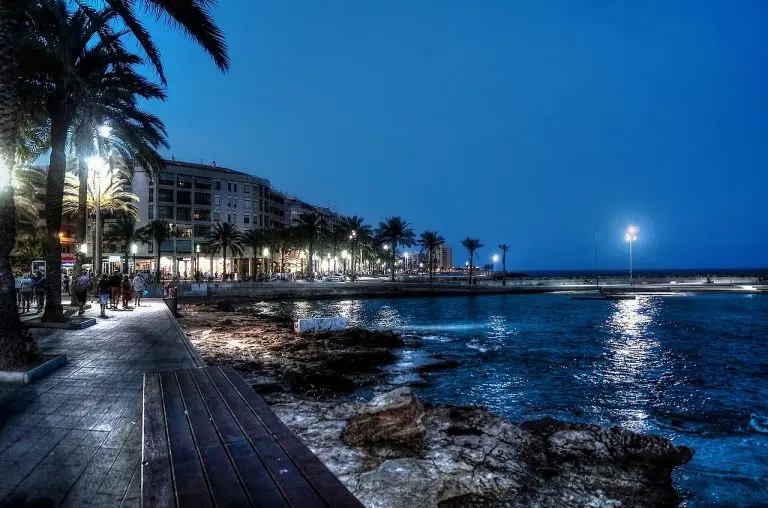
Alicante → Torrevieja
43 kmThere is something deeply Mediterranean about covering the mere 43 km that separate Alicante from Torrevieja: the sea lies on one side, the salt flats trace pink mirrors on the other, and in just over half an hour you go from the bustle of a provincial capital to the unhurried pace of a city turned toward its beaches and its port. It is a short, luminous journey with a culinary stop or two that justifies the trip on its own.
How to get from Alicante to Torrevieja: quick summary
The fastest and most flexible way to travel from Alicante to Torrevieja is by car, with a 43 km route taking around 35 minutes via dual carriageway and motorway. If you don’t have your own vehicle or prefer not to drive, the direct Autocars Costa Azul bus covers the route comfortably and is the only direct public transport option, as there is no train or plane between the two cities. For travellers with light luggage and no rush, the bus is perfect; for those who want to explore the coves and salt flats of the area freely, the car is the best choice.
By car from Alicante to Torrevieja
Driving from Alicante to Torrevieja is a 43 km spin completed in around 35 minutes along fast, well-signposted roads, with two main options depending on whether you prefer the free dual carriageway or the toll motorway. The most direct route combines the A-70, which covers about 28 km toll-free, with the CV-905, which links Benijófar to Torrevieja over the final 10 km or so. If you opt for the AP-7, the Autopista del Mediterráneo (Mediterranean Motorway), you’ll cover about 22 km of the journey with greater ease of flow, though you should factor in the toll cost.
The natural exit from Alicante is to take the A-70 towards Murcia, a wide and generally clear dual carriageway that skirts the metropolitan area and crosses a landscape of market gardens and industrial estates that soon gives way to the first hills of the Baix Vinalopó. After about 28 km on this road, the turn-off onto the CV-905 brings you into the Vega Baja district, a comfortable road that passes through Benijófar and leaves you at the gates of Torrevieja in about 10 km. The final stretch runs between housing developments, palm trees and the characteristic salty smell of the nearby lagoons.
If you choose the AP-7, the Autopista del Mediterráneo, you’ll gain speed and avoid some traffic lights and roundabouts on the final stretch, but don’t forget it is a toll road. In any case, with such a short distance between origin and destination, the real time difference between the two options is minimal. The best bet is to use the A-70 and CV-905 if you’re travelling at a leisurely pace and want to save money, or the AP-7 if you value flow and don’t mind paying for it.
By bus from Alicante to Torrevieja
There is a direct bus from Alicante to Torrevieja operated by Autocars Costa Azul, a comfortable and affordable option that saves you having to look for parking in Torrevieja, especially in high season. The exact journey time and ticket price are not confirmed in the available data, so it is worth checking updated schedules on the company’s website or at Alicante bus station before travelling.
Buses usually depart from Alicante’s central station and make the journey without transfers, which makes this the only direct public transport alternative between the two cities. For those arriving in Alicante by AVE or long-distance train, the bus is a practical connection to Torrevieja and its beaches. Buying your ticket in advance is recommended at weekends and during the summer months, when demand rises noticeably.
Where to stay in Torrevieja
Torrevieja offers accommodation for every budget, from seafront tourist apartments to city hotels and functional guesthouses, with prices that vary greatly depending on the season and proximity to the beach. The most recommended areas to stay are the centre and the promenade, ideal for getting around on foot and enjoying the atmosphere; the Playa del Cura and Los Locos area, perfect for those seeking sea and beach bars; and the residential developments of La Mata, quieter and more family-oriented.
In high season prices rise considerably and it is essential to book weeks in advance, especially if you are looking for an apartment with views of the Mediterranean. In winter, Torrevieja maintains a wide range of open establishments thanks to its mild climate and large resident population, so it is possible to find good deals on hotels and apartments. For short stays, a guesthouse or aparthotel in the centre is a comfortable and well-connected option; for long holidays, an apartment in La Mata or near the salt flats offers more space and tranquillity.
Where to eat en route
The journey between Alicante and Torrevieja crosses one of the most important rice-growing larders of the Mediterranean, so a gastronomic stop is almost obligatory if you are travelling with time to spare. Arroz con costra, typical of Elche and the Baix Vinalopó, is a baked rice dish made with chicken and rabbit stock, sausages and a layer of beaten egg that forms a golden, hearty crust. It is a festive dish, one for spoon and oven, that deserves a leisurely stop.
In Alicante city, before setting off, you can try arroz a banda, cooked in rockfish stock and traditionally served separately from the fish, with saffron and ñora pepper as the flavour base. Its more convenient variant is arroz del senyoret, which comes with the seafood already peeled —prawns, squid— so you can eat it without getting your hands dirty. Both are seafaring dishes that sum up the cuisine of the Alicante coastline.
Once in the market gardens of the Baix Vinalopó and the Vega Baja, caldero de arroz con conejo y caracoles is another local gem: a soupy rice cooked in an iron pot with rabbit, snails, tomato and paprika. This is inland cooking, rooted in farming tradition, and contrasts with the seafood rices of the coast. For a snack or light bite en route, the coca de tomate y atún is a light and tasty option: bread dough with grated tomato, tuna and olive oil, baked until crisp.
To drink, the province has the Alicante Denominación de Origen, with Monastrell reds and Moscatel whites spanning several districts, as well as the wines of the Marina, made in the Marina Alta from grapes such as Moscatel and Giró. A fresh Moscatel white pairs wonderfully with seafood rices, while a Monastrell red goes well with baked dishes and game.
Frequently asked questions about the Alicante-Torrevieja route
How long does it take to get from Alicante to Torrevieja?
By car, the 43 km journey takes about 35 minutes via the A-70 and the CV-905, or via the AP-7. On a direct bus, the exact duration is not confirmed in the available data, but as it is a direct road route, travel time is usually somewhat longer than by private car due to stops and traffic. There is no direct train or flight between the two cities.
Which is cheaper, the train or the bus?
The bus is the only direct public transport option between Alicante and Torrevieja, since there is no direct train and no train station in Torrevieja. Therefore, it cannot be compared with the train on this route. The Autocars Costa Azul bus is the cheapest and most practical alternative for those not travelling by car, although the exact ticket price is not confirmed in the available data.
Is it worth renting a car?
Yes, especially if you want to make food stops in Elche or in the Vega Baja, visit the salt flats of Torrevieja or move freely around the coves and beaches of the area. A car lets you cover the 43 km in about 35 minutes and not depend on bus schedules. If you are only going to stay in the centre of Torrevieja and do not plan to go out, the direct bus may be enough.
When is the best time to travel?
The best time to travel from Alicante to Torrevieja is spring and autumn, when the weather is mild, there are fewer crowds and accommodation prices are lower than in summer. In July and August, traffic on the A-70 and the AP-7 increases considerably and finding parking in Torrevieja can be difficult. Winter is also a good option thanks to the mild temperatures of the Alicante coast.
💡 ¿Sabías que...?
- ● El nombre de Torrevieja proviene de una torre de vigilancia llamada 'torre-vieja', situada cerca de la cala Cornuda, que junto a la Torre de La Mata defendía la costa. (https://es.wikipedia.org/wiki/Torrevieja_(Alicante))
- ● La laguna de Torrevieja debe su color rosa a microorganismos como las halobacterias y el alga Dunaliella salina, y alberga el crustáceo Artemia salina. (https://www.linkalicante.com/laguna-rosa-torrevieja/)
- ● Un terremoto brutal azotó Torrevieja en 1829 y provocó la reconstrucción completa de la localidad bajo la dirección del arquitecto militar Larramendi. (https://torrevieja.com/en/history-of-torrevieja/)
- ● La escritora, dramaturga y poetisa Adela Galiana Albaladejo nació en Torrevieja el 10 de julio de 1825. (https://es.wikipedia.org/wiki/Adela_Galiana)
- ● El documento más antiguo que menciona las salinas de Torrevieja es un privilegio de Alfonso X fechado el 11 de enero de 1273. (https://www.visitasalinasdetorrevieja.com/en/the-salt-flats/)
- ● En 1884 se inauguró el ferrocarril ramal Albatera-Torrevieja, que contribuyó al desarrollo económico local y comarcal. (https://torrevieja.es/es/ciudad/quienes-somos/evolucion-historica)
📍 También te puede interesar
Qué ver en Alicante →
Qué ver en Torrevieja →