Lorca → Murcia
63 kmCrossing the Guadalentín valley under the Mediterranean sun is an experience that turns a simple journey into a small voyage through the light and the most fertile agricultural landscape on the peninsula. Although the distance is short, the trip from Lorca to Murcia offers a fast and efficient connection that lets you go from the monumentality of the city of the Sun to the regional capital in less time than it takes a coffee to cool down, enjoying modern roads that wind between orchards and mountains with hardly any effort.
How to get from Lorca to Murcia: quick overview
The fastest and most flexible option for traveling from Lorca to Murcia is undoubtedly a private car, covering the 63 kilometers in just 45 minutes, although the train offers a relaxed alternative for those who prefer not to drive.
For the traveler who values freedom of movement and wants to explore the surrounding areas or carry bulky luggage, a private vehicle is the main recommendation, especially because the highways connecting both cities are free and high-capacity. However, if your profile is that of a tourist planning to enjoy the local gastronomy in Murcia city without worrying about parking, or if you are traveling alone and prefer to read or work during the journey, Renfe’s train service is a viable option, albeit with limited frequency that requires advance planning. There is no direct bus option with verified data in this guide, so the choice essentially comes down to the dichotomy between the autonomy of the wheel and the comfort of the railway. For families or groups of friends, the car is usually more economical when splitting fuel costs, while for solo travelers or couples looking to avoid the stress of rush-hour traffic, the Intercity can be a haven of tranquility.
By car from Lorca to Murcia
The drive from Lorca to Murcia is done entirely on toll-free highways, specifically the A-7 and the A-30, covering a total distance of 63 kilometers in an estimated time of 45 minutes.
The route begins by taking the A-7, known as the Autovía del Mediterráneo (Mediterranean Highway). This road is fundamental to the connection of Spain’s eastern coast and, on this particular stretch, it is in excellent condition in terms of asphalt and signage. Having no tolls, the trip is very economical in terms of road infrastructure, allowing the driver to maintain a constant and safe speed without the usual interruptions of toll booths. The landscape that accompanies the A-7 is characteristic of the Murcian huerta (irrigated orchard land), with expanses of crops that change with the season, offering a green and vibrant backdrop that contrasts with the gray of the asphalt.
Subsequently, the route connects with the A-30, the Autovía de Murcia (Murcia Highway). This final stretch is crucial for entering the capital. Like its predecessor, the A-30 has no tolls, which facilitates notable traffic flow even during peak hours. It is important to pay attention to lane changes and exits, as approaching the city of Murcia can slightly increase traffic density. The combination of these two highways ensures that the 45 minutes of travel are, in the vast majority of cases, a real time and not an optimistic estimate, as long as no specific incidents occur. For the driver, this means it is a predictable route: you know exactly how long it will take and how much you will spend on fuel, which greatly facilitates travel logistics, whether for work, an appointment, or enjoying a weekend.
By train from Lorca to Murcia
There is a direct rail connection operated by Renfe, using Intercity trains that cover the route between Lorca Sutullena station and Murcia station in times ranging from 58 to 77 minutes.
According to Renfe data, the frequency of this service is two daily trains, which means planning is a critical factor for travelers choosing this option. The first train of the day leaves at 11:03 a.m., which can be limiting for those travelers who need to reach the capital first thing in the morning for work meetings or administrative errands. On the other hand, the last available train leaves at 17:30, which considerably restricts nightlife or late dinners in Murcia if you depend exclusively on returning by train the same day. This schedule limitation makes the train an ideal option for same-day round trips with a very specific purpose, or for stays of several nights where arrival time is not a priority.
The type of train available is the Intercity, a service that offers a higher level of comfort than Cercanías (commuter) trains, with reserved seats and more legroom. The journey duration, which can vary between 58 and 77 minutes depending on intermediate stops and current operations, is slightly longer than by car (45 minutes), but makes up for it with the chance to disconnect from driving. The origin station, Lorca Sutullena, is a key access point for the city, while the destination station in Murcia is usually well connected to the city center, making it easy to transfer to taxis or local transport. It is essential to check exact availability on the Renfe website before traveling, since with only two daily frequencies, seats can sell out during periods of high demand or holidays.
Where to stay in Murcia
To stay in Murcia, the most recommended areas are the Historic Center and the Ensanche (city expansion district), offering a variety of accommodations ranging from mid-range hotels to tourist apartments, with price ranges that usually vary according to the season and how far in advance you book.
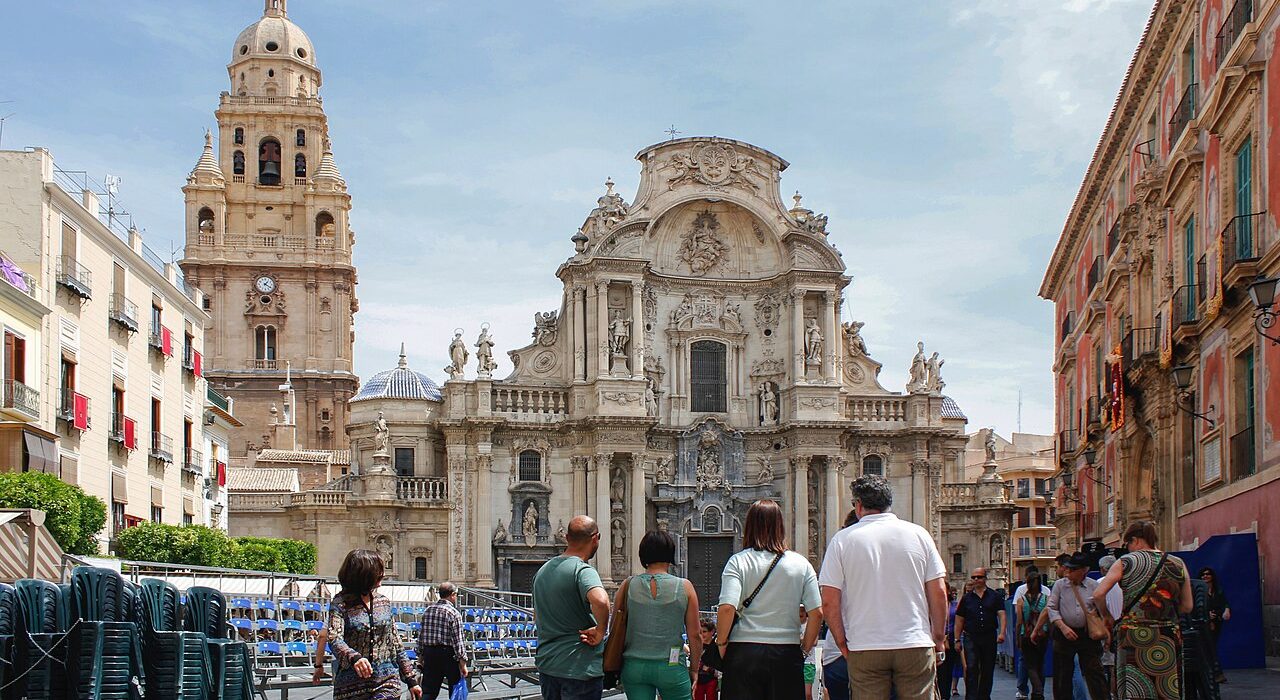
The Historic Center is the preferred option for tourists who want to have the main monuments, such as the Cathedral and the Casino, just a short walk from their room. Staying in this area allows you to enjoy the evening atmosphere of the squares and pedestrian streets, although prices may be slightly higher due to high demand and the privileged location. Accommodations here tend to be charming hotels in restored buildings or modern apartments that take advantage of traditional architecture. For the practical traveler, this area eliminates the need to use public transport or a car once you have arrived, since everything is accessible on foot.
On the other hand, the Ensanche area or well-connected peripheral areas offer an alternative for those traveling by car and looking for parking facilities or more competitive prices. In these areas, it is more common to find standardized hotel chains that offer consistent services and rates that can better fit tighter budgets, especially if booked in advance. Price ranges in the city of Murcia are generally affordable compared with other coastal capitals, with budget options available from 50-60 euros per night in low season, up to mid-high range rates exceeding 100 euros on special dates or for rooms with better views and services. Specific hotel names are not recommended in order to maintain objectivity, but it is suggested to look for establishments with good recent reviews regarding cleanliness and location.
Frequently asked questions about the Lorca-Murcia route
How long does it take to get from Lorca to Murcia?
Travel time varies significantly depending on the mode of transport you choose. If you opt to travel by private car, the journey is very quick, taking approximately 45 minutes thanks to the direct highway connection. By contrast, if you decide to take the train, you should allow for a travel time ranging from 58 to 77 minutes, depending on the specific Intercity service you catch. Although the difference is barely half an hour, in the case of the train you also have to factor in waiting time at the station and getting to it, so the car remains the fastest option in terms of door-to-door travel.
Which is cheaper, the train or the bus?
Based strictly on the data provided for this guide, we do not have verified information about bus routes or their fares for this specific route, so it is not possible to make a direct price comparison with that mode of transport. However, we can analyze the cost of the train versus the car. The train, operated by Renfe, has a variable cost that depends on how far in advance you book and the fare chosen, while the car involves fuel costs for 63 km and vehicle wear and tear. For a solo traveler, the train can be competitive if you find a deal, but for groups of two or more people, the car is usually the more economical option since you can split the fuel costs, especially as there are no tolls on the A-7 or the A-30.
Is it worth renting a car?
Renting a car is worth it if your goal is to have complete freedom over your schedule and to explore areas outside central Murcia, given that public transport by train only offers two daily departures (11:03 and 17:30). If you rely on the train, you will be limited to those departure and arrival times, which can be restrictive for intensive sightseeing or for business. In addition, the distance is short (63 km) and the roads are toll-free highways, which makes driving simple and cheap. If you are only going to be in central Murcia and do not plan to move around much, the rental could be an unnecessary expense if you find central accommodation, but for most traveler profiles coming from Lorca, the flexibility of a car is far superior to the rigidity of the two daily trains available.
When is the best time to travel?
The best time to travel depends on whether you prioritize the weather or transport availability. As for the journey itself, since it is by highway (A-7 and A-30), it is passable all year round, although in summer temperatures in the region can be very high, making it more pleasant to travel on the air-conditioned train during the central hours of the day. As for availability, since there are only two trains a day, it is crucial to avoid traveling on public holidays or weekends without a prior reservation, as Intercity capacity is limited. To enjoy Murcia, spring and autumn are ideal seasons thanks to the mild weather, avoiding the extreme heat of the Murcian summer and allowing you to walk around the city more comfortably after your arrival.