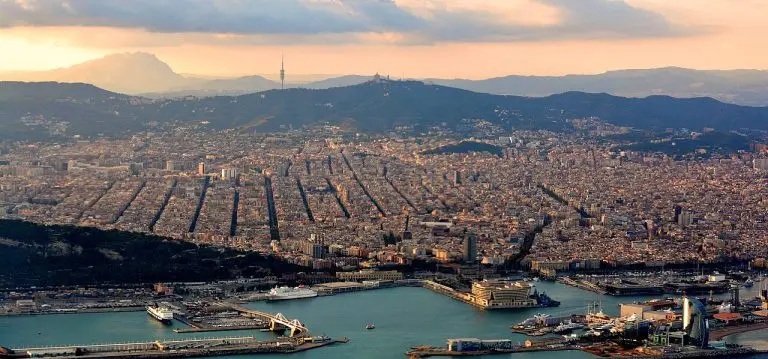
Bilbao → Barcelona
607 kmSome journeys are enjoyed more for what they hide along the way than for the final destination, and the trip from Bilbao to Barcelona is one of them. Driving from the Nervión estuary to the Mediterranean means going from the intense green of the Cantabrian coast to the golden drylands of the Ebro valley, with an almost obligatory stop in Zaragoza to stretch your legs and a final stretch along motorways that smell of the sea. If you don’t feel like driving, a plane puts you in Barcelona in just over an hour, but you’ll miss the pleasure of watching the landscape change kilometre by kilometre.
How to get from Bilbao to Barcelona: quick summary
The route between Bilbao and Barcelona can be done by car (607 km, about 6h 15min), by direct Renfe ALVIA train (431 min), by direct ALSA bus (450 min, between €45 and €100) or by direct Vueling flight (70 min, between €22 and €143). If time is your priority, the plane is unbeatable; if you’re after the cheapest and most flexible option, the bus competes very well; and if you want the freedom to stop in Zaragoza or discover villages along the way, the car is your best ally. A direct train exists but with only one daily departure, which considerably limits flexibility.
By car from Bilbao to Barcelona
The driving route between Bilbao and Barcelona is 607 km and takes approximately 6 hours and 15 minutes along motorways and dual carriageways. The main route relies on the AP-68 from Bilbao to Zaragoza (about 293 km, toll road), then takes the Z-40 to skirt around Zaragoza (about 21 km), continues on the A-2 (about 21 km, no toll) and links up with the AP-2, the Autopista Zaragoza-Mediterrània (about 216 km, no toll), to finish on the AP-7, Autopista de la Mediterrània (about 49 km, no toll) once in Catalonia. The AP-68 stretch is the most expensive due to tolls, but it saves time and avoids busier national roads. The AP-2 between Zaragoza and the Mediterranean is a straight, monotonous stretch, ideal for switching on cruise control and enjoying the landscape of vineyards and cereal fields.
By train from Bilbao to Barcelona
There is indeed a direct train between Bilbao and Barcelona: it is operated by Renfe and the fastest is the ALVIA, which takes 431 minutes (about 7 hours and 11 minutes). Frequency is only 1 train per day, departing at 15:02 from Bilbao-Intermod. Abando Indalecio Prieto station and arriving at Barcelona-Sants. No other schedules are available in the verified data, so it is advisable to book in advance. The train is a comfortable option for those who don’t want to drive or fly, but the duration is considerable and the single departure time considerably limits planning.
By bus from Bilbao to Barcelona
There is a direct bus between Bilbao and Barcelona, operated by ALSA (also listed as Alsa in some sources). The journey takes 450 minutes (7 hours and 30 minutes) and the price ranges between €45 and €100 depending on how far in advance you book and the type of seat. It is the cheapest option at the low end and competes directly with the train on duration, though with more schedule flexibility than the single daily train. For budget-conscious travellers or those who prefer not to drive, the bus is a solid alternative.
By plane from Bilbao to Barcelona
There is a direct flight between Bilbao and Barcelona, operated by Vueling. The average duration is 70 minutes (1h 10min – 1h 15min) and the price varies between €22 and €143 depending on season and how far in advance you book. There are around 7 direct flights per day (52 per week according to idealo, ~7-8 per day), departing from Bilbao airport (BIO) and arriving at Barcelona-El Prat (BCN). Vueling is the only airline with daily direct flights; Iberia and Air Europa appear only with stopovers. The lowest advertised price is €22 (Vueling, December 2026) and €27 in several sources, with typical one-way fares between €47 and €107 and return fares between €70 and €143.
Recommended stops along the way
These are the verified stops you can make on the route between Bilbao and Barcelona, although some deviate slightly from the main line. All of them are of touristic or scenic interest and are worth a visit if you’re not in a hurry.
Durango (Biscay)
Durango is a Biscayan town just 30 km from Bilbao, perfect for a first short stop. It stands out for its medieval old town, the Torre de Lariz and the Urkiola Natural Park a few kilometres away. It’s a good place for a coffee before tackling the toll section of the AP-68.
Azkoitia (Gipuzkoa)
Azkoitia lies inland in Gipuzkoa, in a green, mountainous area. Its main attraction is the Sanctuary of Loyola, an impressive 17th-century Baroque complex built around the birthplace of Saint Ignatius of Loyola. Entry is free and the surroundings are very peaceful.
Azpeitia (Gipuzkoa)
Azpeitia is a stone’s throw from Azkoitia and shares the Urola river valley. As well as the Sanctuary of Loyola, in Azpeitia you can visit the Basque Railway Museum, with steam locomotives and old carriages. It’s an ideal stop for families and fans of industrial history.
Foix (France)
Foix is clearly off the direct Bilbao-Barcelona route, but if you decide to extend the trip through southern France, it’s a charming stop. Its medieval castle dominates the town from above and the old town retains narrow streets and half-timbered houses. It’s an option only for those willing to make a detour through the French Pyrenees.
Tarbes (France)
Tarbes is another French stop outside the main line, but interesting if you cross the central Pyrenees. It stands out for the Jardin Massey, a botanical park with a museum, and for its Notre-Dame-de-la-Sède cathedral. It’s a quiet city, ideal for a gastronomic break with produce from south-west France.
Saint-Gaudens (France)
Saint-Gaudens is a small Occitan town on the route towards the central Pyrenees. Its collegiate church of Saint-Pierre and Saint-Gaudens is a fine example of Romanesque architecture. It’s a discreet stop, without big crowds, perfect for stretching your legs if you’re coming from Tarbes or Lourdes.
Lourdes (France)
Lourdes is world-famous for the Marian sanctuary and the grottoes of Massabielle, where according to Catholic tradition the Virgin appeared to Bernadette Soubirous in 1858. Although it’s far from the direct route, it’s a highly sought-after stop for pilgrims and curious travellers. The basilica and the candlelit processions at night are striking.
Pau (France)
Pau is an elegant city in the French Béarn, with a Renaissance castle where Henry IV of France was born and a Pyrenees boulevard with spectacular views of the mountain range. It’s a more touristy and sophisticated stop, with good restaurants and a lively atmosphere. It only makes sense if you take an alternative route through France.
Where to stay in Barcelona
Barcelona offers accommodation for every budget, from hostels and guesthouses from €25-40 per night to luxury hotels that exceed €200. The most recommended areas to stay are the Eixample, for its central location and good public transport connections; the Gothic Quarter and El Born, for those seeking historic atmosphere and nightlife; and Gràcia, quieter and with a neighbourhood feel. Near Barcelona-Sants there are functional, well-connected hotels if you arrive by train or bus. For short stays, the Eixample is the most practical option, with average prices of €80-150 per night in 3- and 4-star hotels.
Where to eat along the route
The route from Bilbao to Barcelona is a culinary journey in itself: you start with pintxos and cod, cross Navarra and Aragón with their roasts and cured meats, and finish with calçots and Catalan cava. These are the typical dishes and products you can find in each area.
Bacalao al pil-pil (Bilbao, Bizkaia)
A dish of desalted cod cooked at low temperature with olive oil, garlic and chilli. The emulsion of the oil with the cod’s gelatin creates a characteristic thickened sauce. It is one of the most emblematic dishes of Basque cuisine and is served in almost any restaurant in Bilbao.
Txakoli (Bizkaia and Álava, Basque Country)
A young white wine, slightly sparkling and high in acidity, made mainly from Hondarribi Zuri grapes. It is served very cold as an aperitif and pairs perfectly with pintxos and fish. In Bilbao it is almost obligatory to order a glass in the old town.
Pintxos (Bilbao and the Basque Country)
Small portions of food served on bread, typically skewered, tortilla, anchovies or peppers. They are the foundation of the tapeo culture in Basque bars. In Bilbao, the Ledesma area and the old town are home to the best pintxo bars.
Chorizo de Pamplona (Navarra)
A cured sausage made with pork, paprika and garlic, with a firm texture and intense flavour. It is eaten sliced as an aperitif or in a sandwich. It is a classic of Navarrese bars and a good culinary souvenir to take home.
Pimientos del piquillo (Navarra, Lodosa, Mendavia)
Small red peppers, sweet and with thin flesh, roasted and peeled, typically stuffed with meat or cod. They are preserved in oil or served from a jar. In Navarra you will find them as a starter on almost any menu.
Ternasco de Aragón (Aragón, Zaragoza, Huesca, Teruel)
Young lamb roasted in the oven with potatoes and garlic, with a mild flavour and tender texture. It is a traditional Aragonese festive dish and an essential culinary stop if you eat in Zaragoza or the surrounding area.
Wines from Cariñena (Cariñena, Aragón)
Red, white and rosé wines made mainly from Garnacha grapes, medium-bodied and fruity. The area is one of the oldest DOs in Spain. If you pass through Zaragoza, order a Cariñena red to accompany the ternasco.
Calçots (Catalonia, Valls, Tarragona)
Tender onion shoots roasted over embers and served with romesco sauce. They are eaten by peeling the charred stalk and dipping it in the sauce. They are typical of the winter and spring season, and in Catalonia popular calçotades are organised.
Pa amb tomàquet (Catalonia)
Toasted bread rubbed with ripe tomato, olive oil and salt, often accompanied by cured meats or tortilla. It is a basic aperitif of Catalan cuisine and you will find it in any bar or restaurant in Barcelona.
Cava (Catalonia, Penedès)
A sparkling wine made by the traditional method with Macabeo, Xarel·lo and Parellada grapes. It has a fine bubble and is produced mainly in the Penedès. It is the perfect finishing touch to a Catalan meal or a toast on arriving in Barcelona.
Frequently asked questions about the Bilbao-Barcelona route
How long does it take to get from Bilbao to Barcelona?
By car it takes 6 hours and 15 minutes to cover 607 km on the motorway. By plane the direct flight lasts 70 minutes, but you have to add check-in and transfer time. On the direct ALVIA train it is 431 minutes (7h 11min) and on the direct ALSA bus, 450 minutes (7h 30min).
Which is cheaper, the train or the bus?
The bus is cheaper at the low end: between €45 and €100 with ALSA. The direct ALVIA train from Renfe has no exact price in the data provided, but as there is only one train a day and it is a long-distance service, it is usually more expensive than the bus and less flexible. If you are looking to save, the bus is the guaranteed most economical option.
Is it worth renting a car?
Yes, if you want the freedom to stop in Zaragoza, Durango, Azkoitia or take a detour to places like Lourdes or Pau. The car lets you make the journey in 6h 15min and discover the gastronomy and landscapes along the way. If you are only interested in getting to Barcelona, the plane is faster and the bus cheaper, but the car is the only option for exploring the route at your own pace.
When is the best time to travel?
The best time to do this route is spring or autumn, when temperatures are mild and the landscape of the Ebro valley and the Pyrenees is at its best. In summer the heat on the Aragonese stretch can be intense and in winter there is a risk of fog or ice in high areas. If you travel by plane, the lowest prices usually appear well in advance and outside high season.
💡 ¿Sabías que...?
- ● Barcelona fue fundada como Barcino, una pequeña ciudad de fundación romana, entre el 15 a. C. y el 10 a. C. (https://es.wikipedia.org/wiki/Barcelona)
- ● La Sagrada Familia lleva más de 140 años en construcción y aún no tiene fecha para ser acabada. (https://www.abc.es/viajar/abci-diez-curiosidades-barcelona-quiza-desconocias-202202151417_noticia.html)
- ● La estatua de Cristóbal Colón, situada al final de las Ramblas, fue construida con motivo de la Exposición Universal de 1888 y señala hacia Mallorca, no hacia América. (https://supercurioso.com/curiosidades-de-barcelona/)
- ● El panot, el adoquín con forma de flor de cuatro pétalos, es un emblema urbano de Barcelona cuyo origen se remonta a principios del siglo XX. (https://historia.nationalgeographic.com.es/a/feliz-dia-merce-5-datos-que-quiza-no-conocias-sobre-historia-barcelona_24585)
- ● La Rambla son en realidad cinco calles en una: Canaletas, Estudios, San José, Capuchinos y Santa Mónica. (https://www.rtve.es/television/20240514/cinco-curiosidades-sobre-barcelona/16102622.shtml)
- ● Joan Miró (1893-1983) es considerado el pintor más reconocido de la historia de Barcelona. (https://barcelonasecreta.com/personajes-de-barcelona-historia/)
- ● Antoni Gaudí (1852-1926) fue el máximo representante del modernismo arquitectónico y responsable de obras como el Parc Güell, La Pedrera, la Casa Batlló y la Sagrada Familia. (https://barcelonasecreta.com/personajes-de-barcelona-historia/)
📍 También te puede interesar
Qué ver en Bilbao →
Qué ver en Barcelona →