Population
105,000
Province
Ourense
Language
Spanish
Currency
Euro (€)
Time zone
CET (UTC+1)
Climate
Summer
19.4°C
Winter
6.9°C
Best season
junio a septiembre
Daily budget
Food
12-25€
3* hotel
50-80€/night
# Ourense: a complete guide for travellers
The smell of octopus and paprika mingles with the steam rising from the thermal springs in the very heart of the old town. Ourense is one of those cities you don’t just see, you feel: water gushes at over 60 °C in As Burgas, the stone streets of the Casco Vello smell of wine and freshly made empanada, and the Plaza Mayor tilts gently beneath your feet as if the whole city were inviting you to sink into a terrace chair. With 105,000 inhabitants, it is the most populous municipality in inland Galicia and hides a treasure few Spanish cities can boast: free open-air thermal pools beside the river Miño, a monumental old town and a gastronomy that justifies the trip on its own.
## What to see in Ourense: the essentials
### Catedral de San Martiño
The Catedral de San Martiño is Ourense’s great monument and was declared a national monument on 3 June 1931. Its south façade, visible from the Plaza del Trigo, has a defensive look with towers and battlements that recalls the dual religious and civil power held by the bishop. General visiting hours are Monday to Wednesday from 10:00 to 15:00 and 16:00 to 19:00, Thursday to Saturday from 10:00 to 19:00, and Sundays from 13:30 to 19:00, with last entry 45 minutes before closing. General admission costs €10, the reduced rate for over-65s and young people aged 13 to 18 is €9, and pilgrims pay €7. Bear in mind that it closes on 24, 25 and 31 December and 1 January.
### As Burgas
As Burgas are thermal springs of Roman origin whose waters come from underground aquifers located more than a kilometre deep and gush at over 60 °C. They sit in the very heart of the old town and their history goes back to Roman times, whose archaeological remains show that the first settlers established themselves here, giving rise to the city. The area is divided into three sections: the 19th-century monumental fountain or “Burga de Abaixo”, the central esplanade with the open-air thermal pool, and the 17th-century “Burga de Arriba”. It is one of the three “treasures” traditionally sung of the city and an essential visit; remember not to use soap in the waters.
### Museo Arqueológico Provincial de Ourense
The Museo Arqueológico Provincial is housed in the old Pazo Episcopal, a historic building in the heart of the old town declared a historic-artistic monument in 1931. The complex combines a central Romanesque section with later additions, notably the cloister and various episcopal rooms. While the historic headquarters is being remodelled, services are provided in the Santa María de Europa building, in A Carballeira, where most of the collections are stored.
### Claustro de San Francisco
The Claustro de San Francisco preserves pointed arches, decorated capitals and tombs of noble families that reflect its artistic and historical value within Galician convent architecture. It forms part of the monumental complex of the Convento de San Francisco, one of the most outstanding in the city, and can be visited as part of Ourense’s historic and artistic heritage.
### Iglesia de Santa María Nai
The Iglesia de Santa María Nai is a church of medieval origin located in the historic centre, most probably on the site of the old cathedral of Ourense. Its current façade preserves columns and capitals of marble-like appearance dating from the 5th or 6th centuries, and according to a side inscription it was rebuilt in 1084 and again in 1772. Its 18th-century Baroque façade does not reveal the importance of the medieval temple, but inside a Churrigueresque altarpiece stands out, carved in wood in its natural colour. It is reached by a monumental staircase connecting the Plaza de la Magdalena with the Plaza Mayor.
### Iglesia de Santa Eufemia
Since 1767 it has been the parish church of the diocese of Ourense and its façade, the work of Fray Plácido Iglesias, is an archetype of Galician Baroque with its peculiar concave shape, giant-order columns, pinnacles and split pediment with a cross.
### Pazo de Oca Valladares (Liceo de Ourense)
Historic manor house in the old town linked to the Galician nobility, with a stone façade, balconies and decorative noble elements; the exterior visit allows you to appreciate its volume and construction details.
### Church of Santo Domingo
Conventual temple of medieval origin located in the historic centre, with a simple east-facing façade that contrasts with the gilded and polychrome Baroque altarpieces inside, where Romanesque and Gothic elements are preserved.
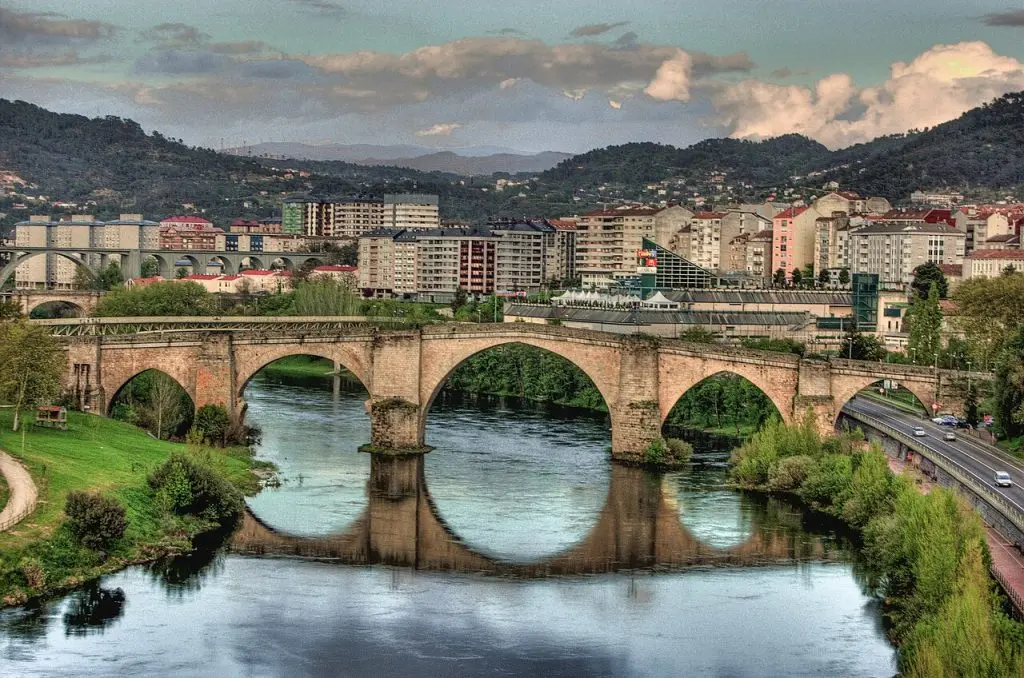
### Roman Bridge of Ourense
Built in the 1st century AD as part of a branch of Roman road XVIII (Vía Nova), of that first construction only some rusticated ashlars of the bases remain standing; the first known reconstruction dates from 1228.
### Plaza Mayor
The Plaza Mayor has been the heart of the historic centre for centuries and has the particularity of being one of the few main squares in Europe with a slightly sloping ground. The Baroque façade of the Casa Consistorial (Town Hall) centres the space, and the other three sides are formed by the arcades of the Espolón, a former promenade of the nobility now converted into one of the liveliest terrace areas in the centre.
### Plaza de la Magdalena
Arcaded square presided over by the church of Santa María Madre, with medieval tombstones attached to one side that recall its past as a canons’ cemetery; it is centred by a Baroque calvary, one of the most beautiful in Ourense.
### Plaza del Trigo
Former market square located next to the south façade of the Cathedral, with arcades that recall its historic commercial function and presided over by the cathedral’s south façade, which offers magnificent views; it is one of the most photographed corners of the historic centre.
### Termas de A Chavasqueira
The medicinal mineral waters emerge at different temperatures and feed several pools and hot springs with free access, with seasonal opening hours that vary throughout the year.
### Termas de O Muíño da Veiga
Public and free thermal baths located on the banks of the Miño, integrated into a restored old mill, with thermal water pools and rest areas beside the river; access is via the riverside promenade and its opening hours vary depending on the season and capacity.
## What to do in Ourense
Ourense offers free open-air thermal bathing, monumental routes through a historic centre full of churches and palaces, traditional markets, festivals with free concerts and a vibrant neighbourhood life centred on wines and terraces. If you travel in June, the Fiestas de Ourense fill the city for five days with free concerts, orchestras, a medieval market, fairground rides, children’s activities and fireworks coinciding with San Juan. In March, Holy Week brings the parish floats out into the streets and highlights the Ceremony of the Desplante on the last Sunday of Easter at the Church of Santa María Madre. In May, Los Mayos celebrate the feast of Santa Cruz with the making of floral figures called maios, reaching their peak on the 3rd. And in December, Christmas extends from the lighting of the lights until mid-January, with the Belén de Baltar in the Plaza de San Cosmede as a standout visit.
For everyday life, the Casco Vello is the gastronomic heart: its pedestrian stone streets are packed with tapas bars, the famous «os viños», where tapas-hopping is almost a local sport. The Centro or Ensanche, around the Parque de San Lázaro, concentrates shopping on the rúa do Paseo, the main commercial artery. And the Ribera del Miño is the great natural attraction: a pedestrian promenade that connects several free open-air thermal pools, perfect for alternating monuments with thermal baths.
## Ourense in a day: express itinerary
- 09:30 — As Burgas: start the day at the thermal springs of the old town, the Roman origin of the city, when the morning light illuminates the steam rising at over 60 °C.
- 10:30 — Catedral de San Martiño (St Martin’s Cathedral): visit Ourense’s great monument, declared a national monument in 1931, with its defensive south façade and monumental interior; enter through the Patín Juan de Austria.
- 12:00 — Plaza del Trigo and Plaza Mayor: stroll through Plaza del Trigo, one of the most photographed corners of the old town, and head up to the sloping Plaza Mayor for a drink under the arcades of the Espolón.
- 13:30 — Iglesia de Santa María Nai (Church of Santa María Nai): climb the monumental staircase from Plaza de la Magdalena and discover the Churrigueresque altarpiece in natural wood inside.
- 14:30 — Lunch in the Casco Vello: go for tapas in the «os viños» of the old town: pulpo á feira (Galician-style octopus), empanada gallega and a well-chilled ribeiro.
- 17:00 — Termas de A Chavasqueira or O Muíño da Veiga: cross the Puente Romano and take a free thermal bath in the pools beside the river Miño; bring a swimsuit, towel and non-slip footwear.
## Where to eat in Ourense: local cuisine
Ourense’s cuisine is hearty, flavoursome and perfect for refuelling after a day of monuments and thermal baths. The star dish is pulpo á feira: boiled, sliced octopus seasoned with olive oil, paprika and coarse salt, traditionally served with cachelos. In winter, caldo gallego comforts with grelos or cabbage, potatoes, beans and pork, while lacón con grelos is a hearty dish combining cured pork shoulder, grelos, chorizo and potatoes. The empanada gallega is the queen of snacks and nibbles, with fillings ranging from tuna and cod to meat or seafood. And carne ao caldeiro, beef simply boiled with potatoes and dressed with oil, garlic and paprika, is a classic of traditional cooking.
To buy fresh produce, the Praza de Abastos Nº 1 de Ourense is a traditional, emblematic market with more than 245 stalls offering meats, fish, fruit and vegetables. The Mercado Ponte Canedo blends the traditional offering with today’s gastronomy, including a pulpería and a bakery with Galician products. The tapas bars of the Casco Vello, the «os viños», are the best place to try everything without breaking the bank: order a tapa with each wine and let the bar guide you. The average price of a meal ranges between 12 and 25 €.
### Michelin-starred restaurants
Ourense has a high-level dining scene recognised by the Michelin guide.
Ceibe (1⭐ Michelin) is near the cathedral and stands out for its escabeches and marinades as a hallmark, a creative proposal that reinterprets Galician tradition.
Nova (1⭐ Michelin) is one of the three Michelin-starred restaurants in the city of Ourense for 2026, with cooking that is well worth the visit.
Pacífico (Bib Gourmand) is a classic family restaurant founded in 1975 with a Bib Gourmand distinction for its good value for money, ideal for eating well without blowing the budget.
## Where to sleep in Ourense
| Zona | Perfil | Precio orientativo |
|---|
| Casco Vello | Corazón histórico y gastronómico, ideal para foodies y amantes del ambiente de bares de tapas | 50-80 € (hotel 3*) |
| Centro / Ensanche | Zona moderna y comercial, perfecta para compras y acceso a la rúa do Paseo | 50-80 € (hotel 3*) |
| A Ponte | Área funcional al otro lado del río, con la estación de tren y acceso rápido a la ruta termal, ideal para mochileros | 18-35 € (hostel) |
| Riberas del Miño (Ruta Termal) | Zona natural de ocio y relax junto al río, ideal para todos los perfiles | 50-80 € (hotel 3*) |
| San Francisco | Barrio tranquilo y residencial en una colina con vistas panorámicas, ideal para familias | 50-80 € (hotel 3*) |
Accommodation prices in Ourense are quite reasonable compared with other Galician cities. A hostel costs between 18 and 35 € per night, a three-star hotel between 50 and 80 €, and if you’re after something more premium, 4-5 star hotels range from 90 to 200 €. The Casco Vello puts you right in the thick of it, but bear in mind that the stone pedestrian streets can be noisy at weekends; San Francisco offers peace and quiet with views just a few minutes’ walk away.
## How to get to Ourense
| Medio | Duración | Precio aprox. | Frecuencia |
|---|
| Tren (estación de Ourense, sin AVE) | Variable según origen | Variable según Renfe | Consultar horarios de Renfe |
| Bus interurbano | Variable según origen | Variable | Consultar frecuencias |
| Coche particular | Variable según origen | Combustible + peajes | Flexible |
Ourense has its own train station, although there is no AVE service, so travel times from Madrid or other major cities may be longer than to other Galician capitals. The intercity bus is a common alternative for arriving from nearby cities. If you travel by car, you will have total flexibility to explore the banks of the Miño and the thermal baths, which are somewhat scattered. For more practical information on schedules, tickets and events, check the
official Ourense tourism website.
## Getting around Ourense
Ourense has an urban bus network for getting around the city, especially useful for journeys between the centre, A Ponte and the more distant thermal bath areas. However, most of the tourist attractions in the historic centre are perfectly walkable, and the thermal route along the Riberas del Miño (Miño riverbanks) is designed as a pedestrian walk. If you stay in the Casco Vello (Old Town) or the Centre, you probably won’t need public transport except to reach the more distant thermal baths or the Mercado Ponte Canedo.
## Best time to visit Ourense
The best time to visit Ourense is from June to September, when average summer temperatures reach 19.4 °C and the open-air thermal baths are enjoyed to the fullest. Winter is fairly cool, with an average of 6.9 °C, although the thermal waters at over 60 °C have a special charm in the cold months. Annual rainfall is 940.9 mm, so always carry a light rain jacket, even in summer. If you want to coincide with the festivities, June is the perfect month: the Fiestas de Ourense fill the city with free concerts and a lively atmosphere.
## Day trips from Ourense
Ourense is an excellent base for exploring the cities of the Galician region. The province of Ourense is full of spa towns, vineyards and river landscapes along the Miño, and from the city you can organise day trips to other points in Galicia. The nearby cities of the region offer a combination of historical heritage, gastronomy and nature that perfectly complements a visit to the Ourense capital.
## Ourense curiosities you didn’t know
The Plaza Mayor de Ourense is the only sloping main square in Spain. Yes, you read that right: the square’s surface has a slight incline that makes it unique in the entire country, an urban oddity you’ll only notice as you walk across it.
Ourense had a bullring that opened in 1906 in Mariñamansa. Although it no longer stands, it is part of the city’s social history and its past as a venue for bullfighting spectacles.
Ramón Otero Pedrayo was born in Ourense on 5 March 1888. The great writer and patriarch of Galician letters is one of the city’s most illustrious sons.
The Puente Romano de Ourense (Roman Bridge) stands about 38 metres above the river level. A considerable height that makes it a privileged viewpoint over the Miño and the thermal riverbanks.
The Catedral de Ourense was declared a national monument on 3 June 1931. An early recognition of its heritage value that places it among the great Galician monuments.
The name of the city of Ourense comes from the Latin Auria or Aregia, a Roman settlement formed around gold mining operations. The gold that attracted the Romans still shines today in the golden stones of its monuments.
## Who is Ourense for
Ourense is a city for everyone, but it shines especially for lovers of thermal bathing, gastronomy and history. Couples will find romantic corners in the arcaded squares of the historic centre and thermal baths at sunset beside the Miño. Families will appreciate the reasonable prices, the parks and the quiet atmosphere of neighbourhoods like San Francisco. Backpackers have affordable accommodation in A Ponte and direct access to the free thermal route. Foodies will go crazy for the «os viños» of the Casco Vello and the Michelin restaurants. And history lovers have a thousand-year-old cathedral, a Roman bridge and a historic centre that breathes the past in every stone.
## Frequently asked questions about Ourense
How many days do I need to see Ourense?
With two full days you can see the essentials: As Burgas, the Cathedral of San Martiño, the Plaza Mayor, the Plaza del Trigo, the Church of Santa María Nai and the thermal springs of A Chavasqueira or O Muíño da Veiga. If you want to add the Archaeological Museum, the Cloister of San Francisco, the Church of Santa Eufemia and enjoy the food and thermal baths at a leisurely pace, three days is ideal.
Is Ourense expensive?
No, Ourense is a fairly affordable city. An average meal costs between €12 and €25, a hostel between €18 and €35 per night, and a three-star hotel between €50 and €80. What’s more, the open-air thermal springs of A Chavasqueira and O Muíño da Veiga are free, and going for tapas in the «os viños» of the Casco Vello (Old Town) is an inexpensive way to eat well.
What is the best time of year to visit Ourense?
The best time is from June to September, with an average summer temperature of 19.4 °C according to AEMET, ideal for enjoying the open-air thermal springs. Winter is cool, with an average of 6.9 °C, but the thermal waters at over 60 °C have a special charm. Annual rainfall is 940.9 mm, so bring a raincoat at any time of year.
How do I get to Ourense from Madrid?
Ourense has a train station, though with no AVE service, so journey times from Madrid are longer than to other Galician capitals. Check schedules and prices on Renfe for the Madrid-Ourense route. The intercity bus is another common option for arriving from nearby cities.
Are the thermal springs of Ourense free?
Yes, the thermal springs of A Chavasqueira and O Muíño da Veiga are public and free, with open-air thermal pools and rock pools beside the river Miño. Their opening hours vary depending on the season and capacity, so check the official Ourense tourism website before you go. You can also see the springs of As Burgas right in the historic centre, where the water gushes out at over 60 °C.
💡 ¿Sabías que...?
-
●
La Plaza Mayor de Ourense es la única plaza mayor de España inclinada. (https://www.laregion.es/comarca-de-ourense/curiosidades-historicas-ourense-que-solo-conoceras-eres-ourensano_1_20240302-2434543.html)
-
●
Ourense tuvo una plaza de toros que vio la luz en 1906 en Mariñamansa. (https://www.laregion.es/comarca-de-ourense/curiosidades-historicas-ourense-que-solo-conoceras-eres-ourensano_1_20240302-2434543.html)
-
●
Ramón Otero Pedrayo nació en Ourense el 5 de marzo de 1888. (https://www.fundacion-oteropedrayo.es/es/su-vida)
-
●
El Puente Romano de Ourense se encuentra situado a unos 38 metros sobre el nivel del río. (https://www.ourense.com/que-ver/puente-romano-de-ourense-historia-de-un-simbolo-de-la-ciudad/)
-
●
La Catedral de Ourense fue declarada monumento nacional el 3 de junio de 1931. (https://catedralourense.com/)
-
●
El nombre de la ciudad de Ourense procede del latín Auria o Aregia, un asentamiento romano formado en torno a las explotaciones de oro. (https://es.wikipedia.org/wiki/Orense)