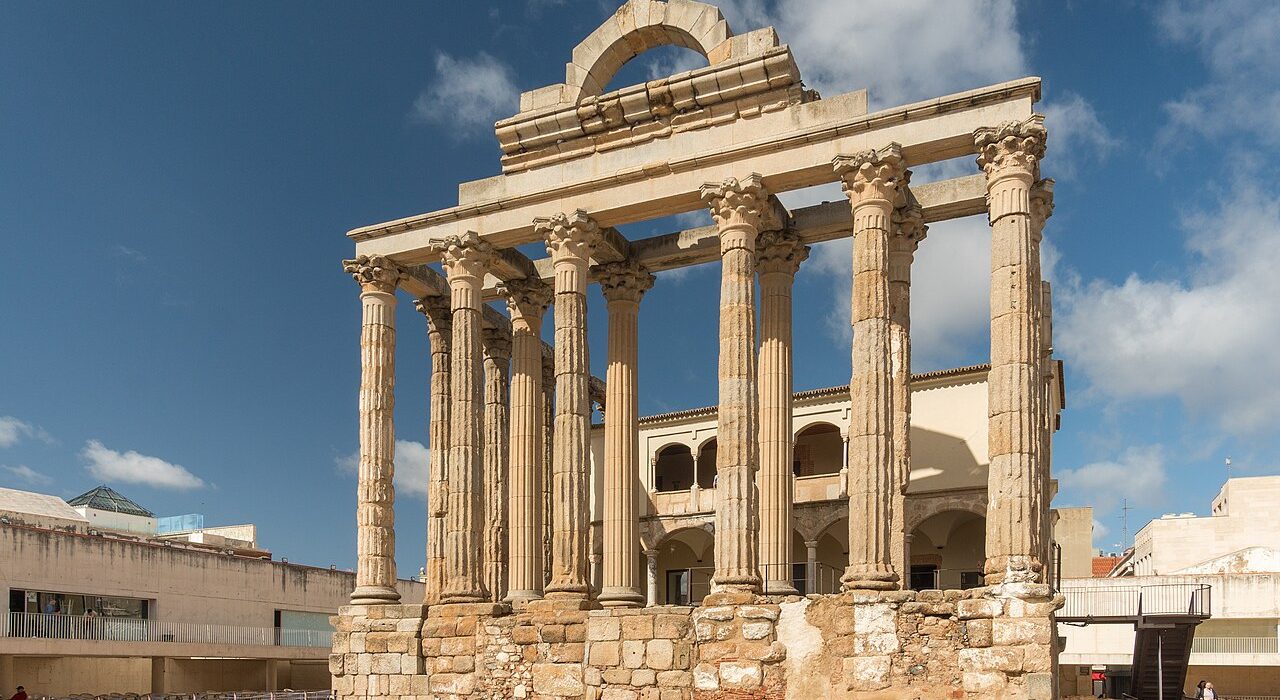
Badajoz → Mérida
60 kmCrossing the Extremaduran plain at full speed on an Alvia train or stopping to gaze at the olive groves from a car window are the best ways to anticipate the Roman grandeur awaiting you at the end of your journey.
How to get from Badajoz to Mérida: quick summary
The fastest way to travel between these two cities is undoubtedly by train, specifically the ALVIA or MD services, which cover the distance in just 30 minutes, although driving offers greater freedom to explore the surroundings without being tied to fixed schedules.
For travelers who prioritize economy above all else, the bus operated by LEDA presents a solid and highly accessible alternative, with fares ranging from €4 to €7. If you are a tourist looking to make the most of every minute at your destination to visit the Teatro Romano (Roman Theatre) or the Museo Nacional de Arte Romano (National Museum of Roman Art), the clear recommendation is to choose the railway operated by Renfe, as it drops you right in the heart of the action without the stress of parking. Conversely, if you are planning a broader route through the region or traveling in a group with bulky luggage, using a private vehicle via the A-66 or A-5 motorways will give you the autonomy needed to manage your own time.
In short, you have three well-connected options: a drive of just 45 minutes, a dense rail network with 13 daily frequencies, or a direct and economical bus service. Your choice will depend entirely on whether you value the train’s top speed, the bus’s savings, or the car’s total flexibility.
Driving from Badajoz to Mérida
Driving from Badajoz to Mérida is a simple and quick journey covering an exact distance of 60 kilometers, typically completed in 45 minutes.
The road infrastructure connecting both provincial capitals is excellent, allowing for smooth and safe driving. You have two major arteries at your disposal for this trip: the Autovía Ruta de la Plata, known as the A-66, and the Autovía del Suroeste, identified as the A-5. One of the great advantages of this route is that both roads are toll-free motorways, meaning you won’t have to worry about paying tolls at any point during the journey, keeping costs limited exclusively to fuel and vehicle wear.
Upon leaving Badajoz, merging onto either of these highways will allow you to maintain a constant speed, enjoying a landscape that changes subtly as you approach the Guadiana basin. Signage is clear and the asphalt condition is usually optimal, contributing to the reliability of the estimated 45-minute travel time under normal traffic conditions. It is an ideal route for those who enjoy driving, as the straightness of the road and low traffic density on many stretches make the journey relaxing. Additionally, arriving in Mérida by car gives you immediate mobility once in the city, though you should keep parking zones in mind if your goal is to visit the historic center, where access may be restricted in certain areas.
By train from Badajoz to Mérida
The train is the fastest and most frequent option for this route, operated entirely by Renfe with up to 13 direct connections daily.
The rail offering is highly varied and adapts to different needs for speed and comfort. If you seek maximum speed, ALVIA trains are your best choice, completing the journey in just 30 minutes; there are 3 daily frequencies of this type. Equally fast are the MD (Media Distancia) trains, with 5 services per day that also complete the trip in 30 minutes. For those preferring a more leisurely pace or alternative schedules, REGIONAL trains offer 3 daily departures with a duration of 36 minutes, and REG.EXP. (Regional Exprés) trains provide 2 daily frequencies taking 43 minutes to arrive.
The operating schedule is quite extensive for a commuter and medium-distance route, with the first train departing from Badajoz station at 6:50 in the morning and the last service departing at 19:40. This perfectly covers the needs of travelers wishing to spend the day in Mérida and return, or those with morning meetings. The origin and destination stations are Badajoz and Mérida respectively, strategically located to facilitate access to urban centers. The punctuality and comfort of Renfe carriages make these 30 or 40 minutes of travel fly by, allowing you to arrive fresh and ready to begin your visit to this heritage city.
By bus from Badajoz to Mérida
The bus is the most economical alternative for traveling between these two cities, with fares ranging between 4 and 7 euros per trip.
The service is operated by the company LEDA, offering direct connections without the need for intermediate transfers. Although the travel time is slightly longer than by car or the fastest train, with an estimated duration of 60 minutes, the price difference can be a decisive factor for many travelers, especially students or tourists on a tight budget. During that hour of travel, passengers can enjoy views of the Extremadura landscape through the bus windows, which often offers a different perspective closer to the terrain than the highway.
The comfort of LEDA buses is generally adequate for trips of this duration, allowing carry-on luggage without issues. It is a very valid option if you are not in a hurry to arrive and prefer to save that money to spend on a good meal in Mérida or entrance to a monument. As it is a direct service, the experience is simple: you board in Badajoz and disembark in Mérida, without logistical complications. It is important to check the company’s specific schedules, as frequency may vary compared to train density, but the value for money of these 4-7 euros is hard to beat in today’s transport market.
Recommended stops along the way
If you are traveling by car, there are two strategic towns located on the route that deserve a brief stop to break the monotony of the journey and stretch your legs.
The first recommended stop is Montijo. Located on the route to Mérida, Montijo is an ideal spot to take a break. Although it is a short stop, it offers the opportunity to see the architecture and atmosphere of a typical village in the area. Stopping here allows you to change the driving pace and enjoy a coffee or a small snack before covering the final kilometers to the capital. It is a place that adds a touch of local authenticity to the trip, taking you away from the speed of the highway for a few minutes to connect with the daily life of the region.
The second mandatory stop is Talavera la Real. This town is also located on the verified route and represents another perfect opportunity to interrupt the journey. Talavera la Real has a particular charm, and its location makes it an interesting geographical landmark between Badajoz and Mérida. Stopping here allows you to observe the rural surroundings and appreciate the tranquility of the countryside. Both stops, Montijo and Talavera la Real, are designed for those traveling in private vehicles who wish to turn a simple transfer into a small sightseeing experience, enriching the trip with micro-explorations before reaching the final destination.
Where to stay in Mérida
Mérida offers a variety of accommodations to suit different budgets, distributed mainly in areas close to the historic center and in quiet residential neighborhoods.
For travelers who want to be at the epicenter of the action, the historic center area is highly recommended. Staying here allows you to walk to the Roman Theatre (Teatro Romano), the Alcazaba, or the Plaza de España in a matter of minutes, avoiding the need for additional transport at night. In this area, you can find charming hotels that often occupy restored buildings, offering a more intimate experience closer to the city’s history. Prices in this area tend to be somewhat higher due to the privileged location, but the convenience of stepping out of your hotel and being right at the monument is an invaluable added benefit.
On the other hand, if you are looking for something more affordable or prefer tranquility, there are options in the outskirts or in well-connected residential areas. Here it is common to find hostels, guesthouses (pensiones), and tourist apartments offering tighter price ranges. Apartments are ideal for families or groups of friends who want to manage their own meals and schedules. Hostels are perfect for solo travelers or backpackers who prioritize savings. Regardless of the area you choose, Mérida is a manageable-sized city, so even staying some distance from the monumental core will not be a major inconvenience, especially if you have traveled by car and have easy access to parking near your accommodation.
Frequently Asked Questions about the Badajoz-Mérida Route
How long does it take to travel from Badajoz to Mérida?
Travel time varies depending on the chosen mode of transport. By car, the 60 km journey takes approximately 45 minutes. The train is the fastest option, with ALVIA and MD services taking just 30 minutes, while REGIONAL and REG.EXP. trains can take between 36 and 43 minutes. Finally, if you opt for the LEDA bus company, you should allow for a duration of 60 minutes.
Which is cheaper, the train or the bus?
Generally, the bus is the most economical option. According to data from the LEDA company, bus ticket prices range between €4 and €7. In contrast, although we do not have exact train fare data, train tickets usually have variable rates that can exceed this range, especially on high-speed trains like the ALVIA, making the bus the winner in terms of pure savings for the traveler.
Is it worth renting a car?
Renting a car is worthwhile if you intend to visit recommended stops along the route such as Montijo and Talavera la Real, or if you plan to move freely around the region once in Mérida. However, if you are only visiting the city center and do not want to worry about parking, the train is superior in speed (30 minutes compared to 45 minutes by car) and saves you the stress of driving, arriving directly at Mérida station.
When is the best time to travel?
Given the high frequency of transport, with 13 trains per day operating from 6:50 to 19:40, you can travel at any time of day with ease. The best time will depend on your personal preferences, but the constant availability of ALVIA, MD, and REGIONAL trains ensures excellent connectivity throughout the year, allowing you to plan your visit without severe seasonal restrictions regarding departure times.
📍 También te puede interesar
Qué ver en Badajoz →
Qué ver en Mérida →