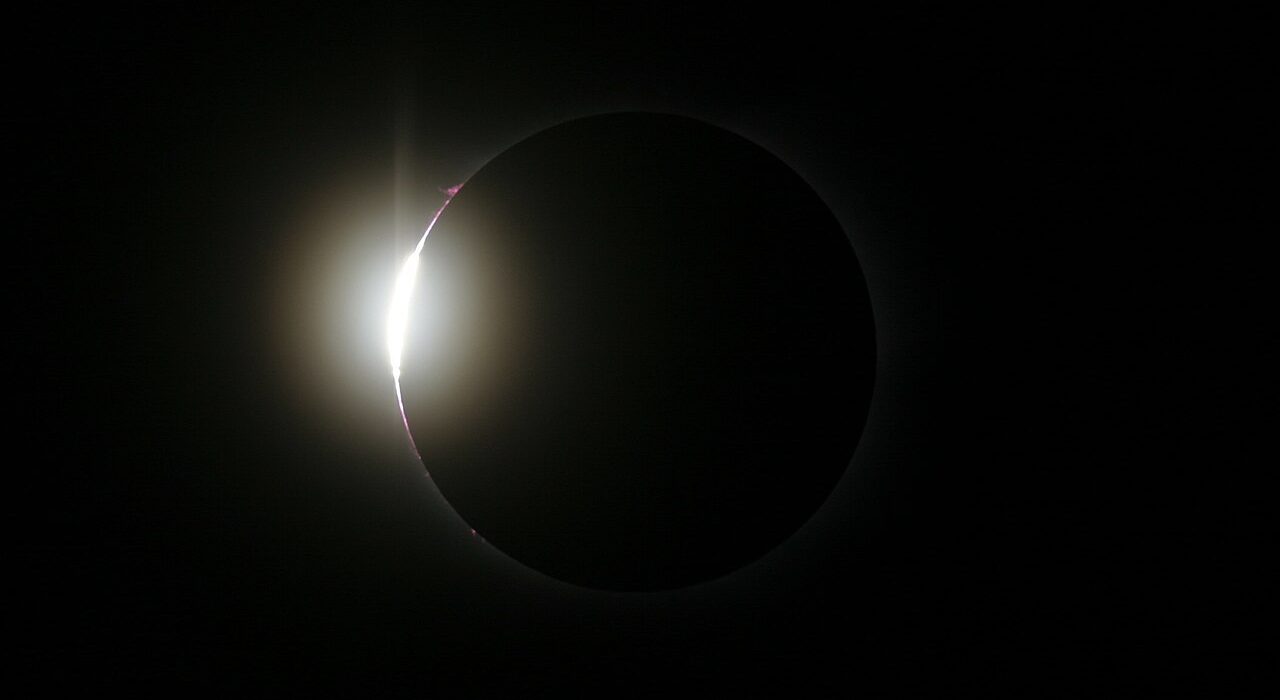
Total Solar Eclipse in Vitoria-Gasteiz — August 12, 2026: Exact Timings and Where to Watch
In Vitoria-Gasteiz the eclipse will be TOTAL; totality begins at 20:27 and lasts 1 min 04 s. This event marks the return of the Moon’s shadow to the Iberian Peninsula after 121 years, being the first total eclipse visible since 1905. This technical guide details the exact minutes, locations with a clear western horizon, and the logistics needed to ensure successful observation.
Eclipse Timings in Vitoria-Gasteiz
The phenomenon unfolds in three critical phases defined by the Moon’s position relative to the Sun. The following times are calculated in local summer time (CEST, UTC+2) and sourced from NASA ephemerides and the Instituto Geográfico Nacional (IGN). First contact marks the start of the partial phase, when the Moon begins to “bite” the solar disk. The totality phase is the only moment safe for observation without eye protection.
| Fase | Hora local en Vitoria-Gasteiz (CEST) |
|---|---|
| Primer contacto (empieza la fase parcial) | 19:32:31 |
| Empieza la totalidad | 20:27:43 |
| Máximo del eclipse | 20:28:15 |
| Termina la totalidad | 20:28:47 |
| Último contacto (termina la fase parcial) | 21:17:12 |
| Duración de la totalidad | 1 min 04 s |
| Magnitud | 1.0038 |
Source: NASA Five Millennium Catalog. Local CEST hours (UTC+2) on August 12, 2026.
Although Vitoria-Gasteiz lies within the path of totality, it is not situated on the central line of the eclipse. This implies a duration of the total phase of 64 seconds, less than the peninsular maximum of 1 minute and 49 seconds recorded in Oviedo. However, being inside the band guarantees the complete experience: sudden darkening, temperature drop, and visibility of the solar corona and stars during the day. The difference in duration does not affect the quality of the visual spectacle, only the exposure time for photography.
Where to Watch the Eclipse in Vitoria-Gasteiz
The most important technical criterion for choosing a location in Vitoria is the west-northwest horizon. Since the eclipse occurs at sunset, the Sun will be low above the horizon, with an altitude of approximately 10° to 12° during totality. Any obstacle (buildings, mountains, or dense trees) in that direction will block the view of the phenomenon during its critical moments.
Based on urban topography and space availability, these are the validated observation points:
- Anillo Verde (Green Belt): This is the safest option from an astronomical point of view. As a belt of peri-urban parks, it offers vast open areas with lower density of tall buildings than the center. Look for elevated zones within the park (such as Zabalgana or Salburua, verifying west orientation) that allow a clean line of sight toward the horizon.
- Parque de la Florida: Located in the center, it is a classic open space. However, mature tree vegetation can be an obstacle for such a low Sun. It is viable only if you locate a specific clearing oriented to the west without branches intercepting the line of sight at 10° height.
- Plaza de la Virgen Blanca: Located in the heart of the Casco Viejo (Old Town). Although the atmosphere will be festive, the surrounding architecture and narrowness of adjacent streets make viewing the low horizon difficult. Recommended only if you seek the social atmosphere rather than the purity of astronomical observation.
- Plaza del Machete: Similar to Plaza de la Virgen Blanca, its dense urban environment severely limits the field of view toward the west. It is not a recommended place for technical observation, although it will allow you to perceive the change in ambient brightness.
For demanding observers, the recommendation is to move to the outskirts of the city toward rural areas to the west, where the horizon profile is lower and free of urban interference.
The August sky in the Basque Country: real probabilities
Weather is the biggest uncertainty. According to historical data from AEMET for the Cantabrian Coast and inland Basque areas in August, the probability of a completely clear sky ranges between 30% and 50%. The main risk is not heavy rain, but low cloud cover, persistent morning fog, or the typical “orballo” (fine drizzle) of the region, which can block the Sun right at the critical moment.
The smart strategy is to monitor high-resolution weather forecasts (AEMET or ECMWF models) 48 and 24 hours before the event. If the forecast for Vitoria indicates compact cloud cover to the west, Plan B must be activated immediately. Logical options include moving inland (toward the Lugo area or southern Asturias), where clearing probabilities are usually higher due to being leeward of the Cantabrian mountain range, or heading to higher elevations above the coastal fog layer.
How to get to Vitoria-Gasteiz for the eclipse
A massive influx of visitors is expected, which will gridlock access routes on August 12. The logistical recommendation is to arrive the day before (August 11) to avoid traffic jams. If traveling from La Rioja, consult our detailed planning in the Logroño to Vitoria-Gasteiz route. For other travelers, train access (Renfe) is a viable alternative to avoid parking stress, although frequencies will be saturated. If you decide to drive, park the day before and do not move the vehicle until August 13.
Where to sleep: book now or arrive the day before
Hotel availability within the path of totality will be exhausted months before the event. Prices will rise drastically as the date approaches. The only sensible strategy is to book accommodation with a free cancellation rate immediately. If Vitoria is fully booked, look for lodging in nearby cities outside the path (such as Burgos or Pamplona) and make the trip early on August 12. Sleeping outside the path is preferable to having no roof over your head.
Safety: 30 seconds you must read
Eye safety is non-negotiable. During the partial phases (from 19:32 to 20:27 and from 20:28 to 21:17), solar radiation is harmful to the retina. You must wear glasses with ISO 12312-2 certification at all times. Only during the 64 seconds of totality, when the solar disk is 100% covered, can you remove them to observe the corona. As soon as the first ray of sun reappears (diamond ring), put your glasses back on immediately. Read our complete guide to the eclipse in Spain for more details on filters and photography.
- ISO 12312-2 eclipse glasses — one per person, purchased in advance. View options on Amazon ES.
The eclipse near Vitoria-Gasteiz
If weather conditions in Vitoria are not optimal, there are other towns in the path of totality less than an hour away that could offer clearer skies or a longer duration of the phenomenon.
| Ciudad | Distancia | Duración totalidad | Inicio totalidad |
|---|---|---|---|
| Logroño | 47 km | 1 min 22 s | 20:28:09 |
| Bilbao | 51 km | 0 min 31 s | 20:27:23 |
| Burgos | 101 km | 1 min 44 s | 20:28:24 |
| Santander | 115 km | 1 min 04 s | 20:26:57 |
Make the most of the trip: what to see in Vitoria-Gasteiz
Since the eclipse occurs at sunset, you have the entire day of August 12 to explore the city. Vitoria is a European Green Capital and boasts a perfectly preserved medieval quarter. Consult our local guide to plan your day: what to see and do in Vitoria-Gasteiz. Combine the cultural visit with the wait for the astronomical event.
Frequently Asked Questions
What time is the eclipse in Vitoria-Gasteiz?
The partial phase begins at 19:32:31 CEST. Totality runs from 20:27:43 to 20:28:47, with maximum eclipse at 20:28:15. The partial phase ends at 21:17:12.
How long does totality last in Vitoria-Gasteiz?
1 min 04 s. As it lies outside the central line, the duration is shorter than the peninsula’s maximum (Oviedo, 1 min 49 s).
Will the eclipse be total in Vitoria-Gasteiz?
Yes. Vitoria-Gasteiz is within the path of totality with a magnitude of 1.0038. The Moon will completely cover the Sun for 1 min 04 s.
Do I need eclipse glasses?
Yes — ISO 12312-2 certified glasses are required during all partial phases. Only during totality can you look at the Sun with the naked eye. Sunglasses do NOT provide protection.
What if it’s cloudy in Vitoria-Gasteiz on August 12?
The probability of clear skies in this area is 30–50% (historical AEMET data). Have a Plan B inland (Lugo, Oviedo) or move according to the AEMET forecast 24 hours prior. Check the AEMET prediction 24–48 hours in advance and stay mobile.
When will the next total solar eclipse visible from Spain occur?
Very soon: 2027-08-02. An exceptional streak for the same region.
Conclusion
The total solar eclipse of August 12, 2026, is a once-in-a-lifetime event for a generation of travelers in Spain. With planning —choosing a location near the central line, checking the AEMET forecast 24–48 hours in advance, using ISO 12312-2 glasses during partial phases, and booking accommodation early— you can experience one of nature’s most spectacular shows. Use this guide alongside our city guides and itineraries to design the perfect trip.