Total Solar Eclipse in Segovia — August 12, 2026: Exact Times and Where to Watch
In Segovia the eclipse will be TOTAL; totality begins at 20:31 and will last 0 min 57 s. This event marks a historic milestone: it is the first total eclipse visible on the Iberian Peninsula since August 30, 1905, breaking a 121-year drought. Segovia lies on the southern edge of the path of totality, offering a unique experience where midday darkness merges with sunset. This technical guide details the exact moments, the best locations with clear western horizons, and the logistics needed to witness the phenomenon safely and with scientific rigor.
Eclipse Timings in Segovia
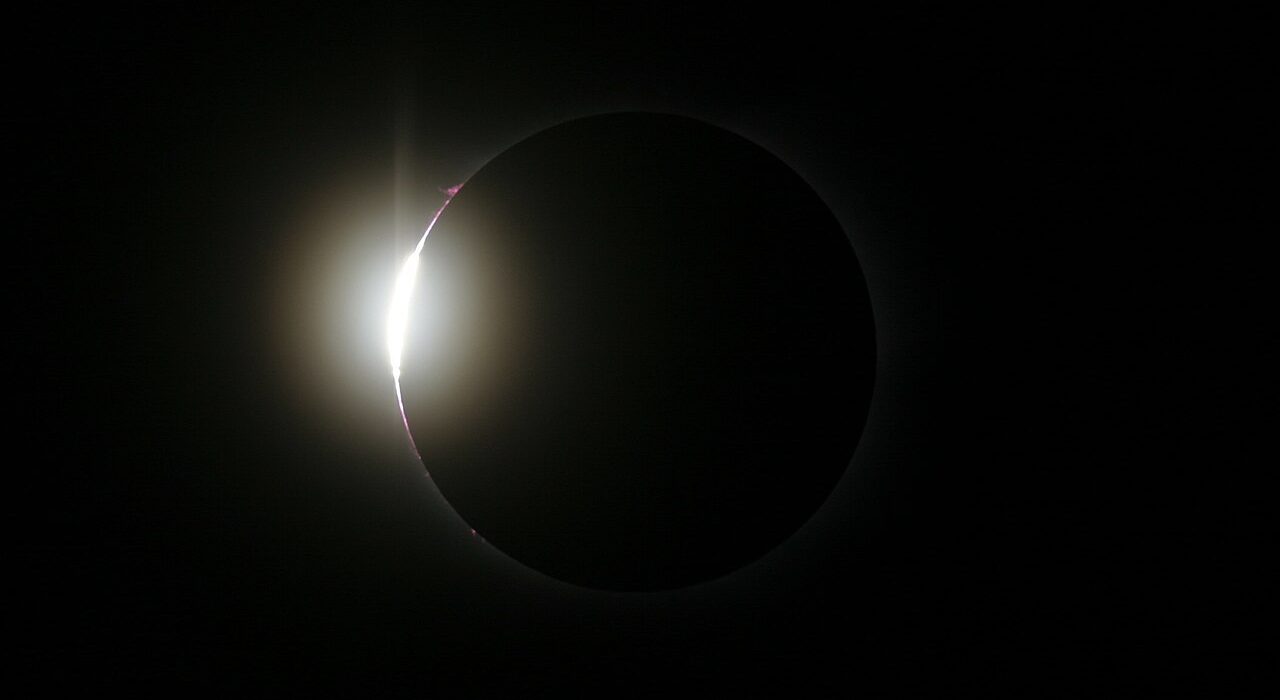
The event’s chronology follows a precise sequence dictated by lunar orbital mechanics. The phenomenon begins with first contact, when the Moon touches the solar disk, initiating the partial phase. Subsequently, totality is reached—the climax moment when the solar corona becomes visible. Finally, last contact marks the end of the event. The following data comes from ephemeris calculations by NASA and the Instituto Geográfico Nacional (IGN), adjusted to local summer time (CEST, UTC+2).
| Fase | Hora local en Segovia (CEST) |
|---|---|
| Primer contacto (empieza la fase parcial) | 19:35:47 |
| Empieza la totalidad | 20:31:09 |
| Máximo del eclipse | 20:31:37 |
| Termina la totalidad | 20:32:06 |
| Último contacto (termina la fase parcial) | 21:19:04 |
| Duración de la totalidad | 0 min 57 s |
| Magnitud | 1.003 |
Source: NASA Five Millennium Catalog. Local CEST times (UTC+2) for August 12, 2026.
It is crucial to contextualize the duration of totality in Segovia. At 57 seconds, the experience is brief but intense. For comparison, the peninsula’s maximum will be reached in Oviedo, with 1 minute and 49 seconds. Being in Segovia means positioning yourself within the path of totality but outside the central line. This does not diminish the spectacle: the temperature drop, changes in animal behavior, and the appearance of stars will be identical. The difference lies in the duration of total darkness, which here will be barely a minute, demanding impeccable photographic and visual preparation so as not to miss a single second of the diamond ring effect.
Where to view the eclipse in Segovia
The critical variable for observation in Segovia is not just sky clarity, but horizon geometry. Since the eclipse maximum occurs approximately one hour before sunset, the sun’s altitude will be low, ranging between 10° and 20° above the west-northwest horizon. Therefore, any architectural or geographical obstacle in that direction will block totality. The following locations have been selected for their orientation and elevation.
- Segovia City Walls (Muralla de Segovia): Walking along the walls offers a natural elevation that helps overcome the low buildings of the old town. However, it is essential to seek sections facing west without obstructions from adjacent towers. The silhouette of the walls against the darkened sky provides an exceptional historical framing, although public crowding will be at its peak at this point.
- Plaza Mayor de Segovia: The heart of the city is accessible and iconic, but presents obstruction risks. Surrounding buildings and the Cathedral may block the sun if it descends below 15 degrees. It is only recommended if an elevated point or a terrace with a direct view to the southwest can be found. It is a comfortable option, but astronomically less safe than open viewpoints.
- Mirador del Postigo del Consuelo: This is, possibly, the best compromise between accessibility and visibility. Located next to the Cathedral, it offers a wide panorama towards the valley and the Castilian plains. Being at one end of the upper city, the western horizon is usually clearer of dense buildings. It is the ideal spot for photographers seeking to integrate the rural Segovian landscape into their eclipse shot.
- Torreón de Lozoya: The gardens of the Torreón provide a controlled open space. As a walled enclosure with vegetation, it allows for finding clearings among the trees towards the west. It is a recommended option for families needing space to set up tripods without the massive crowds of the Plaza Mayor, although it requires verifying that vegetation has not grown obstructively towards the west by 2026.
Specific observation note for Segovia: Being on the southern edge of the path, totality will be grazing. If the western horizon has low clouds or fog, the risk of missing totality is high. It is recommended to arrive at the chosen location at least 2 hours early (around 17:30) to secure a position and verify the line of sight.
The August sky in Castile and León: real probabilities
According to historical climate data from the State Meteorological Agency (AEMET) for the areas of Castile and León, La Rioja, and Navarre, August presents favorable statistics. The probability of clear skies ranges between 70% and 85%. This makes the region one of the safest bets on the peninsula, surpassing northern areas more prone to Atlantic cloud cover.
However, “probability” is not “certainty.” The typical risk at this time of year is extreme heat, with temperatures that can exceed 35°C during the afternoon, followed by possible isolated evening storms of daytime development. These storms can form rapidly in the mountains and move towards the city. The professional recommendation is to monitor the 24- and 48-hour forecast using high-resolution models (such as the ECMWF HRES or the AEMET model). Have a Plan B: if the sky clouds over in Segovia, have identified a place 50 km to the south or north where the cloud front may not have reached.
How to get to Segovia for the eclipse
Mobility logistics will be the biggest challenge. A massive influx of astro-tourists is expected, saturating access routes. There are no specific published routes on our website to reach this city, so planning relies on conventional transport. The most efficient option is the high-speed train from Madrid (30 minutes), although tickets will sell out months in advance. If you choose to drive, prepare for severe congestion on the AP-6 and A-6.
The master stroke is to arrive the day before, on August 11. Park your vehicle and move on foot or by public transport on the day of the eclipse to avoid getting stuck in a traffic jam just as totality is about to begin. If you live in Madrid or nearby, consider leaving extremely early or, again, staying overnight elsewhere. Return traffic on the night of the 12th will be heavy; having fuel and patience is mandatory.
Where to sleep: book now or arrive the day before
Accommodations within the path of totality, especially in heritage cities like Segovia, are subject to unprecedented demand. Bookings for August 2026 began moving in 2025. The honest recommendation is to book NOW with a free cancellation rate. If prices in Segovia capital skyrocket or there is no availability, look for lodging in nearby cities outside the path (such as Madrid or Valladolid) and travel on the morning of the 12th. Sleeping in Segovia will allow you to enjoy the city calmly before the event.
Safety: 30 seconds you must read
Solar observation demands absolute rigor to protect your vision. During ALL partial phases (from 19:35 to 20:31 and again from 20:32 to 21:19), it is mandatory to use glasses with ISO 12312-2 certification. Looking at the sun without protection during these moments can cause permanent blindness. Only during the very brief period of totality (0 min 57 s in Segovia), when the solar disk is 100% covered, can you look with the naked eye and remove your glasses. As soon as the first ray of light reappears (diamond ring), put your protection back on immediately. For more technical details, consult our complete guide to the eclipse in Spain.
- ISO 12312-2 eclipse glasses — one per person, purchased in advance to avoid counterfeit stock. View options on Amazon ES.
The eclipse near Segovia
If weather or logistics prevent you from staying in Segovia, the path of totality crosses other nearby provinces with similar conditions. The following table compares times and durations in neighboring towns so you can evaluate last-minute alternatives.
| Ciudad | Distancia | Duración totalidad | Inicio totalidad |
|---|---|---|---|
| Guadalajara | 87 km | 1 min 07 s | 20:31:21 |
| Valladolid | 94 km | 1 min 27 s | 20:29:53 |
| Palencia | 124 km | 1 min 43 s | 20:29:08 |
| Burgos | 159 km | 1 min 44 s | 20:28:24 |
Make the most of your trip: what to see in Segovia
The eclipse occurs at sunset, leaving the entire day of the 12th free for cultural tourism. Segovia is a compact and monumental city. We recommend visiting the Roman Aqueduct (Acueducto Romano), the Alcázar, and the Cathedral before heading to your observation point. The contrast between Roman engineering and the astronomical phenomenon will make this trip a unique dual experience. Consult our detailed guide to organize your day: what to see and do in Segovia.
Frequently Asked Questions
What time is the eclipse in Segovia?
The partial phase begins at 19:35:47 CEST. Totality runs from 20:31:09 to 20:32:06, with maximum eclipse at 20:31:37. The partial phase ends at 21:19:04.
How long does totality last in Segovia?
0 min 57 s. Being outside the central line, the duration is shorter than the peninsula’s maximum (Oviedo, 1 min 49 s).
Will the eclipse be total in Segovia?
Yes. Segovia lies within the path of totality with a magnitude of 1.003. The Moon will completely cover the Sun for 0 min 57 s.
Do I need eclipse glasses?
Yes — ISO 12312-2 certified glasses are required during all partial phases. Only during totality can you view the Sun with the naked eye. Sunglasses do NOT provide protection.
What if it’s cloudy in Segovia on August 12?
The probability of clear skies in this area is 70–85% (historical AEMET data). BEST statistical weather conditions. Hydration is important. Check the AEMET forecast 24–48 hours in advance and remain mobile.
When will the next total solar eclipse visible from Spain occur?
Very soon: 2027-08-02. An exceptional streak for the same region.
Conclusion
The total solar eclipse of August 12, 2026, is a once-in-a-lifetime event for a generation of travelers in Spain. With planning —choosing a location near the central line, checking the AEMET forecast 24–48 hours in advance, using ISO 12312-2 glasses during partial phases, and booking accommodation early— you can experience one of nature’s most impressive spectacles. Use this guide alongside our city guides and itineraries to design the perfect trip.