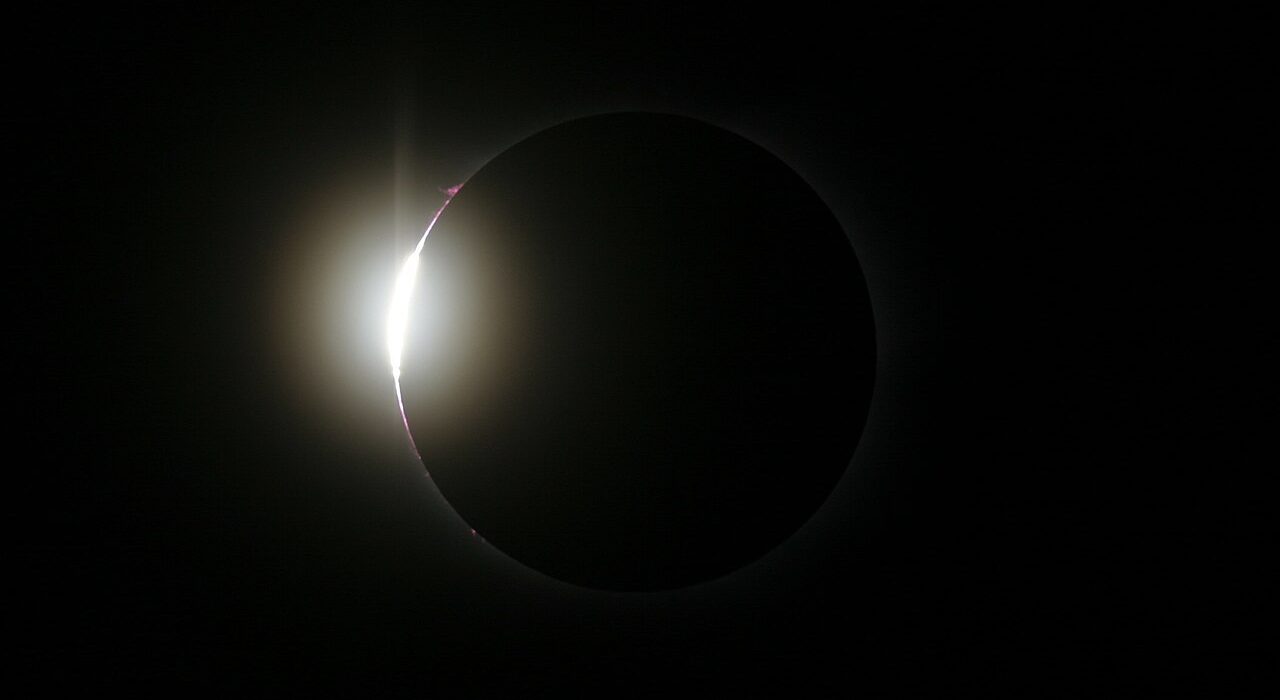
Total Solar Eclipse in Santander — August 12, 2026: Exact Timings and Where to Watch
In Santander, the eclipse will be TOTAL; totality begins at 20:26 and lasts 1 min 04 s. This event marks a historic milestone: it is the first total eclipse visible from the Iberian Peninsula since August 30, 1905, breaking an astronomical silence of 121 years. This technical guide details the exact minutes of each phase, the best viewing spots in the city, and the logistical strategy to ensure visibility given the typical August weather along the Cantabrian coast.
Eclipse Timings in Santander
The chronology of the phenomenon in Santander unfolds in three critical stages that must be monitored with precision. First contact, when the Moon begins to bite into the solar disk initiating the partial phase, occurs at 19:31:22 CEST. The totality phase—the only moment when the sky darkens like night and the solar corona becomes visible—takes place between 20:26:57 and 20:28:01, with maximum eclipse at 20:27:29. The phenomenon concludes definitively at 21:20:09, when the Moon completely leaves the solar disk. These data come from ephemerides calculated by NASA and the Instituto Geográfico Nacional (IGN).
| Fase | Hora local en Santander (CEST) |
|---|---|
| Primer contacto (empieza la fase parcial) | 19:31:22 |
| Empieza la totalidad | 20:26:57 |
| Máximo del eclipse | 20:27:29 |
| Termina la totalidad | 20:28:01 |
| Último contacto (termina la fase parcial) | 21:20:09 |
| Duración de la totalidad | 1 min 04 s |
| Magnitud | 1.0036 |
Source: NASA Five Millennium Catalog. Local times CEST (UTC+2) on August 12, 2026.
It is essential to understand Santander’s position within the path of totality. With a duration of 1 minute and 4 seconds, the city lies on the northern edge of the totality band, far from the central line where the phenomenon lasts longer. The peninsula’s maximum is reached in Oviedo, with 1 minute and 49 seconds of total darkness. Being off the central line means totality will be shorter and the Sun will be lower above the horizon at maximum eclipse. In Santander, the Sun will be at an altitude of approximately 10–12 degrees above the west-northwest horizon during totality, which drastically conditions the choice of viewing location.
Where to watch the eclipse in Santander
The decisive technical criterion for choosing a location in Santander is a clear western horizon. Since totality occurs shortly before sunset, with the Sun at just 10-12 degrees of altitude, any architectural or topographic obstacle in that direction will block the view of the main event. Open spaces with direct visibility toward the sea or low-lying areas to the west are required.
Based on urban cartography and solar orientation, these are the five verified spots for observation:
- Jardines de Pereda (Pereda Gardens): One of the most balanced options. Located facing the bay, they offer a wide maritime horizon to the west. The elevation of the promenade allows for a clear view over the port’s low-rise buildings, minimizing the risk of early obstruction. It is a spacious area, though it will saturate quickly.
- Playa de El Sardinero (El Sardinero Beach): Offers the clearest horizon on the list. Being at sea level and oriented northwest, the probability of low clouds or buildings blocking the Sun is minimal. However, logistics are complex: accessing the site with equipment can be difficult on the sand, and crowds will be massive. Ideal if you prioritize viewing the solar disk over comfort.
- Plaza de Cañadío: Situated in an elevated part of the city, this square provides a privileged perspective. Its orientation and natural height help surpass the downtown building line, offering a clearer window of vision to the west than streets at ground level. It is a strategic point for photographers looking to frame the eclipse with the city in the background.
- Plaza de Pombo: A central pedestrian zone with good space. Although urban, its location allows for some openness toward the west. It is a viable option if access to the coastline is not possible, but it requires verifying on-site that no tall building on Calle Castelar or surroundings cuts the line of sight at 10 degrees of solar altitude.
- Plaza Porticada (Porticoed Square / Plaza de Velarde): The most iconic spot but also the riskiest astronomically. The arcades and surrounding building density can make viewing the low Sun difficult. It is only recommended if an exact point within the square with a direct line of sight to the west can be found, which is complicated. Use it as a cultural backup plan, not as a primary observation location.
The August sky in Cantabria: real probabilities
Weather is the most uncertain variable for astrotourism in northern Spain. According to historical data from AEMET for the Galicia and Cantabrian Coast region, the probability of a completely clear sky in August ranges between 30% and 50%. The main risk is not storms, but evening coastal cloud cover and the region’s typical fog, locally known as ‘orballo’ or sea mist, which usually forms at sunset.
The professional recommendation is not to rely on a single static location. You must have a “Plan B” prepared inland. Cities like Lugo or the interior of Asturias (Oviedo) usually have better clarity statistics when moving away from the direct influence of the Cantabrian Sea. The winning strategy is to monitor AEMET cloud cover forecasts and satellite data in real time 24 to 48 hours before the event. If the forecast indicates low stratus clouds on the Santander coast, move south or inland on the morning of August 12. Mobility is your best insurance against clouds.
How to get to Santander for the eclipse
Cantabria’s infrastructure will face unprecedented pressure on August 12, 2026. Traffic gridlock is expected on main access routes, especially the A-67 and the Cantabrian Motorway (A-8), along with saturation at the train station and Parayas Airport. No specific published routes to this city exist in our current database, making individual planning crucial.
The logistical recommendation is to arrive the day before, on August 11. Attempting to enter Santander on the morning of the eclipse entails a high risk of getting stuck in mile-long traffic jams, which could prevent you from reaching your observation point in time for the partial phase. If traveling by car, park on the outskirts and use public transport or walk to the observation points on the day of the event. If arriving by train or bus, book tickets as far in advance as possible, as capacity will be exhausted months ahead.
Where to sleep: book now or arrive the day before
Accommodations within the path of totality, specifically in attractive coastal cities like Santander, are subject to extreme demand. Bookings for August 2026 began moving in 2025. The honest recommendation is to book accommodation with free cancellation immediately to secure a spot. If prices in Santander are prohibitive or no availability remains, the alternative strategy is to stay in nearby cities outside the path of totality (such as Burgos or Palencia) and travel on the morning of the 12th, although this increases the logistical traffic risk mentioned above.
Safety: 30 seconds you must read
Eye safety is non-negotiable. You must use solar protection glasses certified under standard ISO 12312-2 during ALL partial phases of the eclipse. In Santander, this means from first contact at 19:31 until the start of totality at 20:26:57, and again from the end of totality at 20:28:01 until last contact. Only during the 64 seconds of absolute totality, when the Sun is completely covered and the sky is dark, is it safe to look with the naked eye without protection. The instant the “diamond ring” (the first ray of sunlight) reappears, you must put your glasses back on immediately. For more technical details, consult our complete guide to the eclipse in Spain.
- Eclipse glasses ISO 12312-2 — one per person, purchased in advance to avoid shortages. View options on Amazon ES.
The eclipse near Santander
If weather conditions in Santander are unfavorable or you seek a slightly longer duration of totality, other cities within the path of totality lie less than an hour away. The following comparison table shows key data for nearby locations, allowing for a last-minute decision based on cloud cover.
| Ciudad | Distancia | Duración totalidad | Inicio totalidad |
|---|---|---|---|
| Bilbao | 74 km | 0 min 31 s | 20:27:23 |
| Vitoria-Gasteiz | 115 km | 1 min 04 s | 20:27:43 |
| Burgos | 125 km | 1 min 44 s | 20:28:24 |
| Gijón | 150 km | 1 min 45 s | 20:26:48 |
Make the most of your trip: what to see in Santander
The eclipse occurs at sunset on the 12th, leaving the morning and midday free to explore the city. Santander combines modernist architecture, urban beaches, and top-tier gastronomy. We recommend visiting the Palace of La Magdalena (Palacio de la Magdalena) and strolling through the Botín Centre (Centro Botín) before heading to your observation point. Consult our detailed guide to plan your stay: what to see and do in Santander.
Frequently Asked Questions
What time is the eclipse in Santander?
The partial phase begins at 19:31:22 CEST. Totality runs from 20:26:57 to 20:28:01, with maximum eclipse at 20:27:29. The partial phase ends at 21:20:09.
How long does totality last in Santander?
1 min 04 s. As it lies outside the central line, the duration is shorter than the peninsula’s maximum (Oviedo, 1 min 49 s).
Will the eclipse be total in Santander?
Yes. Santander is within the path of totality with a magnitude of 1.0036. The Moon will completely cover the Sun for 1 min 04 s.
Do I need eclipse glasses?
Yes — ISO 12312-2 certified glasses are required during all partial phases. Only during totality can you view the Sun with the naked eye. Sunglasses do NOT provide protection.
What if it’s cloudy in Santander on August 12?
The probability of clear skies in this area is 30–50% (historical AEMET data). Have a Plan B inland (Lugo, Oviedo) or be ready to move based on the AEMET forecast 24 hours prior. Check the AEMET prediction 24–48 hours in advance and stay mobile.
When will the next total solar eclipse visible from Spain occur?
Very soon: 2027-08-02. An exceptional streak for the same region.
Conclusion
The total solar eclipse of August 12, 2026, is a once-in-a-lifetime event for a generation of travelers in Spain. With careful planning—choosing a location near the central line, checking the AEMET forecast 24–48 hours in advance, wearing ISO 12312-2 glasses during partial phases, and booking accommodation early—you can experience one of nature’s most spectacular shows. Use this guide alongside our city guides and itineraries to design the perfect trip.