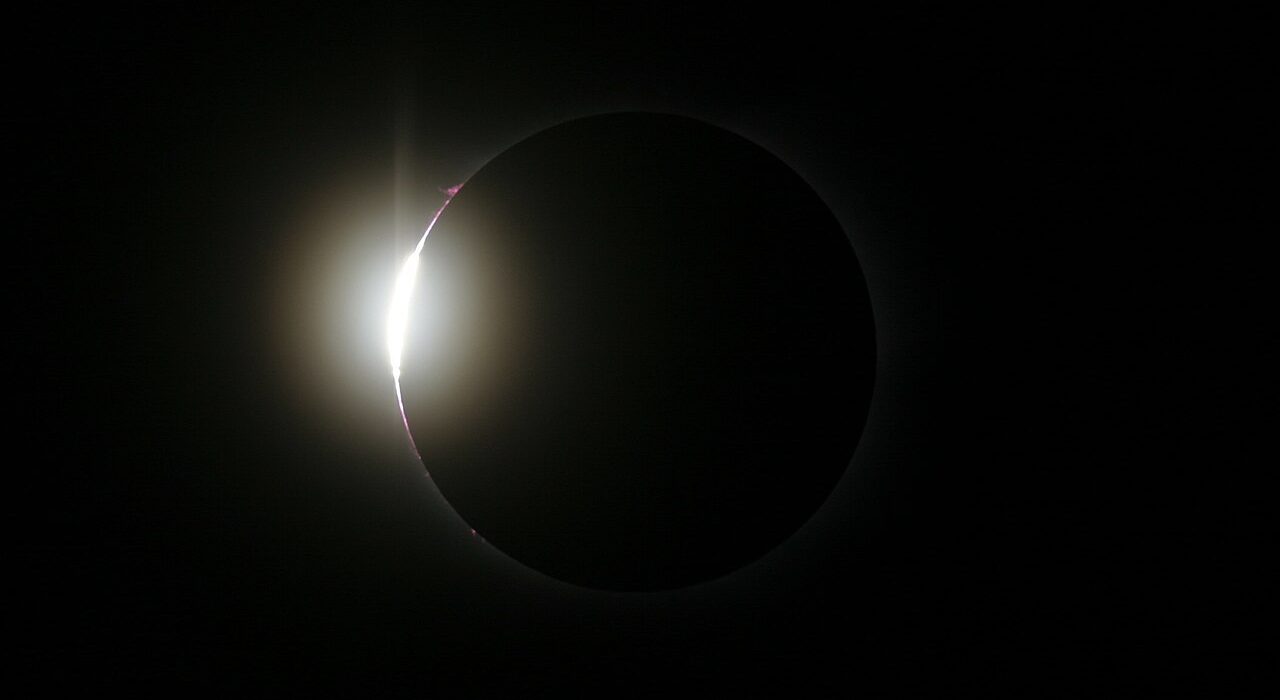
Total Solar Eclipse in Ibiza — August 12, 2026: Exact Timings and Where to Watch
In Ibiza the eclipse will be TOTAL; totality begins at 20:32 and lasts 1 min 04 s. This event marks a historic milestone: it is the first total solar eclipse visible from the Iberian Peninsula since August 30, 1905, breaking an astronomical silence of 121 years. This technical and practical guide provides data verified by NASA and the IGN to help you plan your observation with scientific precision, maximizing your chances of success on an island where the western horizon is the critical factor.
Eclipse Timings in Ibiza
The chronology of the phenomenon in Ibiza is divided into three distinct phases. First contact, when the Moon begins to bite into the solar disk, occurs at 19:39:15 CEST. After nearly an hour of partial phase, total darkness sets in at 20:32:45. Maximum eclipse is recorded at 20:33:18, the moment when coverage reaches 100%. Totality ends at 20:33:49, giving way again to partial light until final contact at 20:53:00. All times are expressed in local summer time (CEST, UTC+2).
| Fase | Hora local en Ibiza (CEST) |
|---|---|
| Primer contacto (empieza la fase parcial) | 19:39:15 |
| Empieza la totalidad | 20:32:45 |
| Máximo del eclipse | 20:33:18 |
| Termina la totalidad | 20:33:49 |
| Último contacto (termina la fase parcial) | 20:53:00 |
| Duración de la totalidad | 1 min 04 s |
| Magnitud | 1.0043 |
Source: NASA Five Millennium Catalog. Local CEST times (UTC+2) for August 12, 2026.
It is essential to contextualize the duration of totality in Ibiza. At 1 minute and 4 seconds, the experience is brief compared to the peninsula’s maximum, which will be reached in Oviedo with 1 minute and 49 seconds. This is because Ibiza lies on the southern edge of the path of totality, far from the central line of the eclipse. Being off the central line means the Moon’s shadow (umbra) grazes the island at high speed. Although the duration is short, the physical experience of sudden night at midday is identical to that on the central line: temperatures will drop sharply, and stars and planets will become visible.
Where to Watch the Eclipse in Ibiza
The selection criterion for an observation spot in Ibiza is non-negotiable: you need a completely clear west-northwest horizon. Since totality occurs approximately one hour before sunset, the Sun will be very low on the horizon, at an altitude of just 10° to 12°. Any obstacle, building, or rise in terrain in that direction will block the view of the phenomenon.
Based on the island’s topography and visibility data, we have selected two verified locations that meet the elevation and orientation requirements:
- Torre des Carregador: Located on the north coast, near Sant Joan de Labritja, this historic fortification offers a privileged elevated position. Its placement on a rocky promontory allows a direct line of sight toward the open sea to the west, minimizing the risk of land-based obstructions. The height above sea level helps “lift” the apparent horizon, gaining crucial seconds of visibility before the Sun touches the water. It is an ideal spot for photographers looking to integrate the tower’s silhouette with the solar corona.
- Mirador del Rei Jaume I (King James I Viewpoint): Situated in the vicinity of Sant Antoni de Portmany, this viewpoint is naturally oriented toward the sunset. It is one of the island’s most famous spots for watching dusk, ensuring correct western alignment. However, due to its popularity, high crowd density is expected. The technical advantage of this point is its accessibility and the breadth of the marine horizon, free from immediate mountains along the eclipse axis. Sea haze could be a factor to consider here more than in the higher elevations of the north.
For both locations, the technical recommendation is to arrive at least two hours in advance to secure a position where your own head, or that of other observers, does not interfere with the line of sight when the Sun is 10 degrees high. In Ibiza, the orography is mountainous; avoiding the island’s interior and south-facing coves is mandatory for this specific event.
The August Sky in the Balearic Islands: Real Probabilities
Weather is the most important uncontrollable variable. According to historical data from the State Meteorological Agency (AEMET) for the Balearic Islands in August, the probability of clear skies ranges between 75% and 85%. This places Ibiza in a favorable position, though not without risks. August is a stable month, but the typical risk during this period is the formation of maritime haze or calima (dust-laden wind) shortly before sunset, right within the eclipse’s time window.
If the 48-hour forecast indicates low cloud cover or dense haze on Ibiza’s west coast, consider a mobility plan. The north coast of Majorca (Pollença or Alcúdia area) tends to present clearer skies at sunset in summer due to breeze dynamics. However, traveling between islands on the day of the eclipse is logistically unfeasible due to transport gridlock. The correct strategy is to monitor cloud models (such as ECMWF or the AEMET model) from August 10 onwards and be prepared to move within the island itself toward the highest available point if haze clings to the coast.
How to get to Ibiza for the eclipse
There are no published car routes from the mainland to Ibiza in our current database, as access necessarily requires sea or air transport. The island has an international airport (IBZ) and ports connected to Denia, Barcelona, and Valencia. For August 12, 2026, total saturation of hotel and transport capacity is expected. Flights and ferries will sell out months in advance.
The logistical recommendation is absolute: arrive on the island the day before, on August 11. Attempting to arrive on the morning of the 12th carries a high risk of delays due to overcrowding. Once on the island, traffic on the day of the eclipse will be heavy, especially on roads leading to the west coast (Sant Antoni and Sant Joan). Use small vehicles or scooters to facilitate parking near viewpoints, as access to the Torre des Carregador (Chargers’ Tower) and Mirador del Rei Jaume I (King James I Viewpoint) is limited.
Where to sleep: book now or arrive the day before
Accommodations within the path of totality in Spain have been booking up since 2025. As a top-tier tourist destination, Ibiza will see additional pressure on its hotel inventory. Our honest recommendation is to book accommodation with free cancellation immediately. If you cannot find availability in Ibiza, consider staying in Ibiza Town or Sant Antoni, which have greater supply, and travel to the observation points on the morning of the 12th. Sleeping outside the path (e.g., southern Majorca) and crossing over on the day of the eclipse is a high-risk strategy due to maritime transport uncertainty.
Safety: 30 seconds you must read
Eye safety is paramount. You must use eclipse glasses certified to the ISO 12312-2 standard during ALL partial phases (from 19:39 to 20:32 and from 20:33 to 20:53). Looking at the Sun without protection during these phases causes irreversible and painless retinal damage. Only during the brief period of totality (1 min 04 s in Ibiza), when the solar disk is 100% covered, is it safe to look with the naked eye. The instant the first ray of light reappears (diamond ring), you must put your glasses back on immediately.
- ISO 12312-2 eclipse glasses — one per person, purchased in advance. View options on Amazon ES.
For a detailed explanation of safe filters and indirect projection methods, consult our complete guide to the eclipse in Spain.
The eclipse near Ibiza
If your plans in Ibiza are complicated by weather or logistics, there are other cities in the path of totality at manageable distances. The following table compares the duration of totality and timings in nearby locations, allowing you to evaluate last-minute alternatives within the archipelago or on the eastern mainland coast.
| Ciudad | Distancia | Duración totalidad | Inicio totalidad |
|---|---|---|---|
| Sant Antoni de Portmany (Ibiza) | 13 km | 1 min 06 s | 20:32:40 |
| Palma | 129 km | 1 min 36 s | 20:31:05 |
| Valencia | 167 km | 1 min 00 s | 20:32:30 |
| Alcúdia (Mallorca) | 180 km | 1 min 29 s | 20:30:34 |
Make the most of your trip: what to see in Ibiza
The eclipse occurs at sunset, leaving the entire day of August 12 free for traditional tourism. Ibiza offers much more than beaches; its UNESCO World Heritage Site status includes Dalt Vila (walled upper town) and the Phoenician-Punic necropolis of Puig des Molins. We recommend visiting these sites in the morning when temperatures are more pleasant. To plan your entire stay, consult our complete guide on what to see and do in Ibiza.
Frequently Asked Questions
What time is the eclipse in Ibiza?
The partial phase begins at 19:39:15 CEST. Totality runs from 20:32:45 to 20:33:49, with maximum eclipse at 20:33:18. The partial phase ends at 20:53:00.
How long does totality last in Ibiza?
1 min 04 s. Being outside the central line, the duration is shorter than the peninsula’s maximum (Oviedo, 1 min 49 s).
Will the eclipse be total in Ibiza?
Yes. Ibiza lies within the path of totality with a magnitude of 1.0043. The Moon will completely cover the Sun for 1 min 04 s.
Do I need eclipse glasses?
Yes — ISO 12312-2 certified glasses are required during all partial phases. Only during totality can you view the Sun with the naked eye. Regular sunglasses do NOT provide protection.
What if it’s cloudy in Ibiza on August 12?
The probability of clear skies in this area is 75–85% (historical AEMET data). The north coast of Majorca (Pollença, Alcúdia) tends to be clearer at sunset. Check the AEMET forecast 24–48 hours in advance and stay mobile.
When will the next total solar eclipse visible from Spain occur?
Very soon: 2027-08-02. An exceptional streak for the same region.
Conclusion
The total solar eclipse of August 12, 2026, is a once-in-a-lifetime event for a generation of travelers in Spain. With planning—choosing a location near the central line, checking the AEMET forecast 24–48 hours in advance, wearing ISO 12312-2 glasses during partial phases, and booking accommodation early—you can experience one of nature’s most spectacular shows. Use this guide alongside our city guides and itineraries to design the perfect trip.