Total Solar Eclipse in Burgos — August 12, 2026: Exact Timings and Where to Watch
In Burgos the eclipse will be TOTAL; totality begins at 20:28 and lasts 1 min 44 s. This event marks the return of a total solar eclipse to the Iberian Peninsula after a 121-year wait, with the last one recorded on August 30, 1905. Burgos occupies a privileged position, practically on the central line of the path of totality, guaranteeing a top-tier astronomical experience. This technical guide details the exact minutes of the phenomenon, analyzes the best observation points within the city considering the sun’s low altitude, and offers verified meteorological data to plan your trip with scientific rigor.
Eclipse Timings in Burgos
The phenomenon unfolds in strict phases that you must time precisely. First contact, when the Moon begins to cover the solar disk initiating the partial phase, occurs at 19:33:21 CEST. Darkness grows progressively until reaching totality, the climax moment which in Burgos extends from 20:28:24 to 20:30:08. Last contact, marking the end of the event, takes place at 21:20:12. All timing data comes from high-precision ephemerides by NASA and the Instituto Geográfico Nacional (IGN), calculated for the geographic coordinates of the Burgalese capital.
| Fase | Hora local en Burgos (CEST) |
|---|---|
| Primer contacto (empieza la fase parcial) | 19:33:21 |
| Empieza la totalidad | 20:28:24 |
| Máximo del eclipse | 20:29:17 |
| Termina la totalidad | 20:30:08 |
| Último contacto (termina la fase parcial) | 21:20:12 |
| Duración de la totalidad | 1 min 44 s |
| Magnitud | 1.0139 |
Source: NASA Five Millennium Catalog. Local times CEST (UTC+2) on August 12, 2026.
With a duration of 1 minute and 44 seconds (104 s), Burgos offers one of the longest totalities in Spain, just 5 seconds short of the peninsular maximum recorded in Oviedo (1 min 49 s). This difference is negligible for the casual observer but confirms that the city lies at the heart of the path of totality. Being on the central line means you will see the solar corona more symmetrically and brightly than at the shadow’s edges. Furthermore, the eclipse magnitude will be 1.0139, ensuring total darkening of the sky, allowing the brightest stars and planets visible at that moment to appear, transforming the August sunset into an artificial night lasting nearly two minutes.
Where to Watch the Eclipse in Burgos
The fundamental technical criterion for choosing a location in Burgos is a clear west-southwest horizon. Since the eclipse maximum occurs approximately one hour before sunset, the Sun will be very low on the horizon, with an altitude of just 10° to 12° during totality. Any obstacle in that direction (buildings, mountains, or dense trees) will truncate the view of the event. Therefore, elevated areas or spots near open riverbeds are superior to enclosed squares.
Based on urban geography and visibility data, these are the three real locations within the city to witness the event, ordered by technical feasibility:
- Arlanzón River and Historic Bridges: This is, without a doubt, the safest option within the urban core. The riverbed offers a strip of open sky towards the west, free from the dense construction of the center. The bridges, especially the Puente de San Pablo (San Pablo Bridge) or the Puente de Santa María (Santa María Bridge), provide a natural elevation that helps overcome possible distant obstacles on the bank. Walking along the banks of the Arlanzón, towards the area of the Paseo de la Isla in its final stretch, allows you to find clearings where the horizon opens up towards the high plains (páramos). It is the place with the best balance between accessibility and a clear viewing angle.
- Paseo del Espolón: The main promenade of Burgos offers space and atmosphere, but presents technical challenges. The row of plane trees lining the walk can block the direct view of the Sun if you stand beneath their canopies. To observe here, you must seek the ends of the promenade or the open areas near the Plaza de España, where the line of sight towards the west is less obstructive. It is a valid option if you prioritize comfort and services, but it requires moving around to find a “patch” of clear sky in the correct direction.
- Plaza Mayor: Located in the medieval heart, it is the natural meeting point, but strictly speaking, the worst astronomical option. Surrounded by historic buildings of considerable height, the western horizon is completely closed from street level. It is only viable if you access a raised hospitality terrace with a southwest orientation or if you position yourself at the side accesses leading towards the river. We recommend using the Plaza Mayor as a meeting point before or after the event, but moving towards the river for the totality phase.
Critical observation note: Data indicates “Elevated high plains with a clean horizon” as the ideal condition for Burgos. If you have mobility, driving 10–15 minutes towards the high areas surrounding the city (such as the road to Atapuerca or zones west of the city) will guarantee you a perfect horizon without building shadows, maximizing the 104 seconds of total darkness.
The August sky in Castile and León: real probabilities
Weather conditions are the most critical risk factor. According to historical data from AEMET for the Castile and León, La Rioja, and Navarra regions, the statistical probability of clear skies in the second half of August ranges between 70% and 85%. This places Burgos among the regions with the best meteorological conditions on the peninsula for this event. However, August is a month of thermal contrasts. Typical risks include extreme daytime heat, with temperatures potentially exceeding 35°C, and the formation of isolated afternoon storms due to convective instability.
The operational recommendation is to monitor short-term forecasts (24–48 hours in advance) via the AEMET website. If low cloud cover is predicted to the west, the “eclipse chasing” strategy involves having a vehicle ready to quickly move to clear areas within the province. Hydration is crucial: you will be exposed to the afternoon sun during the partial phase, which lasts nearly an hour and a half before totality. Bring water, sunscreen, and light clothing, but keep a jacket handy, as temperatures can drop sharply by several degrees during the minutes of totality.
How to get to Burgos for the eclipse
Burgos is a key transport hub in northern Spain, accessible mainly via the AP-1 toll motorway and the A-1 highway from Madrid, and the A-231 from León. Since we have no published guided tours specifically for this event to this city, logistics are up to you. Heavy traffic is expected in the hours leading up to the eclipse, especially on access routes to the path of totality. The masterstroke is to arrive the day before, on August 11. If you arrive on the 12th itself, do so before 14:00 to secure parking and time to scout the terrain. The high-speed train (AVE/Avant) connects Burgos with Madrid and the Basque Country, offering a smart alternative to avoid traffic jams on access roads.
Where to sleep: book now or arrive the day before
The reality of accommodation within the path of totality is critical: hotel rooms are being booked more than a year in advance. As a large city within the path, Burgos will face enormous tourist pressure. Our honest recommendation is to book NOW with free cancellation rates. If the city is fully booked, the alternative strategy is to stay in nearby towns outside the path (such as Miranda de Ebro or Aranda de Duero, though these will also be in high demand) and travel on the morning of the 12th. Do not rely on finding accommodation on the night of the 11th at the last minute.
Safety: 30 seconds you must read
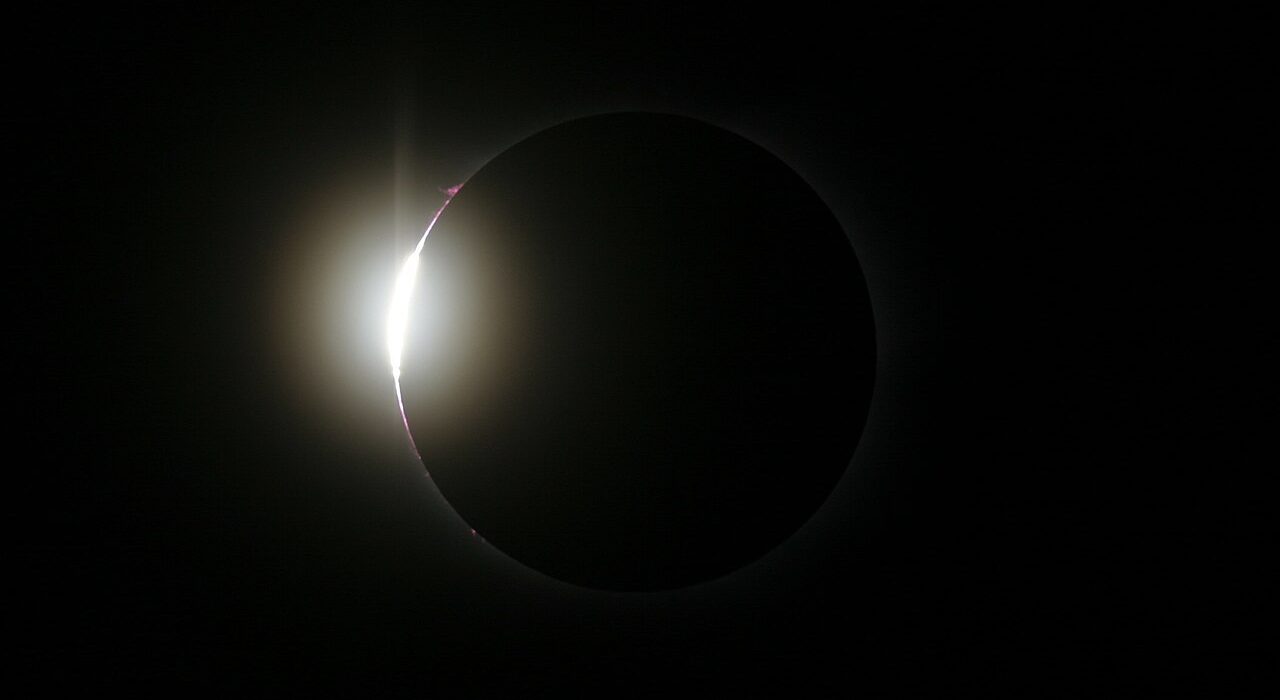
Eye safety is non-negotiable. You must use solar protection glasses certified under the ISO 12312-2 standard during ALL partial phases of the eclipse. This includes everything from first contact (19:33) until the exact start of totality (20:28:24). Only during the brief period of totality (1 min 44 s in Burgos), when the solar disk is 100% covered and the sky darkens like night, is it safe to look with the naked eye. The instant the first ray of sunlight reappears (the “diamond ring”), you must put your glasses back on immediately for the remainder of the partial phase until final contact. Consult our complete guide to the eclipse in Spain for more technical details on solar filtering.
- ISO 12312-2 eclipse glasses — one per person, purchased in advance from specialized stores or reliable distributors. View options on Amazon ES.
The eclipse near Burgos
If logistics or weather conditions require you to move from Burgos, the path of totality covers a wide area of the northern peninsula. The following table compares totality times in nearby cities, allowing you to evaluate whether it is worth traveling a few kilometers to gain seconds of darkness or find a clearer horizon.
| Ciudad | Distancia | Duración totalidad | Inicio totalidad |
|---|---|---|---|
| Palencia | 78 km | 1 min 43 s | 20:29:08 |
| Vitoria-Gasteiz | 101 km | 1 min 04 s | 20:27:43 |
| Logroño | 104 km | 1 min 22 s | 20:28:09 |
| Valladolid | 115 km | 1 min 27 s | 20:29:53 |
Make the most of your trip: what to see in Burgos
The eclipse occurs at sunset on the 12th, leaving the morning and midday free to explore the city. Burgos is a top-tier cultural destination, declared a UNESCO World Heritage Site. We recommend visiting the Gothic Cathedral (Catedral), the Museum of Human Evolution (Museo de la Evolución Humana), and strolling through the Carmen neighborhood. Consult our detailed guide to organize your free time: what to see and do in Burgos. Combining high-level cultural tourism with a historic astronomical phenomenon makes this trip a unique experience.
Frequently asked questions
What time is the eclipse in Burgos?
The partial phase begins at 19:33:21 CEST. Totality runs from 20:28:24 to 20:30:08, with maximum eclipse at 20:29:17. The partial phase ends at 21:20:12.
How long does totality last in Burgos?
1 min 44 s. The city is on the central line, close to the maximum possible duration in Spain.
Will the eclipse be total in Burgos?
Yes. Burgos is within the path of totality with a magnitude of 1.0139. The moon will completely cover the sun for 1 min 44 s.
Do I need eclipse glasses?
Yes — ISO 12312-2 certified glasses during all partial phases. Only during totality can you look at the sun with the naked eye. Sunglasses do NOT provide protection.
What if it is cloudy in Burgos on August 12?
The probability of clear skies in this area is 70-85% (historical AEMET data). BEST statistical weather conditions. Hydration is important. Check the AEMET forecast 24-48 hours in advance and remain mobile.
When will the next total solar eclipse visible from Spain occur?
Very soon: 2027-08-02. An exceptional streak for the same region.
Conclusion
The total solar eclipse of August 12, 2026, is a once-in-a-lifetime event for a generation of travelers in Spain. With planning —choosing a location near the central line, checking the AEMET forecast 24-48 hours in advance, using ISO 12312-2 glasses during partial phases, and booking accommodation in advance— you can experience one of nature’s most impressive spectacles. Use this guide alongside our city guides and itineraries to design the perfect trip.