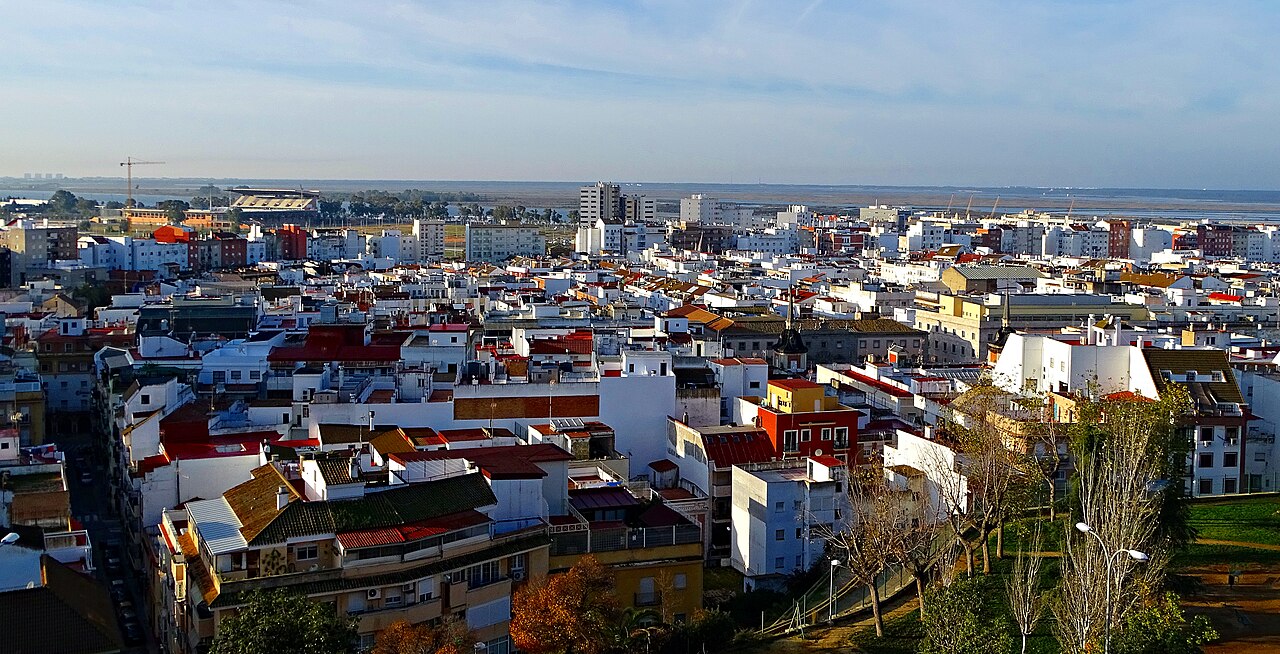
Sevilla → Huelva
94 kmLeaving Seville heading west means entering a landscape that changes pace almost without you noticing, leaving behind the bustle of the capital to breathe the salty Atlantic air in just over an hour. This journey is not simply a 94-kilometer transfer; it is a rapid transition from monumental history to the land of discovery and marshes, where the highway becomes your ally to get there fast or, if you prefer, an invitation to stop in the white villages that dot the route.
How to get from Seville to Huelva: quick summary
The best option for traveling from Seville to Huelva depends entirely on whether you prioritize freedom of movement or the comfort of not driving. If you are looking for total flexibility to explore the towns of El Aljarafe and the coast at your own pace, the car is the undisputed choice, covering the 94 km in just 1 hour and 5 minutes on toll-free highways. On the other hand, if you prefer to relax and read during the journey, the Renfe train offers a solid alternative with 5 daily departures, while the bus stands out as the most economical option for budget-conscious travelers who do not require intermediate stops.
By car from Seville to Huelva
Driving from Seville to Huelva is extremely simple and fast thanks to a network of modern, completely toll-free highways connecting both provincial capitals. The main and most logical route for this destination is to take the A-49, known as the Autovía del V Centenario (V Centenary Highway), which will take you directly to Huelva at no toll cost whatsoever. Although verified data also mentions the availability of the A-66 (Autovía Ruta de la Plata) and the A-4 (Autovía del Sur), these tend to be alternatives for connecting from other points or for longer journeys toward the north or south of Spain, respectively, but the A-49 is the vital artery for this specific route.
The car journey has an estimated duration of 1 hour and 5 minutes, making it a very competitive option compared to public transport if you are in a hurry. Since there are no tolls on any of the mentioned highways (A-66, A-4, A-49), the cost of the trip is strictly limited to fuel and vehicle wear and tear. It is important to keep in mind that, although the driving time is short, traffic leaving Seville can vary depending on the time of day, so it is recommended to avoid peak hours if you want to strictly meet the estimated time of 65 minutes. The road is in good condition, allowing smooth and safe driving throughout the entire route.
By train from Seville to Huelva
The train is a comfortable and direct option for traveling between Seville and Huelva, operated exclusively by Renfe with departures from Seville-Santa Justa station to Huelva station. According to Renfe data, there are 5 daily trains covering this route, offering a reasonable frequency for travelers without a car. The service is mainly divided into two types: the Intercity train, which is the fastest of all with a travel time of 82 minutes and only 1 departure per day, and the MD (Media Distancia) train, which has 4 daily departures and takes approximately 89 minutes to complete the journey.
The train schedule is designed to meet the needs of same-day round-trip travelers or tourists staying overnight in Huelva. The first train leaves at 8:48 in the morning, which is ideal for starting the day early in the city of Huelva, while the last train leaves at 20:50, allowing you to enjoy a relaxed dinner before returning to Seville. By choosing the train, you avoid parking worries at your destination and can enjoy the Andalusian landscape from the window, although you should keep in mind that the total duration (between 1 hour 22 minutes and 1 hour 29 minutes) is slightly longer than by car under optimal traffic conditions.
By bus from Seville to Huelva
The bus is the most economical alternative for getting to Huelva from Seville, with established companies such as FlixBus and ALSA operating direct services. The bus journey takes approximately 75 minutes, which curiously makes it the fastest mode of transport of all those listed, even surpassing the car and the train in theoretical speed, although this may vary slightly depending on urban traffic entering and leaving the city. Ticket prices range from €11 to €29.47, depending on how far in advance you book and the company you choose.
This option is ideal for backpackers, students, or travelers looking to maximize their budget. As it is a direct service, you won’t have to make any transfers, which greatly simplifies the logistics of the trip. However, unlike the car, you lose the flexibility to stop in the towns along the way, and unlike the train, legroom and overall comfort may be inferior depending on the bus model assigned by FlixBus or ALSA. It is advisable to arrive at the Seville bus station early to secure your seat, especially on weekends or public holidays.
Recommended stops along the way
If you decide to make the journey by car, the route is dotted with charming towns that deserve a pause to stretch your legs or discover the essence of the Aljarafe region and the Huelva coast. Here are the verified stops you shouldn’t miss:
- Bollullos de la Mitación: Strategically located on the route, this town is one of the first natural stops after leaving the Seville metropolitan area. It is a quiet place that represents the transition to the countryside, ideal for a quick coffee before venturing further into the province.
- Gines: This municipality is part of the Seville metropolitan area and is known for its quiet, residential atmosphere. It is a perfect stop if you want to see everyday life in the Aljarafe without straying too far from the main highway.
- Gelves: Located very close to the Guadalquivir River, Gelves offers a significant change of scenery as you approach the river area. It is an interesting spot for nature lovers and river views before reaching the open coast.
- Palos de la Frontera: Without a doubt, one of the most important historical stops. Known worldwide for its connection to the Discovery of America, it is a place steeped in history that deserves a visit to understand Huelva’s connection to the ocean.
- San Juan del Puerto: Situated on the Huelva estuary, this town combines maritime tradition with proximity to the capital. It is an excellent stop to sample local cuisine based on seafood in a less crowded setting.
- Trigueros: Further inland, Trigueros offers the tranquility of the towns of the Huelva countryside. It is the ideal place if you want to disconnect from the noise of the highway and enjoy a more rural and peaceful environment.
- Bollullos Par del Condado: Famous for its wine production, this stop is a must for amateur oenologists. The atmosphere of the Condado de Huelva wine region can be felt in its streets, and it is a key point for understanding the economy and culture of the inland area.
- San Juan de Aznalfarache: Known for its privileged views over Seville and the Guadalquivir valley, it is a perfect technical stop at the beginning or end of the journey to enjoy an aerial perspective of the landscape you are about to travel through.
Where to stay in Huelva
When choosing accommodation in Huelva, the city offers several areas suited to different travel styles. While no specific hotels are recommended, certain strategic areas can be identified. For tourists arriving by public transport (train or bus), the most practical option is to look for accommodation in the City Centre or near the Train Station, as you will be able to walk to the main points of interest such as Parque Moret or the Cathedral, saving on taxi costs.
If you are travelling by car and looking for peace and quiet, the residential areas on the outskirts or near Avenida de Andalucía tend to offer apartments and hotels with better prices and easier parking, something that in the historic centre can be more complicated and expensive. Price ranges in Huelva are generally more affordable than in Seville, with budget options for backpackers and mid-to-high-end hotels for families. It is advisable to book in advance if your visit coincides with local events or the summer season, as demand increases considerably due to the sun-and-beach tourism in the province.
Frequently asked questions about the Seville-Huelva route
How long does it take to get from Seville to Huelva?
Travel time varies depending on the means of transport chosen. By car, the journey takes approximately 1 hour and 5 minutes covering 94 km. By bus, the duration is 75 minutes according to FlixBus and ALSA. By train, the time ranges between 82 minutes (Intercity train) and 89 minutes (MD train).
Which is cheaper, the train or the bus?
Generally, the bus is the most economical option. Bus prices with companies such as FlixBus and ALSA range between €11 and €29.47. Although exact train prices are not specified in the data, the lower bus fare (€11) tends to be very competitive compared to standard train fares, making the bus the winning option for the lowest price.
Is it worth renting a car?
Yes, it is worth it if you plan to visit the recommended stops along the route such as Palos de la Frontera, Bollullos Par del Condado or Gelves. Public transport (train and bus) is direct and does not allow for these detours. Additionally, a car gives you total freedom once in Huelva and the journey is short (1h 5min) and toll-free via the A-49.
When is the best time to travel?
The best time depends on your interests, but to avoid crowds and enjoy the towns of the Aljarafe and the coast with good weather, spring and autumn are ideal. If you travel by train, remember that there are 5 daily departures, with the first train at 8:48 and the last at 20:50, which makes it easy to organise day trips at any time of year.
📍 También te puede interesar
Qué ver en Sevilla →
Qué ver en Huelva →