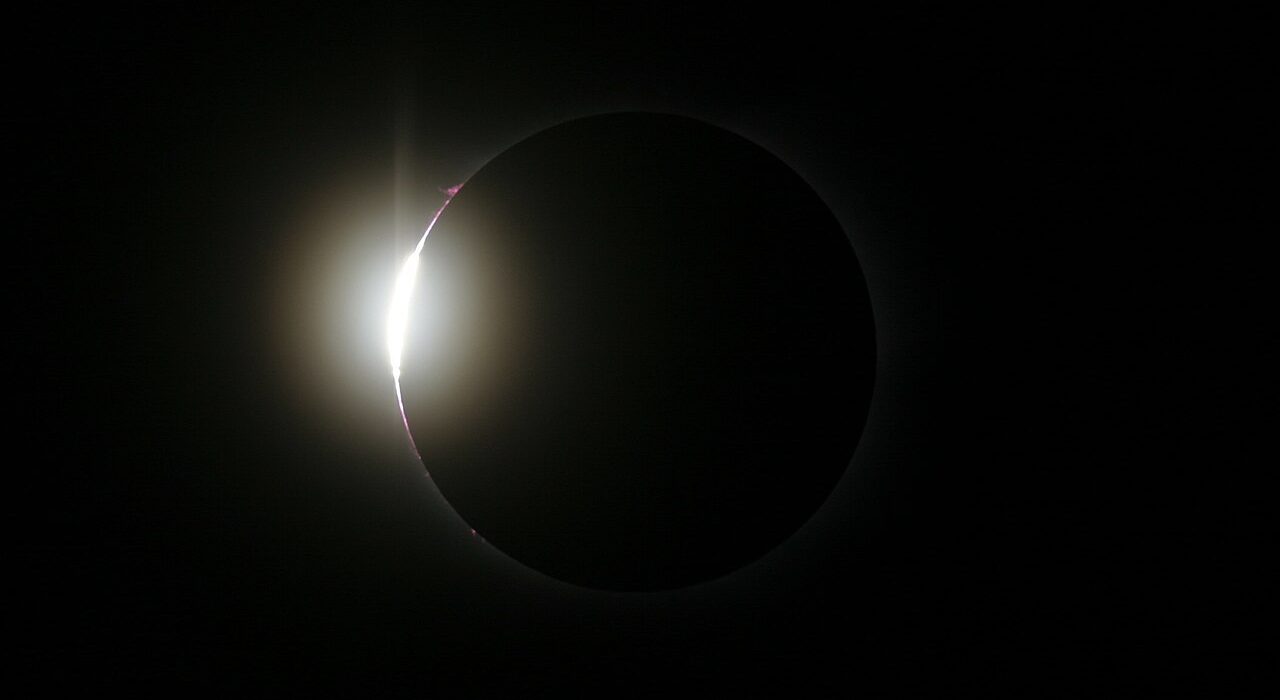
Total Solar Eclipse in Palma — August 12, 2026: Exact Timings and Where to Watch
In Palma the eclipse will be TOTAL; totality begins at 20:31 and lasts 1 min 36 s. This phenomenon marks a historic milestone: it is the first total eclipse visible from the Iberian Peninsula and adjacent islands since August 30, 1905, breaking an astronomical silence of 121 years. Palma de Mallorca occupies a privileged position within the path of totality, offering a significant window of daytime darkness just before sunset. This technical guide details the exact minutes, locations with clear western horizons, and probable weather conditions so you can plan your observation with scientific rigor.
Eclipse Timings in Palma
The event’s chronology follows a precise sequence dictated by orbital mechanics. The partial phase begins at 19:38, when the Moon starts to cover the solar disk. After nearly an hour of progressive darkening, totality is reached. The data comes from NASA ephemerides and the Instituto Geográfico Nacional (IGN), calculated for the city center’s geographic coordinates. It is essential to synchronize your watches to CEST time (UTC+2), as the margin of error for totality is measured in seconds.
| Fase | Hora local en Palma (CEST) |
|---|---|
| Primer contacto (empieza la fase parcial) | 19:38:03 |
| Empieza la totalidad | 20:31:05 |
| Máximo del eclipse | 20:31:53 |
| Termina la totalidad | 20:32:41 |
| Último contacto (termina la fase parcial) | 20:49:22 |
| Duración de la totalidad | 1 min 36 s |
| Magnitud | 1.0152 |
Source: NASA Five Millennium Catalog. Local CEST times (UTC+2) on August 12, 2026.
With a duration of 1 minute and 36 seconds, Palma offers a robust totality experience, although slightly shorter than the maximum recorded on the peninsula in Oviedo (1 minute and 49 seconds). However, the Balearic capital lies practically in the center of the path of totality, with a magnitude of 1.0152. This guarantees that the solar corona will be visible in its fullness, without risk of residual “rings” that might appear at the edges of the band. The central position ensures that the darkness will be profound and associated atmospheric phenomena, such as the sudden drop in temperature, will be perceptible.
Where to Watch the Eclipse in Palma
The deciding factor for choosing a location in Palma is not just safety or space, but solar geometry. Since totality occurs approximately one hour before sunset, the Sun will be very low on the horizon, at an altitude between 10° and 12° in the west-northwest direction. Any obstacle in that line of sight—buildings, mountains, or trees—could cut off observation of the critical moment. Therefore, the priority is a clear western horizon.
Based on urban topography and the required orientation, these are the three verified spots for observation:
- Castell de Bellver (Bellver Castle): This is, without a doubt, the technically superior option. Situated 112 meters above sea level on a wooded hill southwest of the city, the castle offers a 360-degree panorama. Its natural elevation allows views over most of Palma’s buildings and any coastal haze that may accumulate at sea level. From its walls and courtyards, the horizon to the west and southwest is completely free of urban obstacles, guaranteeing a clean view of the descending Sun during totality.
- Playa de Palma: For those seeking an eclipse experience combined with the sea, this coastal stretch east of the city offers an open maritime horizon to the south and southwest. The advantage here is the total absence of land obstructions in the direction of sunset. However, there is a weather risk: the evaporation haze typical of August in the Mediterranean can form near the horizon just at dusk. If the sky is clear, the reflection of the eclipse on the water will add a unique visual dimension to the event.
- Plaza Mayor (Main Square): This is the most central and accessible option, but it requires strategic planning. As an urban space surrounded by mid-rise buildings, the direct view of the low Sun depends on the exact orientation of adjacent streets. To see totality from here, you must position yourself at the western end of the square or on streets leading westward (such as Calle de la Unión or the surroundings of Calle Sant Miquel) to ensure the line of sight is not blocked by facades. It is a valid option if you cannot travel to the outskirts, but optically less reliable than Bellver.
The observational note for this area is clear: the long Mediterranean duration allows combining the event with beach holidays, but accommodation must be booked well in advance due to high tourist demand in August.
The August Sky in the Balearic Islands: Real Probabilities
Weather is the most uncertain variable in astronomical observation. According to historical and climatological data from the State Meteorological Agency (AEMET) for the Balearic Islands in August, the probability of clear skies ranges between 75% and 85%. This makes Majorca a favorable destination, although not without risks. The typical risk at this time of year is not storm clouds, which are less frequent at sunset, but maritime haze and calima (dust-laden wind from Africa).
Haze usually forms due to the temperature difference between the sea and land at the end of the day, creating a low layer that can blur the Sun just as it touches the horizon. Expert advice is to monitor the local forecast 24–48 hours before the event. If models indicate dense haze on the southern coast (Playa de Palma), the Plan B strategy should be to move toward the northern coast of Majorca (areas of Pollença or Alcúdia), which statistically tend to have clearer skies and lower relative humidity at sunset in summer. Mobility flexibility on the 12th will be your best ally against the clouds.
How to get to Palma for the eclipse
On August 12, 2026, a massive influx of visitors is expected on the island. Although no specific bus routes from the mainland have been published for this event, ground logistics will be critical. Traffic on access roads to Palma and ring roads (such as the Vial de Levante or the Ma-20) will suffer severe congestion, especially during the afternoon of the eclipse day.
The operational recommendation is to arrive in the city the day before, on August 11. If you are driving from other parts of the island, make sure to park in permitted areas the night before or on the morning of the 12th, as many areas near optimal viewing points (such as the access to Castell de Bellver) could be restricted or saturated. If you arrive by train from Inca or Manacor, check the special schedules that TIB (Transportes de las Islas Baleares) will likely implement for the night return, given that the eclipse ends almost at 21:00.
Where to sleep: book now or arrive the day before
The reality of the hotel market for total eclipses is relentless: accommodations within the path of totality sell out years in advance. In Palma, occupancy for these dates will be at 100% well before 2026. The honest recommendation is to book a room with a free cancellation policy NOW. If options in Palma city center are sold out or prohibitive, consider staying in nearby towns outside the path of totality (such as Manacor or Llucmajor) and traveling to Palma on the morning of the 12th. Sleeping outside the zone of total shadow is preferable to having no accommodation, provided you can reach a viewing point with a western horizon before 19:30.
Safety: 30 seconds you must read
Eye safety is the absolute priority. You must use glasses with ISO 12312-2 certification during ALL partial phases of the eclipse (from 19:38 to 20:31, and again from 20:32 until the end). Looking at the Sun without adequate protection, even when it is almost covered, can cause permanent and irreversible retinal damage in seconds. Only during the brief period of totality (1 min 36 s in Palma), when the solar disk is 100% covered and the white corona is visible, is it safe to look with the naked eye. As soon as the “diamond ring” (the first ray of light) reappears, you must put your glasses back on immediately.
For more technical details on filters and photography, consult our complete guide to the eclipse in Spain.
- ISO 12312-2 eclipse glasses — one per person, purchased in advance. View options on Amazon ES.
The eclipse near Palma
If your location in Palma is not viable due to crowds or clouds, there are other towns on the island and surrounding areas within the path of totality with similar characteristics. The following table compares duration and times at strategic nearby points so you can evaluate last-minute travel.
| Ciudad | Distancia | Duración totalidad | Inicio totalidad |
|---|---|---|---|
| Alcúdia (Mallorca) | 51 km | 1 min 29 s | 20:30:34 |
| Port de Pollença (Mallorca) | 53 km | 1 min 28 s | 20:30:30 |
| Ibiza | 129 km | 1 min 04 s | 20:32:45 |
| Sant Antoni de Portmany (Ibiza) | 133 km | 1 min 06 s | 20:32:40 |
Make the most of the trip: what to see in Palma
The eclipse occurs at the end of the day, leaving the morning and early afternoon of August 12 free for tourism. Palma is a city with dense and accessible historical heritage. You can visit the Cathedral (La Seu), the Lonja neighborhood, or the Santa Catalina market before heading to your viewing point. Consult our detailed guide to optimize your time: what to see and do in Palma. Combining urban culture with an astronomical event of this magnitude turns the trip into a unique experience.
Frequently Asked Questions
What time is the eclipse in Palma?
The partial phase begins at 19:38:03 CEST. Totality runs from 20:31:05 to 20:32:41, with maximum eclipse at 20:31:53. The partial phase ends at 20:49:22.
How long does totality last in Palma?
1 min 36 s. The city lies on the central line, close to the maximum possible duration in Spain.
Will the eclipse be total in Palma?
Yes. Palma is within the path of totality with a magnitude of 1.0152. The Moon will completely cover the Sun for 1 min 36 s.
Do I need eclipse glasses?
Yes — ISO 12312-2 certified glasses are required during all partial phases. Only during totality can you view the Sun with the naked eye. Regular sunglasses do NOT provide protection.
What if it’s cloudy in Palma on August 12?
The probability of clear skies in this area is 75–85% (historical data from AEMET). The north coast of Majorca (Pollença, Alcúdia) tends to be clearer at sunset. Check the AEMET forecast 24–48 hours in advance and remain mobile.
When will the next total solar eclipse visible from Spain occur?
Very soon: 2027-08-02. An exceptional streak for the same region.
Conclusion
The total solar eclipse of August 12, 2026, is a once-in-a-lifetime event for a generation of travelers in Spain. With careful planning — choosing a location near the central line, checking the AEMET forecast 24–48 hours ahead, wearing ISO 12312-2 glasses during partial phases, and booking accommodation well in advance — you can experience one of nature’s most spectacular displays. Use this guide alongside our city guides and itineraries to design the perfect trip.