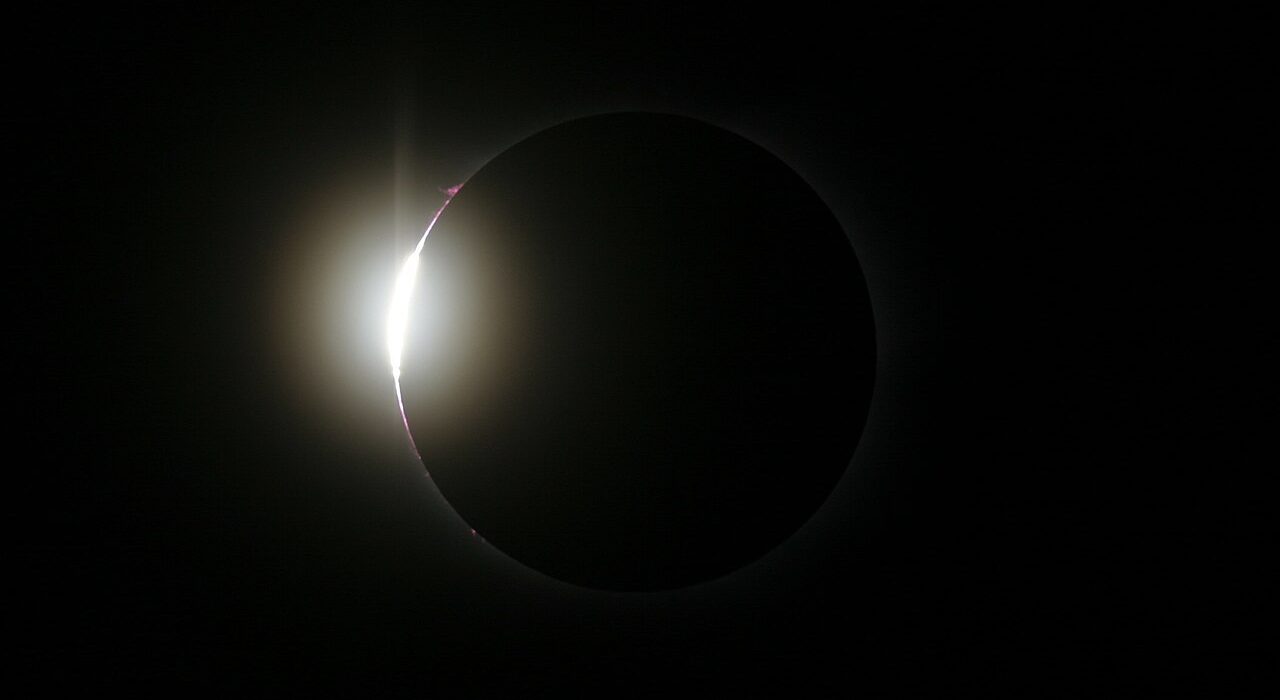
Total Solar Eclipse in Valencia — August 12, 2026: Exact Timings and Where to Watch
In Valencia the eclipse will be TOTAL; totality begins at 20:32:30 and will last exactly 1 minute and 00 seconds. This phenomenon marks the return of a total solar eclipse to the Iberian Peninsula after a 121-year wait, the last one having occurred on August 30, 1905. This technical guide provides data verified by NASA and the IGN (National Geographic Institute), along with an observation strategy adapted to Valencia’s urban geography, where the sun’s low altitude above the horizon will be the determining factor for a successful viewing.
Eclipse Timings in Valencia
The sequence of events in Valencia will unfold during the late afternoon and evening of August 12, 2026, under official summer time CEST (UTC+2). The phenomenon begins with first contact, when the Moon bites into the solar disk, initiating the partial phase. After nearly an hour of progressive darkening, totality is reached—the climax moment where day turns into night. Finally, last contact marks the end of the astronomical event. The following data comes from ephemeris calculations by NASA and the Instituto Geográfico Nacional.
| Fase | Hora local en Valencia (CEST) |
|---|---|
| Primer contacto (empieza la fase parcial) | 19:38:24 |
| Empieza la totalidad | 20:32:30 |
| Máximo del eclipse | 20:33:00 |
| Termina la totalidad | 20:33:30 |
| Último contacto (termina la fase parcial) | 21:01:16 |
| Duración de la totalidad | 1 min 00 s |
| Magnitud | 1.0036 |
Source: NASA Five Millennium Catalog. Local CEST times (UTC+2) on August 12, 2026.
It is essential to understand Valencia’s position within the path of totality. With a duration of 60 seconds, the city lies on the southern edge of the shadow band, far from the central line where duration is maximum. For context, the point of longest duration on the peninsula will be Oviedo, with 1 minute and 49 seconds of total darkness. In Valencia, being on the limit of the band, the lunar umbra passes grazing the area, which implies that any obstacle on the western horizon could cut off the view of totality prematurely. Precision in location is, therefore, more critical here than in northern Spain.
Where to watch the eclipse in Valencia
The technical criterion for selecting an observation spot in Valencia is unique and non-negotiable: a completely clear western or southwestern horizon is required. Since totality occurs approximately one hour before sunset, the Sun’s altitude will be very low, ranging between 10° and 15° above the horizon. Any building, mountain, or tree in that direction will block the view of the main event.
Based on urban topography and visibility data, these are the optimal locations within the city:
- Playa de la Malvarrosa (Malvarrosa Beach): This is, without a doubt, the location with the highest guarantee of success within the urban area. The vastness of the Mediterranean Sea offers a clean western horizon free of obstacles down to the waterline. The sand allows for a 360-degree view without interference from tall buildings. It is the recommended option for those seeking absolute visual safety and space to set up tripods.
- Jardín del Turia (Turia Gardens): The old riverbed offers a green alternative but requires strategic selection of the section. The park is flanked by trees and bridges. To see the eclipse, you must position yourself in open areas, preferably near the western bridges (such as the Pont de l’Exposició or the Pont de les Flors), ensuring that tree canopies do not obscure the low solar trajectory. Avoid the densely wooded areas inside the park.
- Umbracle (City of Arts and Sciences): This outdoor sculptural garden provides an elevated, oriented platform that can work well if the west side of the structure is chosen. The absence of immediate buildings in that direction within the complex helps, although the surrounding avant-garde architecture requires verifying sightlines on-site before the day of the event.
- Bioparc Valencia: Although it is an enclosed venue with dense vegetation, it features clearings and designed observation zones. The key here is anticipation: you will need to identify a specific clearing with a view to the west days in advance. It is not the safest option due to vegetation density, but it offers a controlled and safe environment for families if the exact location is managed well.
- Plaza de la Virgen: Located in the heart of the historic center, this is an iconic but technically risky spot. The height of surrounding buildings and the narrowness of adjacent streets may hide the Sun during its final degrees of altitude. It is only viable if you position yourself at the western end of the square and verify that the silhouette of the Cathedral or neighboring buildings does not intercept the line of sight at 10° altitude.
The August sky in Valencian Community: real probabilities
Weather is the most important uncontrollable variable. According to historical climate data from the State Meteorological Agency (AEMET) for the Valencian Community and southern Catalonia in August, the probability of clear skies ranges between 70% and 80%. This indicates that, statistically, Valencia is a solid bet for the event. However, there is a typical risk at this time of year: coastal haze or calima, which can blur the lunar contour during totality, reducing the phenomenon’s contrast.
The risk of convective storms is low during the sunset time slot, but not null. The professional recommendation is to monitor high-resolution models (such as the ECMWF HRES or IFS) starting 48 hours before the event. If the forecast indicates low clouds to the west, the Plan B strategy should involve a quick move inland or northward, where the topography might break the layer of coastal clouds. The Valencian coast is excellent if the sky is clear, but vulnerable if there are low stratus clouds.
How to Get to Valencia for the Eclipse
We currently do not have published guided tours specifically for this event on our website, so logistics are up to the traveler. Valencia boasts excellent high-speed rail (AVE) connections from Madrid, Barcelona, and Seville, making it an accessible hub. However, massive congestion on access routes is expected on August 12, 2026. It is estimated that hundreds of thousands of people will travel toward the path of totality.
The masterstroke is to arrive the day before, on August 11. Attempting to enter the city or park near observation sites on the morning of the 12th will be extremely difficult due to traffic closures and vehicle density. If driving, park in a remote park-and-ride facility and use public transport or walk. If traveling by train, book tickets as far in advance as possible, as seats will sell out months ahead. Mobility on the day of the event will be slow; plan your route to the observation site at least 3 hours before first contact.
Where to Sleep: Book Now or Arrive the Day Before
Hotel demand within the path of totality has skyrocketed since the eclipse details were confirmed. Accommodations in Valencia and its surroundings have been booked since 2025. Our honest and direct recommendation is to secure lodging with free cancellation immediately. If prices in central Valencia surge, consider staying in nearby towns outside the path (such as Requena or Utiel) and commuting on the morning of the 12th. Sleeping outside the zone of totality is a valid strategy and often more economical, provided you secure round-trip transportation for the same day.
Safety: 30 Seconds You Must Read
Eye safety is paramount. You must use ISO 12312-2 certified solar protection glasses during ALL partial phases of the eclipse, from first contact (19:38) until the start of totality (20:32:30). Only during the exact minute of totality, when the Sun is completely covered and only the white corona is visible, can you view it with the naked eye without protection. The instant the “diamond ring” reappears (end of totality at 20:33:30), you must put your glasses back on immediately for the remainder of the partial phase until last contact. For more technical details, consult our complete guide to the eclipse in Spain.
- ISO 12312-2 Eclipse Glasses — one per person, purchased in advance from specialized stores or certified suppliers. View options on Amazon ES.
The Eclipse Near Valencia
If conditions in Valencia are not optimal or you seek a slightly longer duration of totality, other cities within the path are located at short distances. The following comparison table shows data for nearby locations, allowing you to evaluate whether a last-minute trip north or inland is worth it to gain extra seconds of darkness.
| Ciudad | Distancia | Duración totalidad | Inicio totalidad |
|---|---|---|---|
| Teruel | 115 km | 1 min 34 s | 20:31:04 |
| Sant Antoni de Portmany (Ibiza) | 155 km | 1 min 06 s | 20:32:40 |
| Cuenca | 165 km | 0 min 53 s | 20:32:06 |
| Ibiza | 167 km | 1 min 04 s | 20:32:45 |
Make the Most of Your Trip: What to See in Valencia
The eclipse occurs at sunset, leaving the entire day of August 12 free for conventional tourism. Valencia is a compact, walkable city, ideal for combining science and culture. We recommend visiting the Lonja de la Seda (Silk Exchange) and the Mercado Central (Central Market) in the morning, saving the afternoon to head to your observation point. Consult our detailed guide to plan your stay: what to see and do in Valencia.
Frequently Asked Questions
What time is the eclipse in Valencia?
The partial phase begins at 19:38:24 CEST. Totality runs from 20:32:30 to 20:33:30, with maximum eclipse at 20:33:00. The partial phase ends at 21:01:16.
How long does totality last in Valencia?
1 min 00 s. As it lies outside the central line, the duration is shorter than the peninsula’s maximum (Oviedo, 1 min 49 s).
Will the eclipse be total in Valencia?
Yes. Valencia is within the path of totality with a magnitude of 1.0036. The Moon will completely cover the Sun for 1 min 00 s.
Do I need eclipse glasses?
Yes — ISO 12312-2 certified glasses are required during all partial phases. Only during totality can you view the Sun with the naked eye. Sunglasses do NOT provide protection.
What if it’s cloudy in Valencia on August 12?
The probability of clear skies in this area is 70–80% (historical data from AEMET). The coast offers a good combination for an unobstructed horizon. Check the AEMET forecast 24–48 hours in advance and remain mobile.
When will the next total solar eclipse visible from Spain occur?
Very soon: 2027-08-02. An exceptional streak for the same region.
Conclusion
The total solar eclipse of August 12, 2026, is a once-in-a-lifetime event for a generation of travelers in Spain. With planning —choosing a location near the central line, checking the AEMET forecast 24–48 hours beforehand, wearing ISO 12312-2 glasses during partial phases, and booking accommodation early— you can experience one of nature’s most spectacular shows. Use this guide alongside our city guides and itineraries to design the perfect trip.