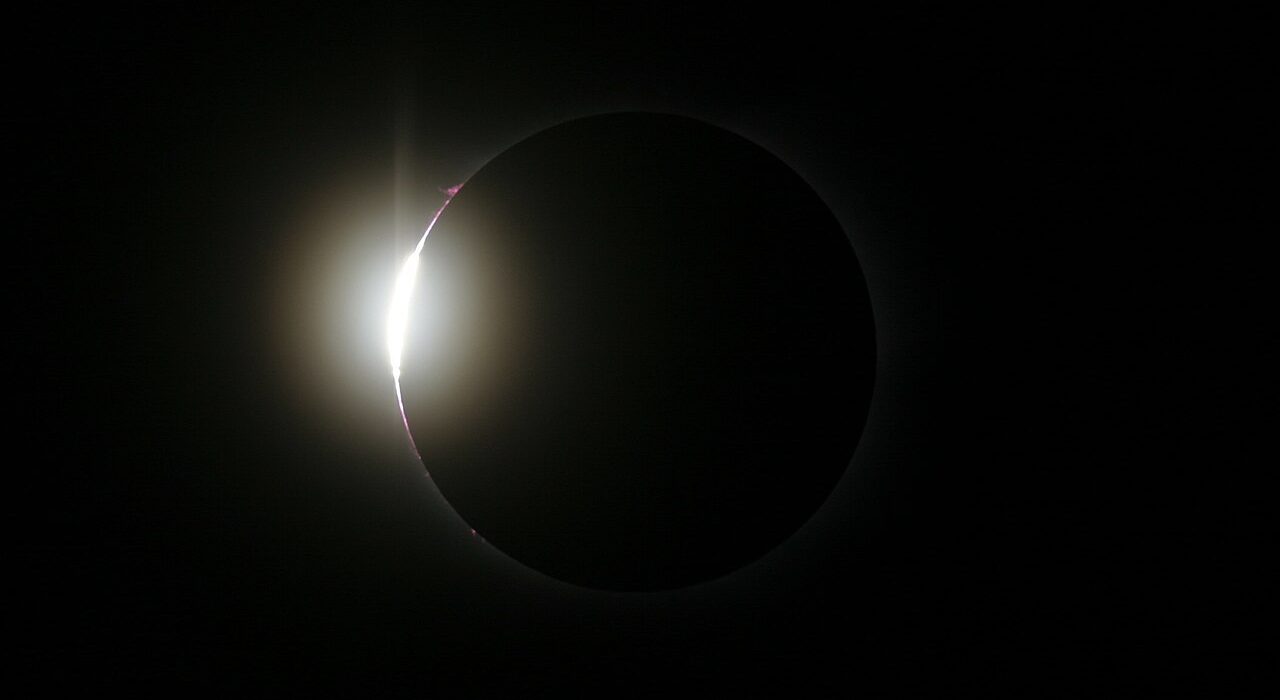
Total Solar Eclipse in Zaragoza — August 12, 2026: Exact Times and Where to Watch
In Zaragoza the eclipse will be TOTAL; totality begins at 20:29 and lasts 1 min 25 s. This event marks a historic milestone: it is the first total eclipse visible on the Iberian Peninsula since August 30, 1905. After 121 years of waiting, Aragon takes center stage in global astronomical attention. This technical guide compiles data verified by NASA and IGN so you can plan your observation with millimetric precision, avoiding common location and safety errors.
Eclipse Timings in Zaragoza
The phenomenon unfolds in critical phases you must time carefully. First contact, when the Moon touches the solar disk initiating the partial phase, occurs at 19:34:40 CEST. Darkness will grow progressively for nearly an hour. The event culminates with totality, a fleeting 85-second interval between 20:29:02 and 20:30:27. Last contact, when the Sun regains its full circular shape, closes the spectacle at 21:07:33. All times are in local summer time (CEST).
| Fase | Hora local en Zaragoza (CEST) |
|---|---|
| Primer contacto (empieza la fase parcial) | 19:34:40 |
| Empieza la totalidad | 20:29:02 |
| Máximo del eclipse | 20:29:44 |
| Termina la totalidad | 20:30:27 |
| Último contacto (termina la fase parcial) | 21:07:33 |
| Duración de la totalidad | 1 min 25 s |
| Magnitud | 1.0074 |
Source: NASA Five Millennium Catalog. Local CEST (UTC+2) hours on August 12, 2026.
Although Zaragoza will experience totality, it is not located on the central line of the eclipse path. The peninsula’s maximum duration will be recorded in Oviedo, lasting 1 minute and 49 seconds. Being off the central line means the Moon’s shadow will cross the city tangentially, reducing the duration of total darkness to 1 minute and 25 seconds. However, the visual experience of the solar corona and the sudden temperature drop will be identical to any other point within the path. The difference is purely chronological: you will have less time to observe chromosphere details before light reappears.
Where to watch the eclipse in Zaragoza
The decisive criterion for choosing a location in Zaragoza is not aesthetics, but solar geometry. During totality, the Sun will be very low above the west-northwest horizon, at an altitude of just 10 to 12 degrees. Any obstacle in that direction (buildings, mountains, or tall trees) will block the view of the main event. You need a completely clear western horizon.
Based on urban topography and the required orientation, these are the five verified spots for observation:
- Puente de Piedra (Stone Bridge): Offers a classic perspective over the Ebro. The advantage is the river’s breadth toward the west. However, crowd density will be extreme. You must position yourself on the north side of the bridge to prevent the basilica’s structure or riverside buildings from blocking the low Sun.
- Parque Grande José Antonio Labordeta: The safest option for families. Open areas near the main entrance or the upper esplanades offer clear lines of sight to the west. Vegetation is abundant, so you should avoid wooded interior zones and seek wide clearings with an unobstructed horizon.
- Puente del Tercer Milenio (Third Millennium Bridge): Geometrically superior for this eclipse. Its elevated structure and orientation allow an unobstructed view of the western horizon over the water. Being farther from the historic center, the probability of obstructions from skyscrapers is lower. Ideal for long-distance photography.
- Torre Mirador del Pilar: Height is your ally. By ascending the tower, you surpass most urban obstructions. You will have a 360-degree view, guaranteeing that the western horizon is clear even if there are low clouds at ground level. This is the premium option to avoid ground-level crowds, although it requires booking in advance.
- Plaza del Pilar: Only recommended if you position yourself at the western ends of the square. The center and eastern side are compromised by the basilica and the town hall. If you manage to find a gap with a clear view toward Calle Alfonso I or the bridge, the experience is unique due to the monumental setting, but the risk of obstruction is high.
Remember the key observation note: the climate in August is very dry, but the Sun’s low position demands that your location has clear “ground” to the west. Do not assume that being in an open square guarantees visibility; physically verify the horizon line before the 12th.
The August sky in Aragon: real probabilities
According to historical records from AEMET for the Aragon, La Rioja, and Navarre regions, August presents the best statistical weather conditions for astronomical observation. The probability of clear skies ranges between 70% and 85%. This places Zaragoza as one of the most reliable locations within the path of totality in Europe.
However, summer climatology in the Ebro valley entails specific risks. Temperatures can exceed 35°C during the afternoon, requiring constant hydration while you wait. More critical is the risk of isolated evening thunderstorms. Although the probability of rain is low, a summer storm can develop rapidly at sunset. The technical recommendation is to monitor very short-term forecasts (nowcasting) 24 and 48 hours before the event. If instability is forecast, have a mobile Plan B ready: being in a car allows you to travel 50 kilometers in 40 minutes to find a break in the clouds.
How to get to Zaragoza for the eclipse
Mobility logistics will be the biggest challenge. A massive influx of astro-tourists is expected toward the path of totality. Access roads and areas around observation points will suffer traffic gridlock from the morning of August 12. There are no specific published routes to this city in our current database, so the strategy must be individual.
The master stroke is to arrive the day before, on August 11. If you arrive on the same day, do so before 14:00. Public transport, especially the high-speed train (AVE), is the smartest option to avoid the stress of parking. If you travel by car, park in peripheral areas and walk to your observation point; attempting to park near the Puente de Piedra (Stone Bridge) or the Tercer Milenio stadium on the day of the event will be practically impossible. Mobility within the city will be restricted in central zones during the eclipse hours.
Where to sleep: book now or arrive the day before
The reality of the hotel market is harsh: accommodations within the path of totality have been selling out since 2025. Zaragoza, being a large city, has more capacity than small towns, but demand will exceed supply. The honest recommendation is to book accommodation with free cancellation immediately. If you cannot find a place in the city, look for lodging in nearby hubs outside the path (such as Teruel or Huesca capital) and travel on the morning of the 12th. Sleeping outside the path is better than not sleeping at all or staying home.
Safety: 30 seconds you must read
Visual safety is non-negotiable. You must use ISO 12312-2 certified solar protection glasses during ALL partial phases. This includes from first contact (19:34) until the start of totality (20:29), and again from the end of totality (20:30) until last contact. Only during the 85 seconds of absolute totality, when the Sun is completely covered, can you look with the naked eye without protection. As soon as the “diamond ring” reappears, put your glasses back on immediately. Ultraviolet radiation can damage your retina irreversibly without causing immediate pain. Consult our complete guide to the eclipse in Spain for more technical details.
- ISO 12312-2 eclipse glasses — one per person, purchased in advance. View options on Amazon ES.
The eclipse near Zaragoza
If you cannot secure a location in Zaragoza or seek to maximize the duration of totality, nearby cities within the path offer viable alternatives. Duration varies slightly depending on latitude and proximity to the central line. Below, we compare data from neighboring localities so you can evaluate whether the trip is worth it.
| Ciudad | Distancia | Duración totalidad | Inicio totalidad |
|---|---|---|---|
| Teruel | 146 km | 1 min 34 s | 20:31:04 |
| Logroño | 157 km | 1 min 22 s | 20:28:09 |
| Salou (Tarragona) | 180 km | 1 min 08 s | 20:29:31 |
| Vitoria-Gasteiz | 198 km | 1 min 04 s | 20:27:43 |
Make the most of the trip: what to see in Zaragoza
The eclipse occurs at sunset, leaving the morning and early afternoon of August 12 free for cultural tourism. Zaragoza is a compact city rich in history. We recommend visiting the Basílica del Pilar (Basilica of Our Lady of the Pillar), the Aljafería Palace, and the Museo del Pilar before heading to your observation point. Consult our complete guide: what to see and do in Zaragoza. Combining culture and science will make your trip memorable beyond the 85 seconds of darkness.
Frequently Asked Questions
What time is the eclipse in Zaragoza?
The partial phase begins at 19:34:40 CEST. Totality runs from 20:29:02 to 20:30:27, with maximum eclipse at 20:29:44. The partial phase ends at 21:07:33.
How long does totality last in Zaragoza?
1 min 25 s. Being outside the central line, the duration is shorter than the peninsular maximum (Oviedo, 1 min 49 s).
Will the eclipse be total in Zaragoza?
Yes. Zaragoza lies within the path of totality with a magnitude of 1.0074. The Moon will completely cover the Sun for 1 min 25 s.
Do I need eclipse glasses?
Yes — ISO 12312-2 certified glasses are required during all partial phases. Only during totality can you view the Sun with the naked eye. Sunglasses do NOT provide protection.
What if it’s cloudy in Zaragoza on August 12?
The probability of clear skies in this area is 70–85% (historical AEMET data). Statistically the BEST weather conditions. Hydration is important. Check the AEMET forecast 24–48 hours in advance and remain mobile.
When will the next total solar eclipse visible from Spain occur?
Very soon: 2027-08-02. An exceptional streak for the same region.
Conclusion
The total solar eclipse of August 12, 2026, is a once-in-a-lifetime event for a generation of travelers in Spain. With planning —choosing a location near the central line, checking the AEMET forecast 24–48 hours in advance, using ISO 12312-2 glasses during partial phases, and booking accommodation early— you can experience one of nature’s most spectacular shows. Use this guide alongside our city guides and itineraries to design the perfect trip.