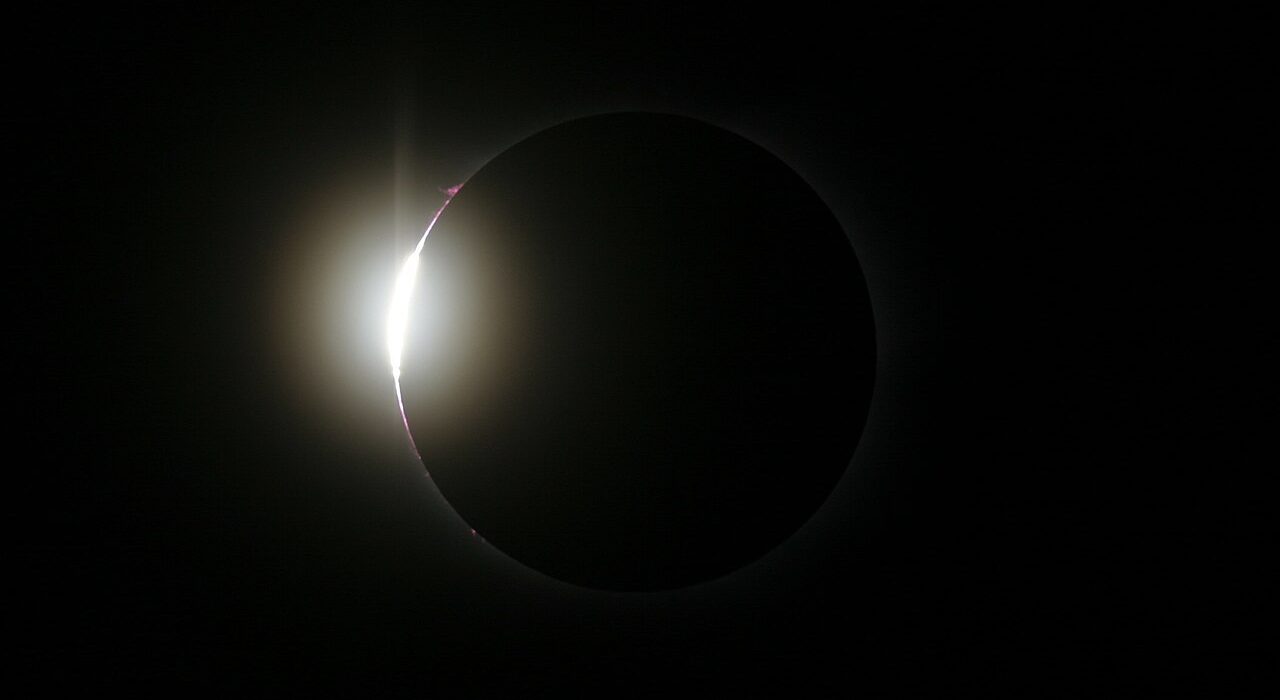
Total Solar Eclipse in Bilbao — August 12, 2026: Exact Timings and Where to Watch
In Bilbao the eclipse will be TOTAL; totality begins at 20:27 and will last 0 min 31 s. This phenomenon marks a historic milestone: it will be the first total solar eclipse visible on the Iberian Peninsula since August 30, 1905, after a 121-year wait. This technical and practical guide offers astronomical data verified by NASA and the IGN (National Geographic Institute), along with specific observation recommendations tailored to the topography and climate of the Basque Country. If you plan to be in the city, here is the critical information to ensure you don’t miss a single second of darkness.
Eclipse Timings in Bilbao
The event’s chronology follows official summer time (CEST, UTC+2). The phenomenon begins with the partial phase at 19:31, when the Moon first touches the solar disk. After nearly an hour of progressive darkening, the totality phase is reached at 20:27. This is the critical moment: the sky will darken as if it were night, causing temperatures to drop and triggering streetlight sensors. The total phase concludes at 20:27:54, giving way once again to the partial phase until the event ends at 21:19.
| Fase | Hora local en Bilbao (CEST) |
|---|---|
| Primer contacto (empieza la fase parcial) | 19:31:47 |
| Empieza la totalidad | 20:27:23 |
| Máximo del eclipse | 20:27:38 |
| Termina la totalidad | 20:27:54 |
| Último contacto (termina la fase parcial) | 21:19:07 |
| Duración de la totalidad | 0 min 31 s |
| Magnitud | 1.0011 |
Source: NASA Five Millennium Catalog. Local CEST times (UTC+2) for August 12, 2026.
It is essential to understand the context of these timings. With a totality duration of only 31 seconds, Bilbao sits on the northern edge of the path of totality. This means the experience will be brief but intense. For comparison, the maximum duration on the peninsula will be reached in Oviedo (1 min 49 s), much closer to the eclipse’s central line. Being in Bilbao implies that the Moon will completely cover the Sun, but the “diamond ring” effect and Baily’s beads will be very fleeting. Nevertheless, the opportunity to witness a total eclipse within the national territory is so exceptional that the 31 seconds fully justify the trip.
Where to Watch the Eclipse in Bilbao
The number one criterion for choosing your location in Bilbao is not aesthetics, but physics: the WESTERN horizon must be absolutely clear. During totality, the Sun will be extremely low on the horizon, at an altitude of just 10° to 12°. Any tall building, mountain, or cluster of trees in that direction will block the view of the main event. In a city surrounded by mountains like Bilbao, this drastically limits viable options.
Based on urban topography and the required orientation, these are the three verified strategic points for observation:
- Mirador de Artxanda (Artxanda Viewpoint): This is, without a doubt, the safest and most recommended option. Situated 234 meters above the city, the viewpoint offers an elevated perspective that clears most obstacles on the urban horizon. From here, the view toward the west and northwest is wide, minimizing the risk of surrounding mountains obscuring the Sun at the critical moment. Additionally, there is enough space for groups, although high attendance is expected. It is the ideal spot for those seeking to guarantee a direct view of the solar disk.
- Puente de La Salve (La Salve Bridge): Offers a unique, open perspective toward the estuary and the Cantabrian Sea in a northwesterly direction. As an elevated structure over the water, it eliminates street-level obstacles. However, it is a critical transit point and is very likely to become overcrowded or have pedestrian traffic closed for safety reasons. If you choose this spot, you must arrive well in advance and have a quick exit plan, as post-eclipse congestion will be massive.
- Plaza Nueva: This is a “calculated risk” option. Although it is an open, central space, it is surrounded by considerably tall buildings. It is only viable if you position yourself at the western end of the square and have a clear line of sight to the west between the buildings. We do not recommend this point for serious astronomical observation unless you have verified on-site that building shadows will not cover the Sun at 20:27. It is better suited for experiencing the social atmosphere of the event than for technical observation.
Critical observation note: Given that totality is so brief (31 s), any obstacle on the western horizon is unacceptable. If weather permits, consider moving slightly west of the city or toward higher areas of the Biscay coast if you can find a clear maritime horizon.
The August Sky in the Basque Country: Real Probabilities
Weather is the factor with the greatest uncertainty for this event in northern Spain. According to historical data from AEMET for the Cantabrian Coast and Galicia zones, the probability of clear skies in August ranges between 30% and 50%. The main risk is not summer storms, but low cloud cover and coastal fog typical of late afternoon and evening in this region, known locally as ‘orballo’ or sea mist.
The Sun will be only 10° high; this is dangerous because low clouds (stratus) tend to form or accumulate near the maritime horizon at sunset. A cloud layer at 500 meters could completely hide the eclipse even if the sky above is blue. The professional strategy is flexibility: monitor the AEMET forecast 24 and 48 hours in advance. If the model indicates low cloud cover on the Bilbao coast, having a “Plan B” inland (toward Vitoria-Gasteiz or southern Álava) or moving west (toward Santander or Asturias) could make the difference between seeing the eclipse or seeing only gray clouds.
How to Get to Bilbao for the Eclipse
Mobility logistics on August 12, 2026, will be complex. A massive influx of travelers toward the path of totality is expected. There are no specific routes published on our website for driving to Bilbao from other cities for this event, so the recommendation is to use public transport whenever possible. The train (Renfe) and bus are the most reliable options to avoid gridlock on the AP-8 and A-8 motorways, which are forecast to suffer severe congestion.
If you must drive, the golden rule is: arrive the day before (August 11). Attempting to enter or leave Bilbao on the afternoon of the eclipse is a bad idea; access roads will turn into giant parking lots. Park your vehicle on the 11th and move on foot or by metro on the 12th. Bilbao’s metro network is efficient and will take you to key points such as La Salve Bridge or the stations providing access to the Artxanda Funicular.
Where to Sleep: Book Now or Arrive the Day Before
Hotel availability within the path of totality is running out years in advance. Accommodations in Bilbao and surrounding areas have been being booked intensively since 2025. Our honest recommendation is to book an option with free cancellation NOW to secure your spot. If prices in Bilbao are prohibitive or there is no availability, consider staying in nearby cities outside the path of totality (such as San Sebastián or Logroño) and traveling on the morning of the 12th. However, keep in mind that return traffic will be heavy.
Safety: 30 Seconds You Must Read
Eye safety is non-negotiable. You must use ISO 12312-2 certified solar protection glasses during ALL partial phases of the eclipse (from 19:31 until 20:27, and again from 20:27:54 until the end). Only during the 31 seconds of absolute totality, when the Sun is completely covered and only the white corona is visible, can you look with the naked eye and remove your glasses. The instant the first ray of light reappears (diamond ring), you must put your glasses back on immediately. For more technical details, consult our complete guide to the eclipse in Spain.
- ISO 12312-2 Eclipse Glasses — one per person, purchased in advance. Do not use normal sunglasses, X-rays, or smoked glass. View options on Amazon ES.
The Eclipse Near Bilbao
If conditions in Bilbao are not optimal or you are looking for a longer totality, these are the nearby cities within the path of totality where the phenomenon will last longer. The difference in minutes can be significant for the photographic and visual experience.
| Ciudad | Distancia | Duración totalidad | Inicio totalidad |
|---|---|---|---|
| Vitoria-Gasteiz | 51 km | 1 min 04 s | 20:27:43 |
| Santander | 74 km | 1 min 04 s | 20:26:57 |
| Logroño | 98 km | 1 min 22 s | 20:28:09 |
| Burgos | 120 km | 1 min 44 s | 20:28:24 |
Make the Most of Your Trip: What to See in Bilbao
The eclipse occurs at sunset, so you will have the entire day of August 12 to enjoy the city. Bilbao has evolved from an industrial hub to a global cultural reference point. We recommend visiting the Guggenheim Museum, strolling through the Casco Viejo (the Seven Streets), and trying local gastronomy via pintxos (Basque tapas). Consult our detailed guide to plan your tourist route: what to see and do in Bilbao. Combining culture and astronomy will make this trip an unforgettable experience.
Frequently Asked Questions
What time is the eclipse in Bilbao?
The partial phase begins at 19:31:47 CEST. Totality runs from 20:27:23 to 20:27:54, with maximum eclipse at 20:27:38. The partial phase ends at 21:19:07.
How long does totality last in Bilbao?
0 min 31 s. Being outside the central line, the duration is shorter than the peninsula’s maximum (Oviedo, 1 min 49 s).
Will the eclipse be total in Bilbao?
Yes. Bilbao lies within the path of totality with a magnitude of 1.0011. The Moon will completely cover the Sun for 0 min 31 s.
Do I need eclipse glasses?
Yes — ISO 12312-2 certified glasses are required during all partial phases. Only during totality can you view the Sun with the naked eye. Sunglasses do NOT provide protection.
What if it’s cloudy in Bilbao on August 12?
The probability of clear skies in this area is 30–50% (historical AEMET data). Have a Plan B inland (Lugo, Oviedo) or be ready to move based on the AEMET forecast 24 hours prior. Check the AEMET forecast 24–48 hours in advance and stay mobile.
When will the next total solar eclipse visible from Spain occur?
Very soon: 2027-08-02. An exceptional streak for the same region.
Conclusion
The total solar eclipse of August 12, 2026, is a once-in-a-lifetime event for a generation of travelers in Spain. With planning —choosing a location near the central line, checking the AEMET forecast 24–48 hours in advance, wearing ISO 12312-2 glasses during partial phases, and booking accommodation early— you can experience one of nature’s most spectacular shows. Use this guide alongside our city guides and itineraries to design the perfect trip.