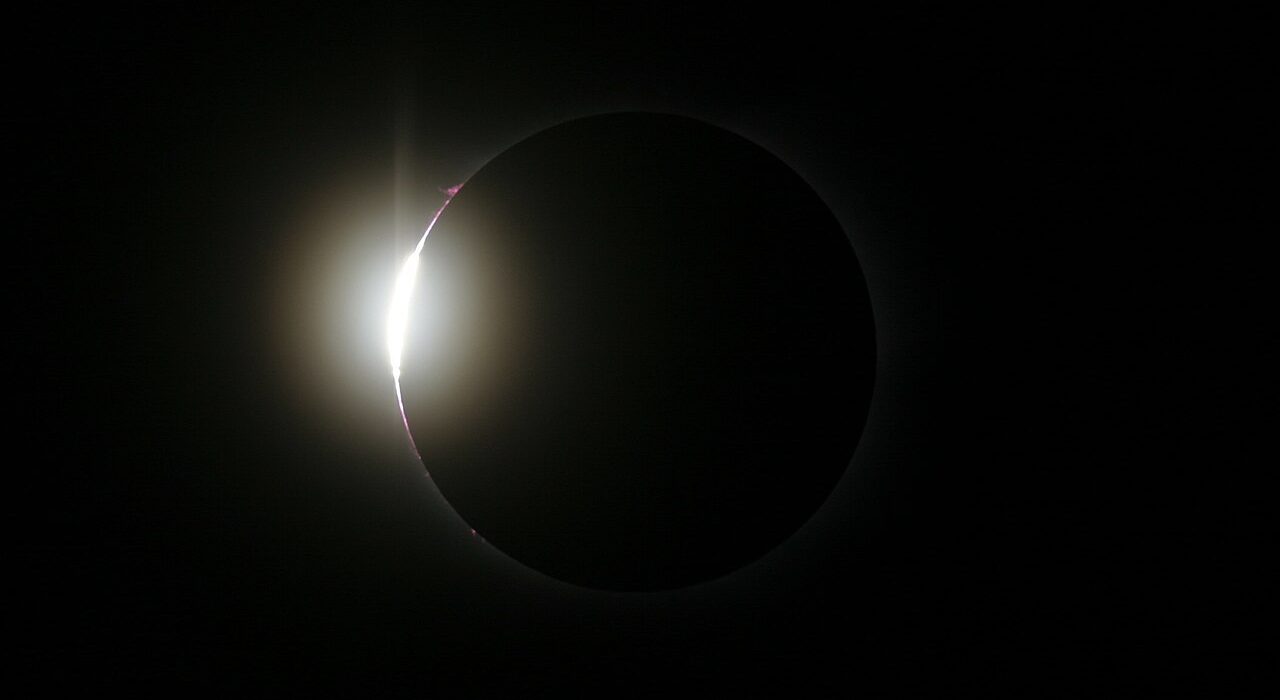
Total Solar Eclipse in A Coruña — August 12, 2026: Exact Timings and Where to Watch
In A Coruña the eclipse will be TOTAL; totality begins at 20:27 and lasts 1 min 17 s. This phenomenon marks a historic milestone: it is the first total solar eclipse visible from the Iberian Peninsula since August 30, 1905, breaking a waiting period of 121 years. This guide offers astronomical data verified by NASA and the IGN (National Geographic Institute), along with a practical strategy to ensure visibility in a city where coastal weather plays a decisive role.
Eclipse Timings in A Coruña
The phenomenon unfolds in three critical phases that every observer must time. First contact, the moment the Moon begins to bite into the solar disk, occurs at 19:30:56 CEST. The partial phase advances for nearly an hour until the Moon completely covers the Sun. Totality, the only moment when looking without protection is safe, begins at 20:27:40 and ends at 20:28:57. Last contact, when the Sun regains its circular shape, takes place at 21:22:01. All times are expressed in local summer time (CEST, UTC+2) according to ephemerides from the Instituto Geográfico Nacional.
| Fase | Hora local en A Coruña (CEST) |
|---|---|
| Primer contacto (empieza la fase parcial) | 19:30:56 |
| Empieza la totalidad | 20:27:40 |
| Máximo del eclipse | 20:28:19 |
| Termina la totalidad | 20:28:57 |
| Último contacto (termina la fase parcial) | 21:22:01 |
| Duración de la totalidad | 1 min 17 s |
| Magnitud | 1.005 |
Source: NASA Five Millennium Catalog. Local CEST times (UTC+2) on August 12, 2026.
It is essential to contextualize the duration of totality in A Coruña. At 1 minute and 17 seconds, the experience is full and dramatic, but we are located at the southern limit of the path of totality. For comparison, the maximum duration on the peninsula is reached in Oviedo, where darkness will last 1 minute and 49 seconds. Being in A Coruña means being within the safe zone of totality, but not on the central line; this implies that the lunar shadow will move faster and the final “diamond ring” effect will be more abrupt. However, for the casual observer, the 30-second difference is imperceptible compared to the visual impact of the solar corona.
Where to Watch the Eclipse in A Coruña
Selecting an observation point in A Coruña hinges on one non-negotiable technical criterion: a clear west-northwest horizon. During totality, the Sun will sit very low, at an altitude of approximately 10 to 12 degrees. Any building, hill, or structure obstructing this view will ruin the experience. You need an elevated spot or a location facing the open sea.
Based on urban topography and the required orientation, these are the optimal spots within the city:
- Monte de San Pedro: Undoubtedly the best technical option within the municipality. Situated 135 meters above sea level, it offers an unobstructed 360-degree panorama. Its elevation reduces the risk of coastal fog (“orballo”) obscuring the Sun during those critical minutes. Furthermore, its orientation toward the Atlantic Ocean guarantees a clean western horizon. It is ideal for photography, though high attendance is expected.
- Jardines de Méndez Núñez: A central and accessible option, but with limitations. While it offers sea views, the line of buildings along Avenida de la Marina and the promenade’s own topography may interfere with a Sun this low (10°). It is viable only if you position yourself at the westernmost end of the garden, near the boundary with the port area, ensuring nothing blocks your line of sight to the sunset.
- Playa de Riazor: The sand provides a clear western horizon, meeting the primary requirement. However, in August, this beach is extremely crowded. The advantage is space: you can walk meters toward the water if people block your view. The downside is humidity and the potential for sea mist, which often rises at dusk in this part of the estuary.
- Plaza de María Pita: Not recommended for this specific eclipse. Although it is the heart of the city and an iconic landmark, it is surrounded by 19th-century buildings exceeding 15–20 meters in height. Given that the Sun will be barely 10 degrees above the horizon, building shadows will almost certainly cover the eclipse before totality arrives. This spot is useful only if you have access to a high terrace or rooftop with permission in adjacent buildings.
The August Sky in Galicia: Real Probabilities
The most critical variable in A Coruña is not astronomy, but meteorology. According to historical data from the State Meteorological Agency (AEMET) for the Galician coast in August, the probability of a completely clear sky ranges between 30% and 50%. The main risk is low cloud cover and advective fog rolling in from the Atlantic at dusk, precisely when the eclipse occurs.
The smart strategy is not to rely on luck, but on mobility. If the AEMET forecast 24 hours in advance indicates “low clouds” or “fog” on the A Coruña coast, you must activate a Plan B inland. Moving 40–50 kilometers toward the interior, toward areas like Lugo or even crossing into Asturias (Oviedo), drastically increases the chances of a clear sky, as maritime influence diminishes. Do not commit to a single observation point; the priority is seeing totality, even if that means driving on the morning of the 12th.
How to get to A Coruña for the eclipse
Travel logistics will be complex. Thousands of visitors are expected to saturate access routes on the 12th. If you are traveling from the south or center of Galicia, the natural route passes through Santiago. You can consult our detailed guide to plan that leg: route from Santiago De Compostela to A Coruña.
Astrotourism experts are clear: do not attempt to arrive on the day of the eclipse if you live more than an hour away. Outbound traffic after the event (starting at 21:30) will gridlock the AP-9 and AG-55 motorways. The masterstroke is to arrive the day before, the 11th, enjoy the city, and keep your car ready with a full tank to move to Plan B if A Coruña’s sky wakes up overcast.
Where to sleep: book now or arrive the day before
Hotel availability in the path of totality is running out months in advance. Accommodations in A Coruña and surrounding areas have been booked since 2025 for this event. If you do not have a reservation yet, the situation is critical. My honest advice: immediately book any option with free cancellation to secure your spot. Alternatively, consider staying in cities outside the path of totality but well-connected (such as Lugo or Ponferrada) and driving there on the morning of the 12th. Sleeping outside the eclipse zone is cheaper and gives you the flexibility to choose the best sky that morning.
Safety: 30 seconds you must read
Eye safety is absolute. During the partial phases (from 19:30 to 20:27 and from 20:28 to 21:22), solar radiation is dangerous and can cause permanent blindness. You must wear glasses certified to ISO 12312-2 standards at all times. Only during the brief period of totality (1 min 17 s in A Coruña), when the Sun is 100% covered and the sky darkens like night, can you remove your glasses and look directly at the solar corona. As soon as the first ray of light reappears (diamond ring), put your glasses back on immediately. For more technical details, consult our complete guide to the eclipse in Spain.
- ISO 12312-2 eclipse glasses — one per person, purchased in advance. View options on Amazon ES.
The eclipse near A Coruña
If the weather in A Coruña is unfavorable, the advantage of being in the north of the peninsula is the proximity to other zones within the path of totality. The following table compares data from nearby cities that could offer better sky conditions or a longer duration of the phenomenon.
| Ciudad | Distancia | Duración totalidad | Inicio totalidad |
|---|---|---|---|
| Lugo | 80 km | 1 min 24 s | 20:28:07 |
| Ponferrada | 174 km | 1 min 27 s | 20:28:44 |
| Oviedo | 206 km | 1 min 49 s | 20:27:05 |
| Gijón | 223 km | 1 min 45 s | 20:26:48 |
Make the most of your trip: what to see in A Coruña
The eclipse occurs at sunset, leaving the entire day of the 12th free for urban tourism. A Coruña is a compact, walkable city, ideal for visiting before the event. We recommend our local guide to organize your day: what to see and do in A Coruña. The Tower of Hercules, the only Roman lighthouse still in operation in the world, is a symbolic place to await sunset, although remember that for the eclipse you need an open horizon, not a lighthouse blocking the view.
Frequently Asked Questions
What time is the eclipse in A Coruña?
The partial phase begins at 19:30:56 CEST. Totality runs from 20:27:40 to 20:28:57, with maximum eclipse at 20:28:19. The partial phase ends at 21:22:01.
How long does totality last in A Coruña?
1 min 17 s. As it lies outside the central line, the duration is shorter than the peninsula’s maximum (Oviedo, 1 min 49 s).
Will the eclipse be total in A Coruña?
Yes. A Coruña is within the path of totality with a magnitude of 1.005. The Moon will completely cover the Sun for 1 min 17 s.
Do I need eclipse glasses?
Yes — ISO 12312-2 certified glasses are required during all partial phases. You can only look at the Sun with the naked eye during totality. Sunglasses do NOT provide protection.
What if it’s cloudy in A Coruña on August 12?
The probability of clear skies in this area is 30–50% (historical AEMET data). Have a Plan B inland (Lugo, Oviedo) or be ready to move based on the AEMET forecast 24 hours in advance. Check the AEMET prediction 24–48 hours beforehand and stay mobile.
When will the next total solar eclipse visible from Spain occur?
Very soon: 2027-08-02. An exceptional streak for the same region.
Conclusion
The total solar eclipse of August 12, 2026, is a once-in-a-lifetime event for a generation of travelers in Spain. With careful planning — choosing a location near the central line, checking the AEMET forecast 24–48 hours in advance, wearing ISO 12312-2 glasses during partial phases, and booking accommodation early — you can experience one of nature’s most spectacular shows. Use this guide alongside our city guides and itineraries to design the perfect trip.