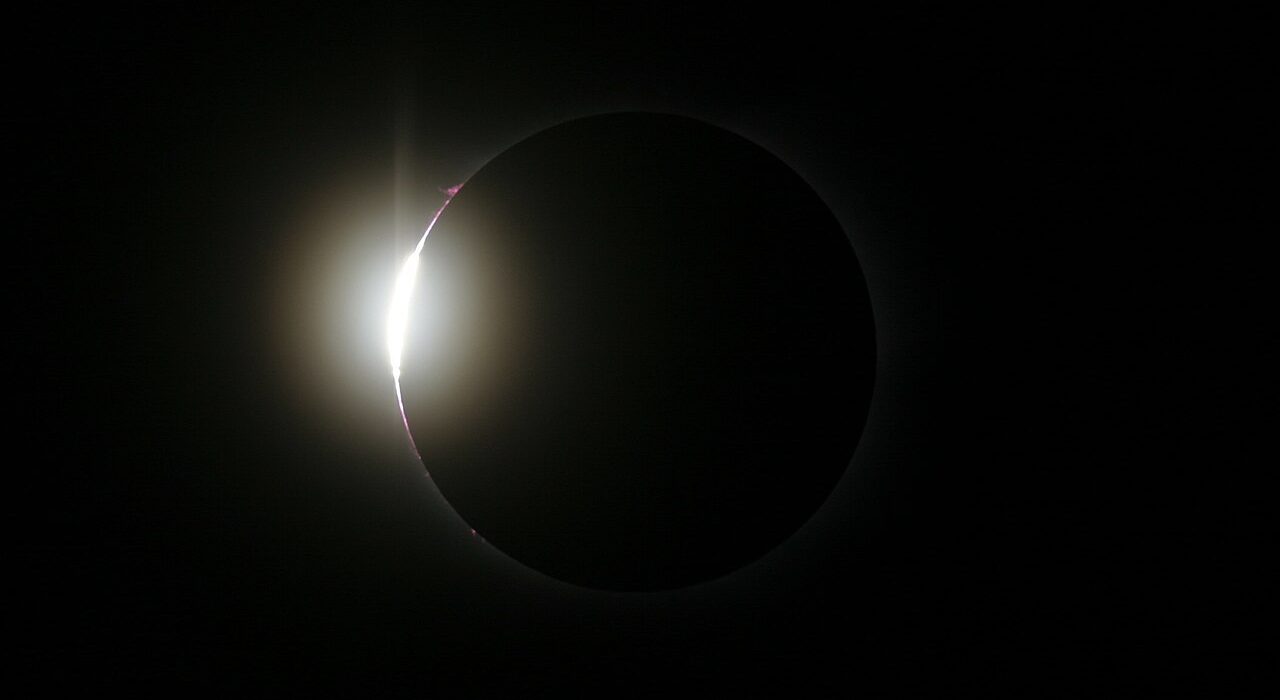
Total solar eclipse in Oviedo — August 12, 2026: exact times and where to watch
In Oviedo the eclipse will be TOTAL; totality begins at 20:27 and lasts 1 min 49 s. This event marks the first total solar eclipse visible from the Iberian Peninsula since August 30, 1905, breaking an astronomical silence of 121 years. Oviedo occupies a privileged position within the path of totality, offering one of the longest durations in the country with excellent urban accessibility. This guide details precise timings, locations with the best western horizons, and the logistical strategy to ensure optimal viewing.
Eclipse timetable in Oviedo
The sequence of the phenomenon follows a strict rhythm dictated by celestial mechanics. First contact, the moment the Moon begins to bite into the solar disk, occurs at 19:31:19 CEST. The partial phase advances for nearly an hour until the Moon’s shadow completely covers the Sun. Totality, the only safe moment to look without protection, takes place between 20:27:05 and 20:28:54. Last contact, when the Sun regains its circular shape, closes the event at 21:21:06. All temporal data comes from ephemerides verified by NASA and the Instituto Geográfico Nacional (IGN).
| Fase | Hora local en Oviedo (CEST) |
|---|---|
| Primer contacto (empieza la fase parcial) | 19:31:19 |
| Empieza la totalidad | 20:27:05 |
| Máximo del eclipse | 20:28:00 |
| Termina la totalidad | 20:28:54 |
| Último contacto (termina la fase parcial) | 21:21:06 |
| Duración de la totalidad | 1 min 49 s |
| Magnitud | 1.0155 |
Source: NASA Five Millennium Catalog. Local times CEST (UTC+2) on August 12, 2026.
Oviedo is not just a stopover; it is one of the critical nodes of the path of totality in Spain. With 1 minute and 49 seconds of total darkness, the Asturian capital surpasses many other mainland towns that will barely reach 90 seconds. Being on the central line of the path guarantees a symmetrical eclipse: the Moon will cover the Sun exactly through the center. This maximizes observation time of the solar corona and reduces alignment margins of error for telescopes. For the casual observer, those almost two minutes make the difference between seeing a ring of fire and experiencing night in the middle of the day.
Where to Watch the Eclipse in Oviedo
The determining factor for choosing a location in Oviedo is not space, but the horizon. Since the eclipse maximum occurs barely an hour before sunset, the Sun will be very low on the west-northwest horizon, at an altitude between 10° and 20°. Any building, mountain, or tree in that direction will block the view of totality. The absolute priority is finding elevated points or squares with a clear western orientation.
Based on urban topography and the list of available public spaces, these are the best options within the city center:
- Plaza de la Catedral (Cathedral Square): Located in the upper part of the historic district, it offers a natural topographical advantage over the rest of the city. Being elevated reduces the risk of low buildings blocking the Sun in its final minutes. It is a strategic spot if you can secure a gap with a view to the west.
- Campo de San Francisco: The city’s green lung provides the necessary space to avoid dangerous crowds. However, it is crucial to seek areas free of trees toward the west. If trees block the view, this park loses its utility for totality, although it remains suitable for the initial partial phases.
- Plaza Daoiz y Velarde (Daoiz and Velarde Square): This wide, open square, located near the train station, lacks significant vertical obstacles in its immediate perimeter. Its orientation and lack of adjacent tall buildings make it one of the safest bets for a clean horizon without leaving the center.
- Plaza de América (America Square): Known for its spaciousness and proximity to the park, it allows for a 360-degree view if the shadow of neighboring buildings is avoided. It is a solid option for large groups needing to spread out.
- Plaza de la Constitución (Constitution Square): Although central and busy, its elevated position relative to the river and its openness toward certain side streets can offer acceptable lines of sight if the density of buildings in the immediate surroundings is avoided.
Critical observation note: The astronomical dossier explicitly recommends the surrounding heights, such as Monte Naranco. If you have a vehicle and weather permits, leaving the urban core for higher elevations west of the city will drastically increase your chances of success by raising your artificial horizon.
The August Sky in Asturias: Real Probabilities
Weather is the uncontrollable variable. According to historical data from AEMET for the Cantabrian Coast and Galicia, August presents a probability of clear skies ranging between 30% and 50%. The main risk is not torrential rain, but low cloud cover, persistent morning fog, or the typical evening ‘orballo’ (drizzle). In August, atmospheric stability is greater than in spring, but coastal humidity can form cloud banks at dusk just as the eclipse occurs.
The professional strategy is mobility. Do not commit to a single location in Oviedo on the 12th. You must monitor the AEMET forecast 24 and 48 hours in advance. If models indicate compact cloud cover west of Oviedo, the mandatory Plan B is to move inland. Towns like Lugo or areas of inland Asturias usually have less maritime influence and clearer skies in summer. Having a car full of gas and a route mapped toward the interior is as important as having protective glasses.
How to get to Oviedo for the eclipse
We currently have no specific guided routes published for this event on our website, so logistics are up to you. Oviedo is a well-connected transport hub, but on August 12, 2026, demand will far exceed supply. The A-66 and A-8 highways will suffer severe congestion, especially in the hours leading up to the eclipse (afternoon of the 12th) and during the departure (night of the 12th).
The tactical recommendation is to arrive the day before, on August 11. If traveling by train, Oviedo Station drops you right in the center, close to the recommended squares. If driving from Madrid, Barcelona, or the south, allow ample safety margins. Traffic will gridlock at access points to the path of totality. Arriving on the morning of the event is risky; arriving the night before guarantees you will be in position before the roads saturate.
Where to sleep: book now or arrive the day before
The reality of the hotel market for total eclipses is relentless. Accommodations within the path of totality in Asturias have been booking up since 2025. For August 2026, occupancy in Oviedo and surrounding areas is likely to reach 100%, with very high dynamic pricing. Our honest advice is to book accommodation with a free cancellation policy immediately. If you cannot find a room in Oviedo, look for a hotel in cities outside the path (such as León or Valladolid) and travel early on the morning of the 12th. Sleeping outside the path is better than not sleeping at all or staying home.
Safety: 30 seconds you must read
Visual safety is non-negotiable. During the partial phases (from 19:31 to 20:27 and from 20:28 to 21:21), solar radiation is sufficient to cause permanent, painless retinal damage. You must wear ISO 12312-2 certified glasses at all times, except during absolute totality. In Oviedo, you have a window of 1 minute and 49 seconds (from 20:27:05 to 20:28:54) to remove your glasses and view the black Sun with the naked eye. As soon as the first ray of light reappears (the diamond ring), put your glasses back on immediately. For more technical details, consult our complete guide to the eclipse in Spain.
- ISO 12312-2 eclipse glasses — one per person, purchased in advance. Do not use regular sunglasses, X-rays, or smoked glass. View options on Amazon ES.
The eclipse near Oviedo
If the weather in Oviedo is unfavorable, note that the path of totality is narrow but crosses several nearby towns. The following table compares timings and duration in neighboring localities so you can evaluate a last-minute mobility plan.
| Ciudad | Distancia | Duración totalidad | Inicio totalidad |
|---|---|---|---|
| Gijón | 26 km | 1 min 45 s | 20:26:48 |
| Ponferrada | 108 km | 1 min 27 s | 20:28:44 |
| Lugo | 143 km | 1 min 24 s | 20:28:07 |
| Santander | 166 km | 1 min 04 s | 20:26:57 |
Make the most of your trip: what to see in Oviedo
The eclipse occurs at sunset, leaving the entire day of August 12 free for tourism. Oviedo is a compact, monumental city ideal for exploring on foot before the event. You can visit the Holy Chamber (Cámara Santa) in the Cathedral or stroll down Uría Street. Consult our detailed guide to organize your day: what to see and do in Oviedo. Enjoying the city in the morning will allow you to reach your observation point relaxed and with time to spare before 19:30.
Frequently Asked Questions
What time is the eclipse in Oviedo?
The partial phase begins at 19:31:19 CEST. Totality runs from 20:27:05 to 20:28:54, with maximum eclipse at 20:28:00. The partial phase ends at 21:21:06.
How long does totality last in Oviedo?
1 min 49 s. The city lies on the central line, close to the maximum possible duration in Spain.
Will the eclipse be total in Oviedo?
Yes. Oviedo is within the path of totality with a magnitude of 1.0155. The Moon will completely cover the Sun for 1 min 49 s.
Do I need eclipse glasses?
Yes — ISO 12312-2 certified glasses are required during all partial phases. Only during totality can you view the Sun with the naked eye. Regular sunglasses do NOT provide protection.
What if it’s cloudy in Oviedo on August 12?
The probability of clear skies in this area is 30–50% (historical data from AEMET). Have a Plan B inland (Lugo, Oviedo) or be ready to move based on the AEMET forecast 24 hours in advance. Check the AEMET prediction 24–48 hours beforehand and stay mobile.
When will the next total solar eclipse visible from Spain occur?
Very soon: 2027-08-02. An exceptional streak for the same region.
Conclusion
The total solar eclipse of August 12, 2026, is a once-in-a-lifetime event for a generation of travelers in Spain. With careful planning—choosing a location near the central line, checking the AEMET forecast 24–48 hours in advance, wearing ISO 12312-2 glasses during partial phases, and booking accommodation early—you can experience one of nature’s most spectacular displays. Use this guide alongside our city guides and itineraries to design the perfect trip.